
Rabbit ears for dogs can be an occasional edible chew for some dogs when the exact product has a clear label, is too large to swallow whole at the start, and is given under continuous supervision. Fur-on ears add hair and a different texture; fur-off ears are easier to inspect and create less loose fur. Neither form is a natural dewormer, and neither is automatically low fat, hypoallergenic, dental, digestible, or safe for every dog.
American Paws does not currently make or sell rabbit ears. Evaluate the category on the product in front of you: read the specific product, match its size to the individual dog's mouth and chewing behavior, count the whole ear in the day's treat budget, and know when a gulper, medically managed dog, puppy, senior, or dog with dental disease needs a different choice.
Rabbit Ears for Dogs: The Short Answer
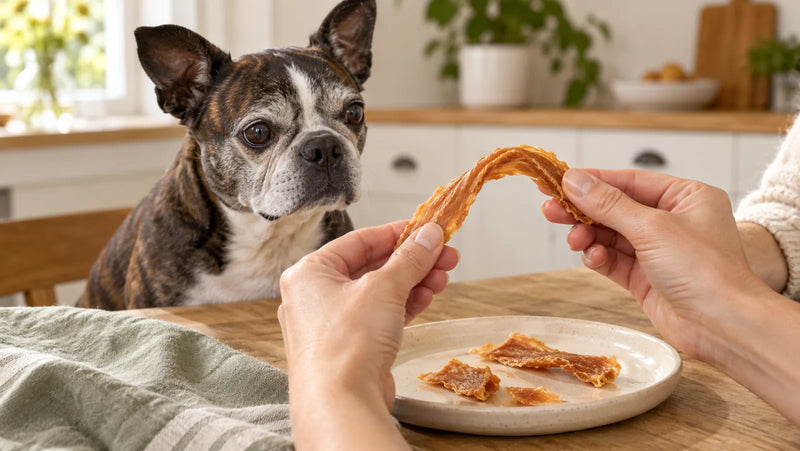
A rabbit ear may suit an adult dog that chews rather than swallows, has no conflict with rabbit or the product's other ingredients, and can be watched from the first bite until the remaining piece is removed. The starting ear should not fit easily inside the dog's mouth. If the dog tries to gulp it, tears off large pieces, guards it, coughs, gags, or becomes frantic, stop the session.
| Question | What a responsible answer requires |
|---|---|
| Is it single-ingredient? | The exact label must say rabbit ear only; coatings, smoke flavor, preservatives, or mixed-animal ingredients cannot be assumed away |
| Is it low fat? | Use the current guaranteed analysis and calories for that product; the category name supplies no universal number |
| Is rabbit a novel protein? | Only if this individual dog has no meaningful prior rabbit exposure and the veterinarian agrees it fits the diet plan |
| Does fur deworm a dog? | No reliable evidence supports that claim; use veterinarian-directed parasite diagnostics, prevention, and treatment |
| Is the size safe? | The whole ear should be too large to swallow easily, and the final small or slippery piece must be removed |
For a wider comparison of tendon, trachea, poultry-foot, skin, and other formats, use the natural dog chew comparison guide. “Natural” describes neither a tested size nor a guaranteed outcome.
What a Rabbit-Ear Chew Actually Is
A rabbit-ear chew is generally the skin and cartilage of the ear, dried with the fur left on or removed. Some sellers list the same product as dog bunny ears. That simple description does not tell you where the animal came from, how the ear was processed, whether another ingredient was applied, how much fat or energy one piece provides, how the package should be stored, or whether the finished product was made for dogs.
Read the full package rather than shopping from a photograph. Look for the product name, complete ingredient list, guaranteed analysis, calorie statement when supplied, responsible company, country-of-origin or sourcing information, lot or batch code, date information, storage directions, and feeding warnings. Reject a loose chew with no traceable label, an open or damaged package, an off odor, visible moisture, mold, pests, or an uncertain storage history.
Processing words also need evidence. “Air-dried,” “dehydrated,” “slow-dried,” and “natural” do not by themselves disclose a validated time-temperature process or finished-product control. Use them as label descriptions, not as proof of how the product was processed or of zero microbial risk.
Potential Benefits Without the Marketing Hype
The most defensible benefit is behavioral: an appropriately sized edible chew can provide a focused activity and a different texture. One intact ear is also a discrete unit, which can make it easier to record what the dog received than an open handful of loose treats. That does not make one ear an automatic serving; its calories and physical size still matter.
Rabbit may offer animal-protein variety. It can be “novel” for a particular dog that has never eaten rabbit, but the word is not a property that permanently belongs to the species. A dog that has eaten rabbit food, mixed-meat treats, flavored medication, or rabbit chews may already have exposure. A veterinarian-managed elimination diet also has stricter ingredient and cross-contact requirements than an ordinary retail snack.
Rabbit ears are often marketed as lower-fat alternatives to pig or cow ears. Some individual products may indeed show a lower fat value, but only the current label can support that comparison. Drying concentrates food by removing water, piece sizes vary, and coatings can change the result. “Looks thin” is not a nutrient analysis.
Chewing may mechanically rub some tooth surfaces, but do not turn that possibility into a plaque-removal or dental-health promise. Product-specific evidence is needed for a dental claim. Home brushing and veterinarian-directed dental care are not replaced by a dried ear.
Fur-On vs Fur-Off Rabbit Ears
The fur decision changes handling and texture more than the core safety test. Both versions remain edible animal tissue that can be gulped, fragmented, contaminated, or poorly matched to a dog's diet and mouth.
| Feature | Fur-on ear | Fur-off ear |
|---|---|---|
| Texture | Hair adds a dry, fibrous surface and may slow some dogs briefly | Smoother surface exposes more of the dried skin and cartilage |
| Visual inspection | Fur can hide part of the underlying surface | Easier to inspect for color, cracks, residue, or visible damage |
| Household handling | May shed loose hair; swallowed fur may appear in stool or vomit | Less loose fur but still requires clean handling and storage |
| Parasite claim | Fur does not become a proven dewormer because it is swallowed | No deworming claim, but no loss of a proven benefit either |
| Shared risks | Whole-piece swallowing, choking, obstruction, broken teeth, digestive upset, calories, allergy conflict, and microbial contamination remain possible | |
A dog may tolerate one form and not the other. Hair can pass through uneventfully, but it can also contribute to gagging, vomiting, or an unpleasant stool change in an individual dog. Fur-free does not mean risk-free; a smooth, saliva-softened remnant may become easier to swallow whole.

The “Natural Dewormer” Claim Is Not Supported
Some sellers say hair brushes worms from a dog's intestine or carries parasites out in stool. That is a plausible-sounding story, not a demonstrated treatment. No reliable clinical evidence shows that eating a furry rabbit ear diagnoses, prevents, or clears an intestinal parasite infection.
The Companion Animal Parasite Council's dog and cat guidelines call for year-round broad-spectrum parasite control, appropriate fecal testing, and anthelmintic treatment for puppies and kittens on a defined veterinary schedule. Dietary hair is not presented as a substitute for those measures.
Do not delay a fecal test, prescribed preventive, or veterinarian-directed deworming because a dog ate fur. Worm species differ, tests have limitations, and treatment depends on the parasite, life stage, dog, exposure, and local risk. Visible material in stool also cannot be safely identified from a marketing claim or photograph alone.
Size the Ear for the Dog in Front of You
The correct size is behavioral, not just numerical. Begin with an intact ear that cannot fit comfortably inside the dog's mouth. Watch whether the dog settles into repeated chewing or immediately turns the ear lengthwise and attempts to swallow it. A determined gulper can make even a visually large chew unsafe.
The VCA chew-toy safety guide advises choosing an item too large to fit entirely in the mouth, avoiding excessively hard options, knowing the individual dog's destructive style, retiring damaged items, and supervising. An edible ear softens and shrinks during use, so sizing must be reassessed throughout the session rather than only at handoff.
- Mouth size: Can the dog close its jaws around the whole width or pull the ear behind the molars?
- Chewing style: Does the dog work gradually, or crush and gulp valuable food?
- Dental status: Are there fractured, worn, loose, painful, or recently treated teeth?
- Competition: Will another pet's presence make the dog rush or guard the chew?
- End piece: Can the handler remove the remnant before it becomes a slippery swallow-sized plug?
Do not use a breed name as a shortcut. Two dogs of the same weight can have different jaw shapes, dental histories, bite force, resource guarding, and eating speed. Choose for the dog you can actually observe.
Supervise Every Chew From First Bite to Removal
Give the ear in a quiet, washable area while the dog is stationary. Keep other pets, children, and high-value-food competition away. Supervision means close enough to see the piece and intervene; it does not mean checking from another room after several minutes.
Remove the chew if the dog tries to swallow it whole, breaks off a large section, coughs, gags, paws at the mouth, repeatedly stretches the neck, drools suddenly, regurgitates, or makes repeated swallowing attempts. The Merck Veterinary Manual's esophageal foreign-object guidance lists sudden excessive drooling, gagging, regurgitation, and repeated attempts to swallow among warning signs. It notes that partial obstruction may still allow fluid to pass.
Breathing difficulty, blue or pale gums, collapse, or severe distress is an emergency. Seek immediate veterinary care. Repeated vomiting, a painful or enlarged abdomen, refusal of food, marked lethargy, inability to keep water down, or absent stool after a suspected swallowed chunk also needs prompt veterinary direction. Do not induce vomiting unless a veterinarian specifically directs it for this dog and object.
“Edible” and “digestible” are not guarantees against choking or obstruction. Digestion takes time, while a lodged or oversized piece creates a physical problem first.
Check Label, Source, Processing, and Hygiene
A short ingredient list can make a chew easier to audit, but inspect the actual wording. “Rabbit flavor,” mixed-animal smoke, oil, glycerin, preservatives, or an unlisted coating can change the allergy and calorie decision. A transparent responsible company, lot code, date, and contact path matter if a defect or recall question appears.
Handle rabbit ears like other animal-based dog treats. Wash hands after touching them, clean the feeding surface, keep the package dry and closed according to its directions, and prevent young children, older adults, pregnant people, and immunocompromised household members from handling the chew or the dog's saliva-covered leftovers. Do not put a used chew back into the clean retail bag unless the label provides a safe storage method for a saliva-wet remnant.
Discard a chew that becomes wet and forgotten, develops an off odor, shows mold or insects, picks up household cleaner, or has an unknown storage history. Dry appearance does not make sanitation optional.
Calories, Fat, and Sensitive Dogs
Count the entire ear as a treat unless the label and your measured portion say otherwise. If the package provides calories by piece, compare that piece with the dog's veterinarian-confirmed daily energy plan. If it gives only calories by weight, use an accurate weight and do not pretend every natural ear has the same mass.
Dogs with a pancreatitis history, prescribed low-fat food, gastrointestinal disease, a therapeutic diet, active weight loss, food allergy evaluation, or previous difficulty with animal chews need veterinary review before the first trial. Puppies, seniors, dogs with dental disease, and dogs recovering from oral or digestive surgery may need a non-chew reward.
Rabbit is not automatically hypoallergenic. A dog can react to any dietary protein, and a novel-protein plan works only when prior exposure and cross-contact are controlled. Do not add a retail rabbit ear to a formal elimination trial without the veterinarian managing that trial.
Rabbit Ears vs Other Natural Chews and Treats
Choose by format rather than treating every dried animal part as interchangeable. The dedicated guide to duck feet for dogs covers a smaller bone-rich poultry-foot chew. American Paws' single-ingredient dehydrated chicken feet are another bone-rich poultry format; the live product page lists 100% USA chicken feet and approximately 30 kcal per piece, about 28 pieces per 1 lb bag. They are not a fur-on substitute and not proof that rabbit ears share the same processing, ingredients, or fit.
The beef trachea chew guide addresses a ring-shaped cartilage format with different structure and claim questions. The guide to lung treats for dogs covers a light, airy reward that is usually portioned as a treat rather than chosen for a long chew session. Each deserves its own label and supervision decision.
| Format | Main physical distinction | Do not assume |
|---|---|---|
| Rabbit ear | Thin skin and cartilage, with fur on or off | That fur deworms or every ear is low fat |
| Duck or chicken foot | Bone-rich poultry foot with claws and joints | That it behaves like a soft ear or fits every gulper |
| Beef trachea | Thicker cartilage ring or tube | That cartilage marketing proves a medical benefit |
| Lung treat | Airy, brittle reward pieces | That a training reward provides long-duration chewing |
American Paws does not sell rabbit ears. If rabbit is essential because of a veterinarian-directed diet, choose a traceable rabbit product that fits that plan rather than substituting poultry. If the goal is simply to compare current American Paws dog treats, use the exact live label for each option.
How to Try a Rabbit Ear More Cautiously
- Confirm diet fit. Check prior rabbit exposure, allergies, medical restrictions, dental health, and total treat calories.
- Audit the package. Verify ingredient, source, analysis, calories when supplied, lot/date, storage, and responsible company.
- Choose an intact size. Do not start with a piece that fits easily in the mouth.
- Use one dog and one quiet area. Separate other pets and remove distractions that encourage rushing.
- Make the first session brief. Watch the chewing pattern before allowing more time; the clock does not override behavior.
- Hold other new extras. A single change makes vomiting, diarrhea, itching, or appetite changes easier to interpret.
- Remove the shrinking remnant. Trade calmly for another reward before the piece becomes swallow-sized or slippery.
- Record the response. Note the product, lot, amount eaten, session behavior, stool, vomiting, skin signs, and any reason the trial ended.
Stop and call the veterinary team if the dog develops repeated vomiting or diarrhea, significant itching or swelling, unusual lethargy, abdominal pain, refusal of food, trouble swallowing, or another concerning change. A first trial is an observation exercise, not proof that unlimited future use is safe.
Frequently Asked Questions
Are rabbit ears safe for dogs?
They can be appropriate for some dogs when the product is traceable, the starting ear is too large to swallow whole, the diet allows rabbit, and an adult supervises continuously. Gulpers, dogs with dental or digestive disease, and dogs on therapeutic or elimination diets may need another option.
Are furry rabbit ears a natural dewormer?
No reliable evidence shows that fur prevents or treats intestinal worms. Do not replace fecal testing, year-round parasite control, or veterinarian-directed medication with a furry chew. Contact the veterinary team when parasites are suspected.
Are rabbit ears low fat?
Some individual rabbit-ear products may analyze lower in fat than some other ear chews, but the category has no universal value. Read the current guaranteed analysis and calories for the exact package, then compare the portion actually fed.
Are rabbit ears good for dogs with food allergies?
Rabbit may be novel for a dog that has never eaten it, but it is not universally hypoallergenic. Check all ingredients and cross-contact information. A veterinarian-directed elimination trial should not include an unapproved retail chew.
Can puppies have rabbit ears?
A puppy's changing teeth, small mouth, immature chewing behavior, calorie needs, and vaccination or parasite plan make an individual veterinary decision important. Do not use a universal age. Choose only a puppy-appropriate product and supervise every moment if the veterinarian agrees.
How often can a dog have a rabbit ear?
There is no responsible category-wide schedule. Frequency depends on the ear's calories and fat, the dog's size, complete diet, other treats, medical plan, stool response, and chewing safety. Count every ear within one shared extras budget.
Are fur-on or fur-off rabbit ears better?
Neither is universally better. Fur-on adds hair and may be harder to inspect; fur-off creates less loose fur but can still be gulped or cause digestive upset. Choose from the dog's behavior, tolerance, and the exact product—not a deworming myth.
Choose the Dog, the Label, and the Size—Not the Myth
A rabbit ear is a chew format, not a parasite treatment or a bundle of guaranteed health claims. The useful decision is concrete: Does this labeled product fit the dog's exposure history, calorie and fat plan, mouth, teeth, and chewing behavior? Can an adult supervise it and remove the final piece?
American Paws does not make rabbit ears. You can compare current American Paws dog treats by their exact ingredient and format, or review the dehydrated chicken-feet page if a single-ingredient poultry chew fits the dog. Keep the categories separate, read the live label, and choose the smallest-risk format that still meets the dog's enrichment goal.