
Treats for dogs with no teeth should be easy to pick up, control, and swallow—not merely soft when squeezed. A dog with a healed, comfortable mouth may do well with a measured meat topper, uniformly crumbled freeze-dried pieces, or one small portion softened immediately before serving. New tooth loss, recent extraction, coughing, gagging, repeated dropping, mouth pain, or weight loss needs a veterinary exam and an individualized feeding plan first.
Missing teeth do not describe the whole mouth. Two dogs can have the same number of teeth and very different comfort, tongue control, jaw movement, gum health, appetite, and swallowing ability. Choose a texture for the dog in front of you, then watch one calm trial instead of relying on the word “soft” on a package.
Treats for Dogs With No Teeth: The Quick Answer
| Situation | Practical treat path | Next step |
|---|---|---|
| Healed mouth; swallows normally | Measured topper, uniform crumbs, or one fully softened portion | Offer a tiny supervised trial in a shallow dish |
| Cannot pick up loose pieces | Thin, cohesive moist texture that can be lapped | Ask the veterinarian whether that delivery method fits the dog |
| Recent extraction or oral surgery | Only the food and texture in the discharge plan | Wait for the dental team to clear treats |
| Coughing, gagging, repeated swallows, or dropping food | No new treat experiment | Stop and contact the veterinary team |
| Prescription or medically managed diet | Use only an explicitly approved reward | Do not assume meat topper or freeze-dried chicken fits |
The useful options are usually soft, crumbly, or lickable because they reduce chewing work. They are not automatically safe for abnormal swallowing, a painful mouth, or a medical diet. A dog that cannot manage one texture may need a different delivery method—or may need the problem evaluated before receiving any extra food.
Missing Teeth Do Not Automatically Mean a Dog Cannot Eat
Dogs can surprise owners after dental loss. A VCA overview of tooth fracture treatment notes that most dogs do well with missing teeth and that some dogs with no teeth may even continue eating kibble. That is reassuring, but it is not a direction to test hard food after surgery or to assume every toothless dog has normal swallowing.
Picking up food, chewing it, and swallowing it are separate tasks. A dog may lap a mash easily but struggle to pick up a slick cube. Another may manage dry kibble but swallow a flexible strip too quickly. A third may have enough remaining teeth to fracture a hard treat but still be painful. Texture should follow observed function and veterinary findings, not a photograph of the mouth.
The broader guide to choosing treats for senior dogs compares age-related calorie, ingredient, and texture needs. Having few or no functional teeth is a narrower problem, and age alone does not define it. Younger dogs can lose teeth, and many seniors retain useful teeth.
Get the Mouth and Swallowing Problem Defined First
The AAHA Senior Care Guidelines recommend oral and pharyngeal assessment when a pet has trouble picking up, chewing, or swallowing food or shows discomfort during the process. That distinction matters: buying something softer does not diagnose periodontal disease, an extraction problem, an oral mass, jaw pain, or a swallowing disorder.
The American Veterinary Dental College's owner resources identify multiple extractions, advanced periodontal disease, difficult extractions, oral masses, severe trauma, and jaw fractures among reasons a primary veterinarian may involve a board-certified veterinary dentist. If tooth loss is new, the cause is uncertain, or the mouth remains uncomfortable, ask who should evaluate it before building a treat routine.
Stop the food trial and contact the veterinary team for persistent mouth bleeding, facial swelling, foul discharge, refusal to eat, repeated food dropping, one-sided chewing, weight loss, coughing, gagging, repeated failed swallows, or regurgitation. Breathing difficulty, blue or pale gums, collapse, or suspected airway obstruction is an emergency. Do not try to solve those signs with a thinner puree or a different bag of dog treats.
Three Treat Formats That Can Reduce Chewing Work
Finely ground meat topper
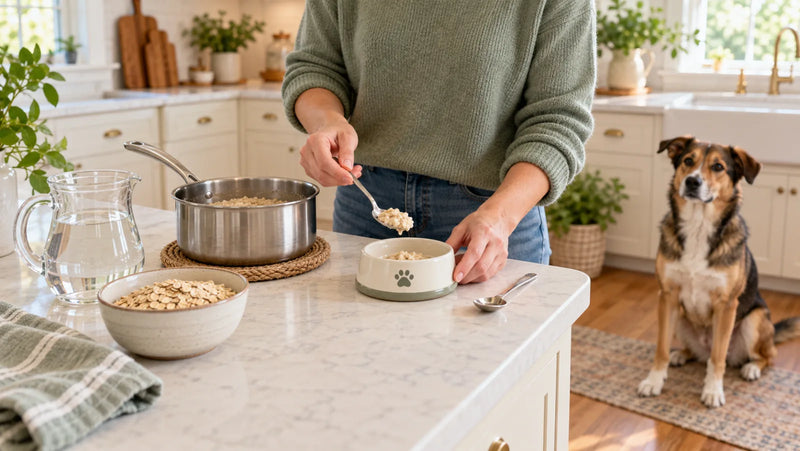
A finely ground topper can be easier to control than a strip or cube because it can be measured and offered as a thin layer in a shallow dish. Measure the dry amount first. If the veterinarian says a moist texture is appropriate, add only enough warm water to form a cohesive spoonable texture. Avoid free-pouring fine powder toward the dog's face, and do not leave a deep sticky mound that can be gulped.
A topper remains an extra. It does not become a complete meal because water was added, and it does not disappear from the calorie budget because the portion looks small. Record the dry amount used so different household members do not keep adding “just a little” to every meal.
Uniform freeze-dried crumbles
Freeze-dried pieces can often be crushed into uniform crumbs or softened in a clean dish. The goal is not random dust beside hard centers. Break or crush the measured portion, inspect it, and choose one consistent texture. If the dog laps rather than bites, a fully moistened crumb may be easier to collect than a dry piece that skitters around the bowl.
Do not offer a whole crunchy piece merely because it breaks between human fingers. A toothless dog may swallow it intact. The first trial should be tiny, upright, calm, and observed from pickup through swallow. Stop if the dog repeatedly loses the piece, coughs, gags, paws at the mouth, or needs several attempts.
A small amount of the familiar complete food
Sometimes the best reward is part of the dog's usual complete diet, prepared in a form the veterinarian already approves. This is especially useful when a prescription diet, elimination trial, diabetes plan, kidney plan, or other restriction leaves little room for separate treats. Reserve a measured amount from the daily ration rather than adding an untracked extra.
That option is not emotionally inferior to a special snack. A reward works because the dog values it in the moment. Familiar food delivered after a desired behavior can still be useful while keeping the medical and calorie plan simpler.
How to Soften a Treat Without Creating a New Storage Problem
- Measure the dry portion first. Do not soak an open-ended handful and estimate later.
- Use a clean shallow dish. Add warm water only; skip broth, gravy, milk, oil, salt, seasonings, and sweeteners.
- Wait for the center. Split or mash the piece after soaking and check that no firm core remains.
- Make the texture consistent. Use a thin smear or small soft mound rather than a sticky ball or mixed hard-and-soft pieces.
- Serve the prepared portion promptly. Never return damp pieces or wet utensils to the dry bag.
The FDA's pet-food storage guidance recommends retaining the original package information—including product identity, manufacturer, lot, and best-by date—and promptly refrigerating or discarding unused moist food. Keep the dry product in its original bag or preserve that identity with any secondary container. Follow the exact label and ask the manufacturer about storage outside the labeled method.
Water changes handling. A dry shelf-stable piece that has been soaked is now a moist serving; the original dry-bag shelf life does not tell you how long the prepared portion can sit out. Preparing only what the dog will receive now avoids an unnecessary leftover decision.
A Four-Part Texture and Delivery Test
1. Can the dog pick it up?
Place one tiny portion in a stable shallow dish. Watch whether the dog can collect it with the lips and tongue without chasing it across the floor, scraping the gums, or repeatedly dropping it. A raised edge can help contain a crumb, but a deep bowl can make observation difficult.
2. Is the texture consistent?
Press and split the portion before offering it. Look for a hard center, sharp edge, long fiber, hidden chunk, or dry clump inside a moist exterior. “Soft outside” is not enough if the piece breaks into a large firm plug.
3. Is the portion shaped for control?
A thin smear on a shallow spoon or dish may be easier to lap than a round blob. Uniform crumbs may be easier than one long strip. Keep the portion small enough to observe and count, but not so dusty that it disperses around the nose.
4. Does one calm swallow look ordinary?
Offer the trial while the dog is upright and unhurried. Watch through the swallow rather than turning away when the food leaves the dish. Normal behavior for that dog matters; repeated neck extension, coughing, gagging, multiple swallow attempts, distress, or food returning is a reason to stop and call the veterinary team.

Treats and Chews to Avoid or Reconsider
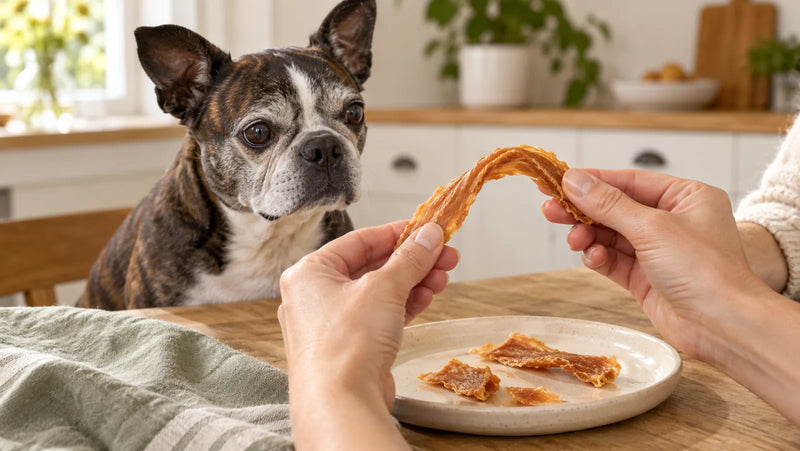
Avoid offering an intact dehydrated meat strip simply because it is made of real meat. A dog without functional teeth may be unable to tear it into controlled pieces and may try to swallow it whole. The same concern applies to large chunks, chicken feet, bones, antlers, hard chews, and other items designed around prolonged biting or grinding.
The Veterinary Oral Health Council advises matching chew size to the dog's body weight and limiting chew use to times when an owner can observe the dog, specifically to reduce obstruction risk. Tooth loss does not remove that risk. A VOHC seal also speaks to plaque or tartar efficacy for an evaluated product; it does not prove that a chew is suitable for a particular toothless dog.
Also reconsider sticky nut-butter globs, dense cheese cubes, hard biscuits, rawhide, loose dry powder, and human “soft” foods with unknown salt, fat, onion, garlic, xylitol, or other ingredients. Softness is one property. Ingredient fit, calorie density, portion shape, storage, and the dog's medical plan still matter.
For an older dog that still has some chewing ability, the guide to soft dog treats for senior dogs compares flexible strips, crumbs, and softening methods. It does not make flexible jerky a default for a dog with no teeth; the no-teeth decision must start with pickup and swallow function.
Recent Tooth Extraction Is a Separate Medical Stage
A newly extracted mouth is not the same as a healed toothless mouth. The AAHA Dental Care Guidelines say discharge communication should cover immediate postoperative oral care and any necessary diet change, such as soft or premoistened food, along with the duration of that change. Follow that written plan exactly; do not introduce a treat because it looks softer than kibble.
Ask the dental team what may be fed, how it should be prepared, when treats can resume, and what signs should trigger a recheck. Do not probe the extraction area, use a chew to “test” healing, or assume a product labeled dental is appropriate. Temporary postoperative rules can change after healing, so schedule the recommended recheck rather than extending or ending restrictions by guesswork.
How Two American Paws Options Fit—and Do Not Fit
Chicken Meal Topper
The current American Paws chicken meal topper page lists 100% USA chicken breast, freeze-dried and finely ground into crumbles. That format can be measured in its dry state and offered as crumbs or, when the dog's veterinary plan allows, moistened in a clean shallow dish for immediate use. The same page lists approximately 25 kcal per teaspoon, which gives the measured dry amount a calorie value to log.
It is still a chicken treat for supplemental feeding, not a complete diet or a treatment for poor appetite, dental disease, or swallowing difficulty. It does not fit a dog avoiding chicken, a veterinary elimination diet unless explicitly approved, or every kidney, pancreas, diabetes, allergy, or calorie plan. Use the live label and the veterinarian's direction for the individual dog.
Freeze-Dried Chicken Pieces
The current American Paws freeze-dried chicken pieces are listed as small, crunchy pieces made from 100% USA chicken breast. The product page lists approximately 5 kcal per piece and a 0.5–1 inch size. For a toothless dog, the useful preparation is a measured portion crumbled uniformly or softened completely—not a whole dry piece offered on the assumption that “small” equals easy to swallow.
Compare the two products by the texture you can prepare and measure, not by which photograph looks softer. Ask the veterinarian about fat, texture, and post-surgical suitability for either product. The current American Paws dog-treat collection shows live formulas and formats.
Portion and Medical-Diet Rules Still Apply
Tooth loss does not create extra calorie room. Measure the dry topper, crumbs, or complete-food reward before adding water, and count that amount with every other extra. If multiple people reward the dog, use one daily container or written log so a lickable format does not become an invisible stream of calories.
Soft and low fat are also different decisions. A product can be easy to lap and still be unsuitable for a dog whose veterinarian has set a fat target. The guide to reading low-fat dog treat labels explains why guaranteed-analysis percentages and vague front claims are not enough. Pancreatitis history, diabetes, kidney disease, food allergy, prescription diets, and unexplained weight or appetite changes all require individual veterinary direction.
A cat with missing teeth has different species, diet, and feeding considerations; the guide to treats for senior cats is the appropriate starting point for the cat-side question.
Frequently Asked Questions
Can dogs with no teeth still have treats?
Often, yes, once the mouth is healed and the dog can pick up and swallow the prepared texture normally. Use a measured topper, uniform crumbs, a fully softened portion, or part of the approved complete diet. New dental loss, pain, or swallowing changes need veterinary assessment first.
Can a dog with no teeth eat dry kibble?
Some can; VCA notes that some dogs with no teeth continue to eat kibble. That does not mean every dog should, especially after extraction or when pickup, chewing, or swallowing has changed. Follow the dog's dental and veterinary plan rather than using another dog's ability as proof.
Can I soak freeze-dried dog treats?
You can soften one measured portion with warm water when the veterinarian agrees that the resulting texture fits the dog. Wait until the center is fully soft, mash out firm pieces, serve promptly, and never return damp food to the dry package.
Is a meal topper a treat for a toothless dog?
It can be an occasional measured reward or meal addition, but it remains part of the dog's total extras. It is not complete nutrition by itself and may conflict with chicken restrictions, a prescription diet, or another medical plan. Measure the dry amount before moistening it.
Are dental chews useful when a dog has no teeth?
A dental chew is designed around contact with teeth and is not automatically useful or safe when functional teeth are absent. VOHC acceptance addresses demonstrated plaque or tartar control for the evaluated product, not universal suitability. Ask the veterinarian what oral-care method and products make sense for the mouth that remains.
What can a dog have after tooth extraction?
Only what the dental team clears in the discharge plan. Soft or premoistened food may be recommended for a specific period, but the texture, timing, medication schedule, and recheck depend on the procedure and dog. Do not add treats until the team says they fit.
Choose for the Mouth the Dog Has Today
The best texture is the one a comfortable dog can pick up, control, and swallow without struggle—and that also fits the calorie, ingredient, and medical plan. Start with one measured portion, prepare it consistently, observe the entire first trial, and stop when the dog shows a new problem. A softer product should never be used to hide pain or delay an exam.
If chicken fits the dog's plan, compare the live label for the finely ground chicken topper with the freeze-dried chicken that can be crumbled or softened. Ask the veterinarian first for a fresh extraction, mouth pain, abnormal swallowing, a medical diet, or unexplained weight or appetite change.