
The best cat treats for senior cats are small, easy for that individual cat to eat, calorie-labeled, and compatible with the cat's main diet and health plan. Choose a soft texture for a comfortable mouth—not to hide dental pain—and choose lower-calorie portions only when body condition calls for them.
There is no single “senior” treat that suits every older cat. Unexplained weight loss, new chewing changes, kidney disease, diabetes, food allergy, or a prescription diet should put the veterinary team in charge of the treat list.
Cat treats for senior cats: the four checks that matter
Start with the cat rather than the package front:
- Mouth comfort: can the cat chew the texture without dropping food, chewing on one side, drooling, or backing away?
- Body and muscle condition: is the goal to maintain, safely reduce, or restore weight under veterinary guidance?
- Medical compatibility: does kidney disease, diabetes, hyperthyroidism, food allergy, urinary disease, or another condition change the acceptable ingredients?
- Measurable portion: can you find calories per piece or gram and divide the treat into genuinely tiny rewards?
A product does not need the word “senior” on the bag to pass these checks. Likewise, a senior label does not guarantee that the texture, calories, or nutrient profile fits the cat in front of you.
Does a senior cat need soft treats?
Match texture to comfortable chewing
Soft treats can reduce chewing effort for a cat with a comfortable but less powerful bite. A pea-size portion of a soft, species-appropriate product may be easier to lick or swallow than a large hard biscuit. Moist texture can also be useful when the veterinarian wants more water in the overall feeding plan.
Soft is not automatically safer, lower in calories, or better for teeth. Some lickable products are calorie-dense, and some include several ingredients that may not suit a therapeutic diet. Read the same ingredient and calorie panels you would check on a crunchy treat.
Do not use soft food to hide dental pain
New preference for soft food can be a clue, not just an age-related taste. The AVMA's oral-health guidance lists bad breath, abnormal chewing, drooling, dropping food, reduced appetite, refusal to eat, and pain around the mouth as reasons for a veterinary dental check.
Do not force open a painful cat's mouth to investigate; a frightened or hurting cat may bite. Soft treats do not treat tooth resorption, inflamed gums, a broken tooth, an oral mass, or disease below the gumline. Solve the pain first, then choose a texture that fits the treated mouth.
Cats with few or no teeth still need an individual plan
Many cats with few or no teeth can move and swallow an appropriately textured food, but the best form depends on healing, tongue and jaw function, remaining roots, and the main diet. A veterinarian may approve a smooth lick, tiny moist morsel, or another form after dental treatment.
Do not assume tooth loss makes every hard crumb dangerous or every puree safe. A large sticky blob can still be difficult to manage, and an untreated painful root can make any food unpleasant.
Should senior-cat treats be low-calorie?
Low-calorie helps only when weight and activity call for it
A lower-calorie reward can help an overweight or less-active cat stay within a veterinary weight plan. The useful comparison is calories in the portion actually served—not a “light” word on the package. One small reward may deliver fewer calories than a large serving of a product marketed for weight control.
Safe weight loss in a cat should be supervised. Reducing food too aggressively can be dangerous, and treats should never replace the complete diet or create an unbalanced do-it-yourself plan.
Underweight seniors may need a different goal
Older cats are not all prone to weight gain. The AAHA/AAFP senior-cat nutrition guidance notes that underweight is common in senior cats and that digestive and energy needs can change. Some healthy seniors need more calorie-dense, digestible main food rather than lower-calorie extras.
Unexplained weight or muscle loss can accompany dental pain, chronic kidney disease, hyperthyroidism, diabetes, cancer, or another condition. A treat that tempts a few bites should not delay an exam or turn into a substitute for complete nutrition.
Count calories per reward, not marketing words
Write down the calories per piece or per gram. Then decide how many reward moments you want and divide the portion before the session starts. A five-calorie piece broken into five crumbs still totals five calories if every crumb is fed; the advantage is better timing and smaller bites, not disappearing calories.
This matters because a cat's daily treat allowance can be small. A product that seems tiny in a human hand may use a large share of that allowance.
How many treats can a senior cat have?
Keep treats, toppers, lickable snacks, table food, food used for medication, and supplements together below 10% of daily calories. The WSAVA guide to feeding treats to cats shows how quickly common extras can exceed a cat's small allowance.
For an illustrative example, a cat eating 200 calories a day would have a ceiling below 20 calories for all extras combined. That is a ceiling, not a target, and 200 calories is not a prescription for your cat. The veterinarian may set a different total based on ideal weight, body and muscle condition, activity, age, and disease.
Our daily cat-treat calorie guide owns the full count and calculation method. For a senior cat, use that math together with any medical-diet instructions rather than adding a second age-based allowance.
A label checklist for treats for older cats
Species and life-stage suitability
Confirm that the product is labeled for cats or for both cats and dogs. A storewide catalog can include dog treats alongside dual-species products, and location on the same collection page does not make every item cat-appropriate.
Also check whether the treat is intended only for intermittent or supplemental feeding. Most treats are not complete and balanced meals, even when they contain real meat and a short ingredient list.
Calories and serving size
Find calories per piece, ounce, gram, pouch, or serving. If calories appear only for a multi-piece serving, divide them before deciding how many pieces to use. “Small” and “training size” describe dimensions, not necessarily calorie density.
When the label does not provide a usable number, contact the manufacturer. Guessing is especially unhelpful for a senior cat whose main food or weight plan is tightly measured.
Ingredient clarity without overpromising
A named animal protein and a short list make a product easier to evaluate. A single-ingredient chicken treat, for example, tells you exactly which animal protein it contains. It does not guarantee that the food is hypoallergenic, free from cross-contact, low in phosphorus, low in sodium, suitable for kidney disease, or allowed during an elimination trial.
Healthy senior cats should not automatically have protein restricted. AAHA notes that protein needs and muscle maintenance matter in older cats, while chronic kidney disease may call for a prescription renal diet with controlled phosphorus and other features. The diagnosis changes the decision.
Texture, piece size, and storage
Press or break a piece before offering it. A reward should be easy to divide into a size the cat can handle without gulping. Avoid a hard, oversized treat that requires forceful biting, especially when oral comfort is uncertain.
Follow storage directions exactly. Keep dry treats dry and resealed; refrigerate opened moist products when the label requires it. Discard anything moldy, rancid, slimy, unusually swollen, off-smelling, or left outside its safe time and temperature.

Treat formats to consider
Soft or moist treats
A soft morsel may work for a cat whose veterinarian has confirmed a comfortable mouth and approved the ingredients. Choose a portion that is small enough to lick or swallow easily, and avoid leaving an opened moist product unrefrigerated.
Do not equate soft with dental care. A soft treat may reduce chewing effort, but it does not remove plaque, treat pain, or replace a professional oral exam.
Lickable treats
Lickable products can make one small serving last through several cooperative-care or bonding moments. Measure the amount into a spoon or dish rather than feeding an entire tube by default. Check calories, sodium, phosphorus information when relevant, thickeners, flavorings, and whether the product is complete food or supplemental.
If a cat is on a prescription diet, even a small lick must be approved. Palatability does not cancel the medical plan.
Breakable freeze-dried chicken
For a senior cat with comfortable chewing, no chicken restriction, and no conflicting therapeutic diet, a light freeze-dried piece can be broken into tiny crumbs. It is crunchy, not soft, so test the texture and never force it on a cat that hesitates to chew.
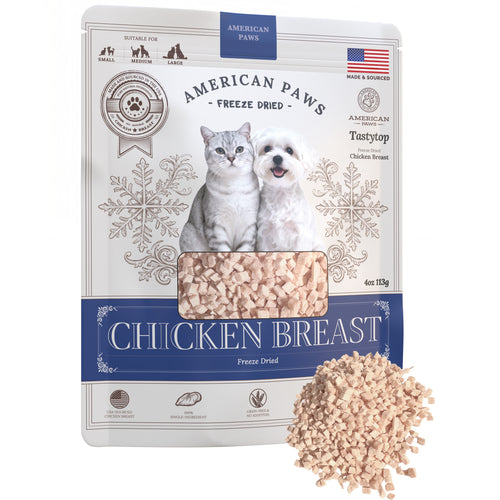
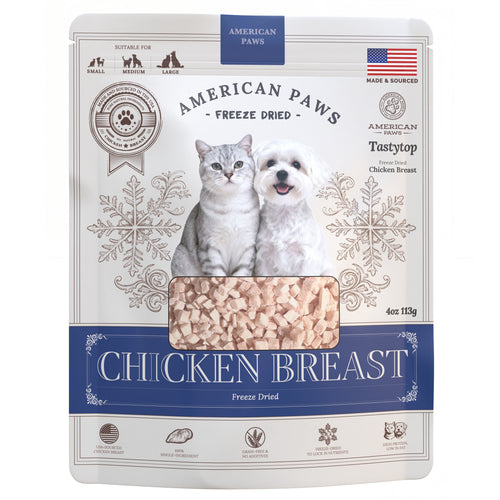
American Paws single-ingredient freeze-dried chicken treats for cats contain 100% USA chicken breast and are labeled at approximately five calories per light piece. Pieces are about half an inch to one inch, so one piece should become several tiny senior-cat reward moments rather than one large bite.
The product's 74% minimum protein and one-ingredient label are factual product features, not proof that it fits kidney disease, a chicken allergy, or an elimination trial. Our guide to freeze-dried chicken for cats covers the general format; this article only decides whether the texture and portion fit an older individual.
Part of the cat's complete food
If the veterinarian approves, set aside a few pieces or a teaspoon from the measured daily complete food and use that portion as rewards. This creates reward moments without adding a new ingredient or a second calorie source.
Do not take so much from a meal that the cat's regular intake becomes hard to track, and do not let a cat skip meals while waiting for richer treats.
When a medical diet changes the answer
Chronic kidney disease
There is no universal over-the-counter “kidney-safe treat.” Renal diets may control phosphorus, protein quality and quantity, sodium, calories, and other nutrients as part of a complete plan. A plain meat treat can be single-ingredient and still conflict with that plan.
The AAHA senior nutrition guidance for disease management explains that kidney-disease stages can change dietary recommendations. Ask the treating veterinarian for an approved product and amount; do not choose by “natural,” “high protein,” or “senior” language alone.
Diabetes, obesity, and hyperthyroidism
These conditions create different goals. A cat with diabetes may need consistent meal timing and carefully selected foods. A cat in an obesity program needs controlled calories and safe, gradual change. A hyperthyroid cat may lose weight despite eating well and may be on an iodine-controlled diet that outside treats can disrupt.
Do not combine them under one low-calorie rule. Use the exact ingredient and calorie allowance supplied by the veterinary team.
Food allergy or elimination trials
A single named protein can make a label easier to understand, but it may be the exact protein the cat must avoid. During a veterinary elimination trial, an unapproved crumb can interfere with the result.
Use only the prescribed diet or treats the veterinarian explicitly lists. “Limited ingredient,” “single protein,” and “single ingredient” describe different label ideas; none automatically guarantees the cross-contact controls required for diagnosis.
How to introduce a new treat to a senior cat
- Check the plan: confirm the ingredient and calories fit the cat's health and main diet.
- Choose a calm time: do not test a new food during vomiting, diarrhea, appetite loss, or another illness.
- Offer one tiny taste: use a crumb, small lick, or pea-size soft morsel.
- Keep everything else familiar: introduce only one new product so a reaction is easier to identify.
- Watch the cat: note chewing, swallowing, appetite, stool, vomiting, itching, swelling, and behavior.
Stop the new treat for repeated vomiting or diarrhea, itching, hives, facial swelling, or obvious discomfort. Breathing difficulty, collapse, or rapidly worsening swelling is an emergency. A senior cat that stops eating, eats much less, or suddenly changes food preference also needs prompt veterinary advice.
Use treats for gentle training and enrichment
Older cats can still learn. Tiny rewards can reinforce stepping onto a scale, entering a carrier, touching a target, accepting brief grooming, or moving to a comfortable perch. Keep sessions short and place the reward where the cat does not need to jump, twist, or stand on a slippery floor.
Our mother guide to training treats for cats covers timing, clickers, and reward technique. For a senior, the adjustment is physical comfort: fewer repetitions, easy access, stable footing, and crumbs small enough that training does not become a meal.
Treats and products to avoid
- Dog-only products: confirm the species label; do not assume a dog treat is safe for cats.
- Large, hard chews: they can be difficult for a painful mouth and are not a substitute for dental care.
- Raw animal treats: senior or medically vulnerable cats and household members may face pathogen risk.
- Seasoned human food: onion, garlic, excess salt, sauces, and mixed ingredients add avoidable risk.
- Unknown calories: an unmeasured daily extra can quietly crowd out complete food.
- Unapproved extras on a therapeutic diet: a tiny amount can still conflict with kidney, diabetes, allergy, thyroid, or urinary management.
- Spoiled or poorly stored treats: discard products with mold, rancid odor, damaged packaging, or uncertain storage.
Chocolate, alcohol, caffeine, xylitol, grapes, raisins, onion, and garlic should never become cat treats. When an ingestion may be toxic, contact a veterinarian or animal poison-control service promptly rather than waiting for symptoms.
Frequently asked questions
What age is a cat considered senior?
The AAHA/AAFP life-stage checklist defines senior cats as older than 10 years. Other labels may use a different cutoff. Health, body condition, mouth comfort, and disease matter more to treat selection than the birthday alone.
Are soft treats better for all senior cats?
No. Soft texture can reduce chewing effort, but a healthy older cat with a comfortable mouth may enjoy a tiny crunchy crumb. New preference for soft food, dropping food, drooling, or one-sided chewing should trigger a dental check rather than an automatic switch.
Can senior cats eat freeze-dried chicken treats?
Many can if chicken is allowed, the mouth is comfortable, and the veterinary diet has no conflict. Choose a cat-labeled product, break a light crunchy piece into tiny crumbs, count the calories from the whole piece, and store it dry. It is not a soft treat.
What treats can a cat with kidney disease have?
Ask the veterinarian managing the kidney disease for an approved list. Kidney diets may control phosphorus, protein, sodium, and other nutrients, so a plain meat or single-ingredient treat is not automatically compatible. A portion of the prescribed complete diet may be the simplest reward if the veterinarian approves.
What treats can a cat with no teeth have?
After the veterinarian confirms healing and rules out painful remaining disease, a small smooth lick or tiny moist morsel may be appropriate. Some toothless cats also manage selected small foods well. The right texture depends on the individual mouth; do not rely on a generic no-teeth product list.
Choose for the cat in front of you
A good senior-cat treat is not defined by one texture or a “light” label. It fits the cat's mouth, body and muscle condition, main diet, medical plan, and tiny calorie budget. Measure one small portion, divide it into reward moments, and keep complete food in charge.
If your senior cat can comfortably handle a light crunchy crumb and chicken is approved, consider the American Paws single-ingredient freeze-dried option above. You can also browse the current American Paws treat catalog, but verify the species label on every item because the collection includes dog and dual-species products. For a younger life-stage comparison, use our separate treat guide for kittens rather than applying senior advice in reverse.