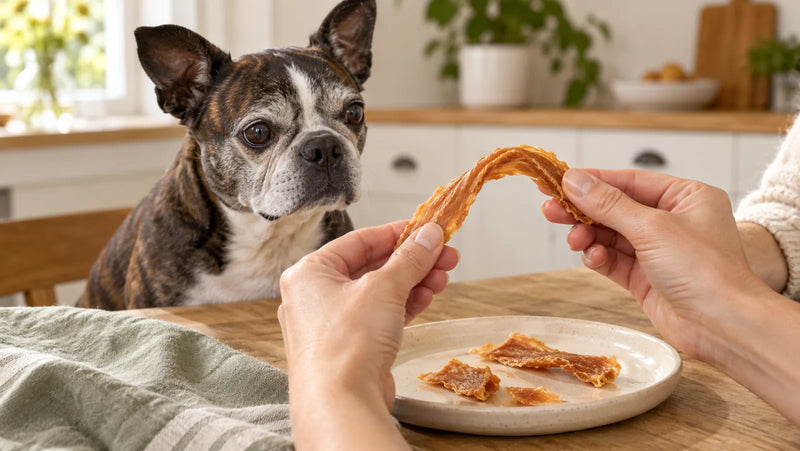

Wholesale dog treats for breeders should be selected by the puppy's age, chewing ability, diet, and job—not by pounds or price alone. Keep tiny nursery rewards separate from sealed go-home packs, count every extra inside the puppy's veterinarian-confirmed food plan, preserve the exact ingredient, lot, date, and storage directions, and choose wholesale or private label only after the product and packaging workflow are clear.
The phrase “puppy-safe” should describe a decision process, not a promise printed across every pouch. One product can be a practical reward for a weaned puppy that chews and swallows calmly, yet be a poor fit for a younger puppy, a dog on a veterinary diet, or a puppy that tries to gulp large pieces. A breeder needs a repeatable system that follows each puppy from staff use to the family handoff.
Wholesale Dog Treats for Breeders: The Short Answer
| Use | Best operating choice | Do not assume |
|---|---|---|
| Brief nursery reward | Tiny, easy-to-count pieces from one approved formula | A full piece is one puppy serving |
| Handling or early training | Fast delivery, low crumb load, and a reward the puppy can finish promptly | Food is the only useful reward |
| Chew-style enrichment | Individual mouth, tooth, size, and chewing-behavior screen with uninterrupted supervision | A product is appropriate because another litter used it |
| Go-home pack | Sealed, fully identified product with current label and written owner handoff | An unmarked sample bag gives the family enough information |
| Medical or diet restriction | Use only what the puppy's veterinary team approves | Single ingredient means allergy-safe or diet-trial-safe |
Start with one product and one job. Prove that staff can identify it, portion it, store it, and document it before adding another protein or texture. That discipline is more valuable than a broad assortment that nobody can trace.
Separate Nursery Rewards From Go-Home Packs
An opened nursery container is an operating supply. Staff control who receives it, how much is used, when it was opened, which original lot it came from, and how the container is cleaned and closed. A sealed go-home pack is different: it becomes a product in another household, where the family needs the complete current label, feeding role, storage directions, responsible-company contact, and a clear explanation of how the breeder used it.
Do not scoop treats from a communal tub into an attractive but unidentified pouch. That shortcut disconnects the food from its ingredient statement, lot or best-by identity, calorie information, and storage directions. It also leaves the receiving family unable to check a concern against the exact product. If a sample-size format differs from the regular package, identify the difference instead of making the small bag look like an undisclosed retail unit.
A practical breeder program therefore uses two written records. The nursery log names the exact product, lot or date code, opening date, storage container, puppies cleared to receive it, and person responsible. The go-home packing record connects each sealed pouch to the product and label version placed in the family's kit. Those records do not need to be elaborate; they do need to be usable.
Decide Whether a Puppy Is Ready Before Choosing a Treat
Puppy nutrition begins with a complete diet formulated for growth. AAFCO's consumer guide to selecting pet food explains that growth is a distinct life stage and that treats and supplements are generally fed in addition to complete food rather than serving as complete diets themselves. A go-home reward should never quietly displace the food responsible for balanced growth.
Every extra shares one budget. The WSAVA Nutrition Committee's treat guide says treats should provide no more than 10% of a dog's daily calories and tells owners to ask the veterinary healthcare team for an individual daily energy requirement. For a growing puppy, the practical lesson is not to copy an adult calorie table. Use the puppy's current food plan and exact treat label, then count training rewards, chews, toppers, table tastes, and family handouts together.
The guide to building a puppy's daily treat allowance covers that calculation in detail. A breeder can include a simple handoff note showing the product and amount actually used, but should not turn a litter average into a prescription for every puppy after placement.
Food is also not the only reward. The American Veterinary Society of Animal Behavior's humane-training position supports reward-based methods and names toys, treats, or other appropriate reinforcers as ways to reward a behavior. That gives the breeder room to use tiny food rewards when they fit while using toys, access, praise, or play when another reward is more appropriate.
Match the Format to the Job and the Individual Puppy
Tiny rewards for handling and early training
For a brief name response, carrier entry, grooming touch, or calm handling repetition, the useful unit is usually much smaller than a whole retail piece. Choose a product that can be divided consistently, then weigh several realistic fragments rather than guessing from appearance. Record either the actual calories per labeled piece and fraction used or the grams used across a session. Natural meat pieces vary, so “one piece” is not a stable unit unless the label and product make it one.
Watch how the individual puppy takes the reward. The piece should not require a long struggle during a rapid training sequence, scatter sharp crumbs across a shared area, or encourage grabbing from fingers. Stop and reassess coughing, repeated gagging, frantic gulping, vomiting, diarrhea, refusal, or any change that concerns the veterinary team. A wholesale case does not override what the puppy is showing you.
Longer chews require a different screen
A chew is not simply a larger training treat. Mouth size, tooth development, chewing style, whole-piece fit, product hardness, supervision, and the point at which the remaining piece must be removed all matter. Never leave a litter with loose chews and assume staff can reconstruct which puppy consumed what.
The separate guide to chicken feet for puppies owns the age, tooth-development, fit, supervision, and frequency decision for that specific chew. Use it before considering a chicken foot for an individual puppy; do not treat the product as a default component of every go-home box.
Health restrictions remain veterinarian-led
Known or suspected food reactions, an elimination diet, a prescription diet, gastrointestinal disease, swallowing difficulty, poor growth, medication timing, or another medical restriction belongs to the veterinary team. “Single ingredient” can make the declared formula easier to read, but chicken and beef can still be wrong for an individual puppy. A breeder should maintain a clear no-treat or approved-item flag rather than asking staff to interpret medical notes at the jar.
How to Forecast a 10 lb Per-Product Order
The American Paws wholesale and private-label minimum is 10 lb per product. That is a purchasing unit; how many puppies, sessions, pieces, or go-home packs a case covers comes from the measured trial below. Whole-muscle strips, freeze-dried pieces, organs, and chew products naturally vary in piece weight and break pattern.
Build the forecast from a real trial:
- Choose the exact product and job. Do not forecast “assorted treats” as if every format behaves alike.
- Weigh the working unit. Weigh multiple pieces or fragments prepared the way staff will actually use them.
- Measure real daily use. Record grams used per puppy during a short pilot, including crumbs and discarded pieces.
- Separate program stock from go-home allocation. A sealed family pack should have a defined fill weight rather than whatever remains after nursery use.
- Add only a documented reserve. Account for the expected litter schedule, training days, and packing plan without turning optimism into inventory.
A simple working formula is: daily grams per puppy × participating puppies × program days, plus sealed go-home grams and a written reserve. Compare that total with 4,535.9 grams in 10 lb. Reorder from measured consumption, not from the visual level in a storage bin. If the first 10 lb order is larger than near-term use, confirm that the exact product's labeled shelf life and your storage capacity support the plan before buying.
Build a Go-Home Pack That Families Can Actually Use
A good pack does more than look finished. It lets a family identify the product, understand its limited role, store it correctly, and ask a useful question later. Preserve these fields:
- Exact identity: product name, intended species, ingredients, and whether it is a treat or supplemental item.
- Amount: net contents in the sealed pack and the small working amount the breeder used.
- Nutrition context: calorie information from the current label where available, plus a reminder that all extras share one budget.
- Traceability: lot or best-by identity and the responsible company's contact path.
- Storage: the exact product's unopened and after-opening directions.
- Puppy handoff: the age and circumstances in which the breeder used it, without promising that the new household should continue unchanged.

The family should know that the puppy's complete growth food remains the nutritional base and that a veterinarian should review any diet restriction or persistent symptom. Avoid claims that a reward will calm a puppy, improve growth, clean teeth, prevent allergies, or fit every breed. Specific, modest instructions are more useful than reassuring adjectives.
If the program uses custom pouches, the guide to private-label dog treat packaging explains how product format, fill weight, usable opening, barrier evidence, closure, seal zone, and artwork handoff affect the bag choice. Test the filled and sealed pouch before committing to a full print run.
Store and Rotate Breeder Inventory by the Exact Label
Keep unopened stock in the conditions stated for the selected product. American Paws' current storage direction for the relevant shelf-stable lines is a cool, dry place away from sunlight, with the package resealed after opening. Do not transfer one product's shelf life or handling directions to every item in the catalog. The current label, quote, and product record control.
At receiving, record the product, quantity, lot or best-by information, condition, and date. Keep bags off damp floors and away from heat, direct light, cleaning chemicals, pests, and open water. Use earliest-date-first rotation. When a bag is opened, keep its identity with the working container and write the opening date. Never top off an older container with a new lot until it has been emptied, cleaned, and documented.
Quarantine a package that is wet, torn, swollen, unsealed, missing its identity, unusually odorous, or otherwise inconsistent with the expected product. Preserve the package, lot information, photographs, and remaining contents, then contact the supplier. “It probably came from the same order” is not traceability.
AAFCO's product-handling safety resource emphasizes clean hands and surfaces, separation to prevent cross-contamination, proper cooking where food is prepared, and prompt chilling for products that require it. A breeder handling shelf-stable treats should still use clean, dry scoops and containers and keep food away from sanitation chemicals and raw-food preparation.
Choose Wholesale or Private Label for the Actual Job
Finished-product wholesale
Finished wholesale is the simpler lane when the breeder wants current American Paws packaging and a product that arrives with its established identity. Use the American Paws wholesale program to confirm the exact product, pounds per product, current price, availability, freight, and timing. Bulk pricing starts at $14 per lb; see the current catalog and obtain a current quote for the selected item. The 10 lb minimum applies per product, so two proteins are two separate minimums.
Customer-supplied-bag private label
Private label fits a breeder that wants an approved pouch bearing its own brand or program identity and is prepared to manage the artwork and label workflow. In the current American Paws process, the customer supplies approved bags; American Paws fills the selected product, adds an oxygen absorber, and heat-seals the bag within the agreed scope. Confirm the pouch, fill weight, product, label, case count, freight, and handoff before printing or accepting family orders.
The private-label dog treat manufacturer guide explains the broader supplier review, while the American Paws private-label program is the direct path for a customer-supplied-bag project. A finished package still needs truthful labeling and an accurate division of responsibility. FDA facility registration is not FDA approval of a pouch, product, claim, or breeder program.
How American Paws Fits a Breeder Program
American Paws operates in Highland, California and lists FDA Food Facility Registration No. 13526766664. That fact identifies the facility in the federal registration system; it is not a certification seal, product approval, veterinary endorsement, or declaration that one item is appropriate for every puppy.
Use the live label for the exact product. Some current products have short, transparent ingredient lists, but the assortment is not one formula and should not be described as universally single-ingredient. Compare the current American Paws dog treats and product labels, then ask which item best fits the intended breeder-use or go-home job. Confirm calories, piece or strip behavior, package size, storage, and availability instead of relying on a category name.
A useful inquiry includes the product or protein, pounds per product, litter ages, nursery versus go-home use, intended pack weight, customer-bag status, storage conditions, destination, and target date. It should also disclose any texture requirement or exclusion that changes the job. Details shorten the path to an accurate scope; adjectives do not.
A Seven-Step Breeder Purchasing SOP
- Define two jobs. Write separate requirements for breeder-supervised nursery use and sealed family go-home packs.
- Set readiness and exclusion rules. Put the veterinary team's restrictions, food-reaction history, chewing concerns, and no-treat flags ahead of convenience.
- Audit the exact product. Verify intended species, ingredients, feeding role, calories where available, texture, lot and date method, and storage.
- Run a measured pilot. Weigh the fragments or portions staff actually use and record consumption, waste, and puppy response.
- Choose the commercial lane. Use finished wholesale for current branded packages or private label for the customer-supplied approved-bag workflow.
- Protect identity. Keep original product, lot, best-by, opening date, storage container, and go-home pack records connected.
- Review before reordering. Compare forecast with actual grams used, sealed packs produced, waste, remaining dated stock, and next litter timing.
Frequently Asked Questions
What is the American Paws wholesale minimum for breeders?
The minimum is 10 lb per product. A product means one specific item, not a mixed total across several proteins or formats. Contact American Paws for the current item, price, availability, freight, and timing before planning a litter handoff.
What age can puppies start having treats?
Age alone does not clear a treat. Consider weaning and growth diet, the individual puppy's ability to chew and swallow the exact texture, veterinary restrictions, and the job the reward will perform. Start with the breeder's and veterinary team's plan rather than copying another litter's calendar. The guide to when puppies can have treats covers weaning and first-reward readiness in more detail.
How many treats can a puppy have each day?
Use the puppy's current daily calorie plan and the exact product's calorie information, then keep every treat and extra inside one shared allowance. The commonly used 10% ceiling is not a target and should not be converted into a universal piece count. The veterinarian should set the individual plan.
Can chicken feet go in puppy go-home packs?
Not automatically. Chicken feet are chew-style products, so tooth stage, mouth and piece fit, chewing behavior, uninterrupted supervision, diet room, and the family's ability to manage the chew all matter. Use the chicken-feet-for-puppies guide and individual veterinary advice before including one.
Can a breeder use private-label bags?
Yes, when the selected product, customer-supplied approved bag, artwork, label, fill weight, oxygen absorber, seal area, and packing scope are confirmed in advance. Private labeling does not make an incomplete label complete or transfer every brand responsibility to the packer.
How should bulk dog treats be stored?
Follow the exact product's current label. Keep applicable shelf-stable stock cool, dry, away from sunlight, sealed against moisture and pests, and connected to its lot and date identity. Record when a working bag is opened, rotate by date, and quarantine damaged or suspect packages.
Build One Documented Puppy-Reward Lane First
A breeder program does not need the largest assortment. It needs one product that staff can identify, measure, use consistently, store correctly, and hand off with enough information for a family to make a responsible next decision. Begin with an exact job and a measured pilot; let real consumption determine the reorder.
For current American Paws packaging, send the product, pounds per product, litter ages, nursery or go-home use, intended pack amount, storage plan, destination, and target date through the wholesale inquiry. If the project uses customer-supplied approved pouches, use the private-label inquiry and include the bag status, fill weight, and artwork timeline. We will confirm the exact scope rather than guessing from the words “puppy pack.”