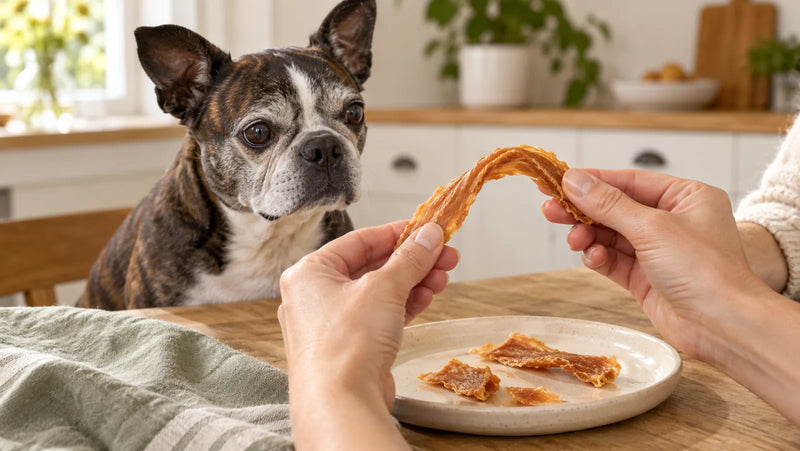

Air dried vs dehydrated dog treats is often a comparison between label language, not two cleanly separated technologies. Both can use warm moving air and time to remove moisture, and brands may use the terms differently. Choose by the documented ingredient list, heat or pathogen-control step, drying conditions, finished-product controls, package, and storage directions—not by assuming “air-dried” is raw, gentler, softer, safer, or more nutritious.
The useful question is not which word sounds more natural. It is whether the maker clearly explains what went in, what happened before and during drying, how the finished batch is controlled, how the treat should be stored, and whether its physical form fits the dog. That evidence is more informative than a front-of-bag adjective.
Air Dried vs Dehydrated Dog Treats: The Short Answer
Dehydration broadly means removing water. Air drying emphasizes that air carries moisture away from the food. In a modern cabinet or tunnel, controlled heat and moving air commonly work together, so a product can reasonably be described as both air-dried and dehydrated.
Neither term, standing alone, tells you all of the following:
- whether the starting meat was raw, cooked, marinated, ground, or whole-cut;
- whether a measured internal-temperature step occurred before, during, or after drying;
- the air temperature, product temperature, drying time, or validated process;
- whether the result will bend, tear, crunch, crumble, or rehydrate;
- how the finished batch is checked or which package protects it;
- the storage instructions or supported shelf life for that exact product.
If a comparison chart claims those answers from the two words alone, it is probably simplifying brand-specific practices into universal rules.
Why the Two Terms Overlap
University of Minnesota Extension's drying overview explains the basic mechanism: drying preserves food by removing enough moisture to limit microbial growth, while low humidity, low heat, and good air circulation are central to effective drying. That description shows why “air-dried” can sit inside the broader idea of dehydration rather than opposite it.
Manufacturers can still use the terms to signal different house processes. One may reserve “air-dried” for a slower or lower-temperature line and “dehydrated” for another cabinet setting. Another may call all warm-air products dehydrated. Those can be legitimate brand conventions, but they are not a dependable universal temperature scale.
“Natural,” “slow,” and “gentle” also need context. Slower is not automatically safer. Lower air temperature does not reveal whether the meat reached a specific internal temperature. A warmer process does not by itself reveal the finished texture or nutrient profile. Ask for actual process facts instead of ranking adjectives.
Compare the Process, Not the Marketing Word
Use a six-part comparison that works across brands. Every row asks for evidence that cannot be recovered from “air-dried” or “dehydrated” alone.

| Process question | What to look for | What the label word cannot prove |
|---|---|---|
| Starting material | Species, cut, whole or formed, complete ingredient list | Single ingredient, quality, or allergy fit |
| Before drying | Cooking, measured heat step, marinade, handling controls | Raw or cooked status |
| During drying | Equipment, air range, product temperature, time range | One universal “air-dried” temperature |
| Finished batch | Documented endpoint and verification appropriate to the product | Sterility or zero risk |
| Physical form | Thickness, bend, break, size, bone content, supervision needs | Softness, chew time, or suitability for every dog |
| Package and storage | Seal, directions, best-by information, lot traceability | Automatic room-temperature stability |
Answers can be simple. “Whole chicken breast, heated to a measured internal temperature, dried within a stated air range, packed with a lot code, and stored as the label directs” tells a shopper more than an elaborate name without documentation.
Temperature and Safety Are Separate From the Name
Drying and a pathogen-control step are related but not identical ideas. Removing moisture changes the environment in the food; it does not allow a shopper to infer how the raw ingredient was handled or whether a measured heat step occurred. The exact sequence matters.
American Paws uses a disclosed sequence for its poultry treats: the meat is heated to an internal temperature of 165°F before drying. Drying then proceeds at 130–140°F. Whole chicken-breast strips run for more than six hours. Those are facts about this process, not definitions of every dehydrated or air-dried treat on the market.
The numbers also should not be reverse-engineered into a piece weight, calorie value, moisture percentage, water-activity value, shelf life, or guarantee for a different item. Use the current product page and package for the selected treat. Manufacturing controls, sanitation, raw-material handling, batch verification, packaging, and storage all remain part of the safety system.
FDA's animal-food overview says animal food should be produced under clean conditions, be free of harmful substances, and be labeled appropriately and truthfully. A clear maker should be able to discuss the actual product without turning a registration, label word, or single temperature into an approval claim.
Texture Depends on More Than Air-Dried vs Dehydrated
Texture begins with the ingredient. Lean breast meat behaves differently from fatty meat, organ tissue, skin, tendon, or a mixture. Whole-cut strips preserve muscle fibers; ground and formed pieces can be engineered to a more consistent shape. Thickness changes how heat and moisture move through the piece.
The recipe matters too. A one-ingredient strip can dry differently from a product made with humectants, binders, or other ingredients. Time, temperature, endpoint, cooling, package barrier, and storage after opening can all affect whether a piece feels pliable, tough, crisp, or crumbly.
That is why “air-dried is soft” and “dehydrated is crunchy” are unreliable rules. Read the exact product description, look at the pieces, and test the form conservatively. Break or cut a reward to a suitable size where the product allows it, supervise chewing, and choose another format for a dog that gulps, has dental limitations, or cannot comfortably manage the piece.
Shelf Life Comes From a System, Not a Buzzword
Shelf life depends on more than removing water. The finished endpoint, package barrier, seal integrity, oxygen and humidity exposure, fat content, handling, storage temperature, and product-specific validation all matter. The same front-label term can appear on products with very different directions.
FDA's pet food and treat storage guidance recommends keeping products in the original bag or container so the product name, maker, lot number, and best-by information remain available. It also emphasizes a cool, dry storage location and a secure place that pets cannot enter.
Follow the exact package. Do not copy a storage period from another brand, protein, package size, or drying method. Reseal as directed, use clean dry hands or utensils, and discard a treat that has an off odor, visible mold, damaged package, unusual moisture, pests, or another sign that it may no longer be suitable. If a dog becomes ill and the treat may be involved, stop feeding it, retain the package and lot details, and contact the veterinarian and manufacturer.
Air-Dried Is Not the Same Question as Freeze-Dried
Freeze-drying is a different moisture-removal route: food is frozen, and ice is removed through a vapor transition under reduced pressure. Conventional warm-air drying moves heat and air around the food while moisture leaves. The resulting pieces can differ in porosity, density, breakability, storage behavior, and use.
That distinction deserves its own comparison. Our freeze-dried versus dehydrated dog-treat guide owns the broad process and format decision. If the choice is specifically between two chicken formats, use the chicken-specific format comparison. This page stays with the overlapping warm-air label terms.
How American Paws Makes Its Chicken Jerky
The current American Paws flagship is whole-cut chicken jerky made from 100% USA chicken breast, with nothing else added. The product is accurately described as single-ingredient, made in USA, and dehydrated. Those claims belong to this confirmed product; they should not be pasted across an entire catalog without checking each label.
The process separates the heat step from the longer drying step. Chicken reaches an internal 165°F before it enters drying at 130–140°F, and breast strips dry for more than six hours. Moving air is naturally part of drying, but there is no need to force the product into an invented “air-dried versus dehydrated” hierarchy. “Whole-cut dehydrated chicken jerky” is clear and supportable.
The process description does not provide a universal daily amount or calorie count. Piece size and natural variation matter, and all treats need to fit the dog's complete diet and calorie plan. For the broader ingredient, package, portion, storage, and selection framework, see our complete chicken-jerky selection guide.
Six Questions to Ask Before Buying a Dried Dog Treat
- What exactly is in it? Read the complete ingredient list and confirm the protein fits the dog.
- Was it raw, cooked, or otherwise heat-treated? Ask for the actual sequence rather than guessing from the label word.
- What drying facts can the maker share? Look for a credible equipment, time, temperature, and endpoint explanation appropriate to the product.
- How is the finished product controlled? Ask about batch identity, traceability, packaging, and what the company checks.
- Does the physical form fit this dog? Consider size, thickness, bend, break, chewing behavior, dental status, and supervision.
- What does the exact package require? Follow storage, resealing, best-by, feeding, and discard directions for that item.
For the deeper safety decision—ingredient fit, source, process transparency, package condition, storage, portioning, and what to do if something seems wrong—use our dehydrated-treat safety checklist.
Frequently Asked Questions
Are air-dried and dehydrated dog treats the same?
They can overlap. Dehydration describes moisture removal broadly, while air-dried emphasizes air circulation. A manufacturer may distinguish its lines, but the words do not create one universal process boundary. Compare the actual ingredient, heat, drying, finished-product, package, and storage facts.
Are air-dried dog treats raw?
Not necessarily. Some products may start raw or use lower temperatures; others include a cooking or measured heat step. The term alone does not answer the question. Read the label and ask the maker.
Are dehydrated dog treats cooked?
Sometimes, but not always in the way a shopper assumes. A process may heat the ingredient before drying, during drying, after drying, or use another validated sequence. Look for the documented internal-temperature and process description.
Is air-dried food safer than dehydrated food?
The name alone cannot establish that. Safety depends on raw materials, handling, the full process, sanitation, finished-product controls, packaging, storage, traceability, and correct use. No dried treat is automatically risk-free.
Which type is softer?
Neither label guarantees softness. Protein, cut, fat, thickness, recipe, time, temperature, endpoint, package, and storage influence texture. Judge the actual piece and the dog's chewing needs.
Do dried dog treats need refrigeration?
Follow the exact label. Some sealed commercial treats are designed for cool, dry storage, while another product may have different instructions. Do not transfer directions from one package to another, and keep the original lot and best-by information.
How is freeze-dried different?
Freeze-drying begins by freezing the food and removing ice through a vapor transition under reduced pressure. Warm-air drying uses heat and airflow as moisture leaves. That process difference can create distinct texture and rehydration behavior, but neither word alone decides suitability.
Choose the Product With the Clearest Process
A useful label starts the conversation; transparent process facts finish it. Compare the exact ingredient, heat sequence, drying conditions, finished-product controls, physical form, package, storage, and traceability. Then fit the treat to the dog's ingredient tolerance, chewing behavior, training use, and total calorie plan.
Want a transparent whole-cut option? Review the current American Paws chicken-breast jerky when one-ingredient chicken fits the dog. Read the current product page and package, prepare an appropriate piece, supervise, and store exactly as directed. To compare other formats without assuming they share the same process or claims, browse the confirmed American Paws dog treat assortment.