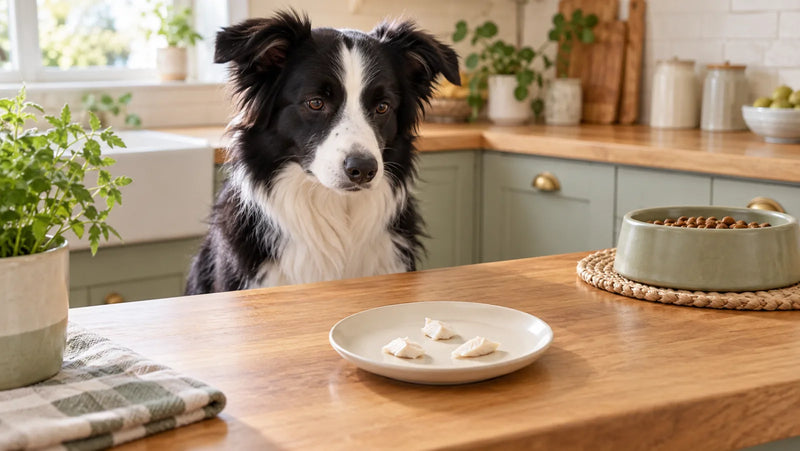

The best dog food toppers solve one clear feeding problem without crowding out a complete meal. Compare freeze-dried crumbles, plain dog-safe broth, wet mix-ins, and powders by their full ingredient lists, calorie information, feeding statements, texture, and storage needs—not by a “healthy” or “natural” claim on the front.
Every topper also shares the same extras budget with dog treats, chews, table tastes, and food used for medication. The right format is the smallest measured addition that does the intended job for the individual dog. There is no universal winner for pickiness, aging, or weight management.
Best Dog Food Toppers: Quick Comparison
Begin with the routine you want to improve. Aroma, moisture, softer texture, and easy portion control are separate goals. A format that excels at one may add storage work, label complexity, or calories that do not fit another.
| Format | Practical strength | Best-fit job | Check before buying |
|---|---|---|---|
| Freeze-dried crumbles | Dry, portable, easy to sprinkle or break smaller | Measured aroma and texture over kibble | Calories per stated serving, ingredient identity, moisture control, supplemental statement |
| Plain dog-safe broth | Distributes moisture and aroma through a bowl | Light moistening when the full recipe is appropriate | Onion, garlic, related alliums, sodium, concentrate directions, refrigeration |
| Wet mix-in | Soft texture and strong aroma | Dogs that prefer a moist, blended upper layer | Calories, complete ingredient list, opened storage, leftover timing |
| Powder | Fine coverage from a small measured scoop | Evenly distributing a clearly identified ingredient | Scoop size, density, dust, added flavors, dry-tool and resealing instructions |
Format names are not nutrition grades. Freeze-dried does not mean low calorie, broth does not mean low sodium, wet does not mean complete, and powder does not mean a tiny serving is nutritionally invisible. Compare the exact label and the amount you actually plan to use.

First Define the Job—Not the Trend
Write one sentence before shopping: “I want a measured topper that adds aroma,” “I need a softer texture,” or “I want to moisten the upper layer without seasoning.” That sentence gives you a way to reject products that add features but do not solve the actual problem.
If the term itself is still unclear, the complete dog food topper definition and feeding guide explains how a supplemental addition differs from a complete meal. For the step-by-step serving routine, see our guide on how to use a dog food topper.
Most healthy dogs eating an appropriate complete diet do not need a topper. It is an optional tool. A useful tool earns its place by doing one modest job predictably; it should not turn every meal into a search for a richer flavor.
Freeze-Dried Crumbles: Dry, Portionable, Concentrated
Freeze-dried crumbles are practical when you want dry storage, portability, visible portioning, and a texture that can be sprinkled or mixed into the top of kibble. Fine crumbs distribute aroma across more of the bowl, while larger pieces may be easy for a dog to pick off and leave the base meal behind.
The low-moisture appearance can be misleading if a shopper equates light weight with low calories. Water removal changes weight and volume; it does not make the ingredient calorie-free. Read the calories and serving size for the exact product, then measure that serving with the tool you will use at home.
Also check whether the label says the product is for intermittent or supplemental feeding. A topper that resembles freeze-dried food is not automatically a complete-and-balanced diet. Our freeze-dried topper format guide owns the detailed dry-versus-moistened use, storage, and texture questions.
Broth: Moisture and Aroma With an Ingredient Audit
Broth spreads easily through a bowl and can add aroma without leaving large pieces to sort out. The tradeoff is label complexity. Human broths, bouillon, soup bases, concentrates, gravies, and restaurant liquids may include onion, garlic, other alliums, substantial sodium, fat, or seasoning that does not belong in a dog's routine.
Read every ingredient and the sodium amount for the prepared serving. “Reduced sodium” compares a product with its regular version; it does not establish a canine allowance. “No salt added” also does not mean sodium-free. Concentrates must be evaluated at their directed dilution, not by an undiluted teaspoon.
The newly published chicken broth safety and label-check guide explains allium screening, sodium claims, a plain homemade method, and measured use. Screen the broth for safety first; only then compare it with the other formats below. Broth should add light moisture or aroma, not replace fresh water or hide ongoing appetite loss.
Wet Mix-Ins: Soft Texture With Refrigeration Rules
A wet topper can be useful when a dog prefers a soft texture or when a small amount needs to blend through the upper layer of food. It can also bring more ingredients, a shorter after-opening window, refrigeration, and residue that must be removed from the bowl promptly.
Check whether the product is a supplemental topper, a complete food, or a treat-like mix-in. Similar tubs and pouches can have different nutritional roles. Compare calories for the amount you will actually spoon into the bowl, not for an assumed “small dollop.” Use a measured utensil because a rounded spoonful can change from meal to meal.
Follow the label's refrigeration and discard directions. Once opened or mixed with dry food, wet product should not sit indefinitely. If a dog needs softer food because chewing has suddenly changed, schedule a veterinary or dental evaluation rather than treating the topper as the diagnosis.
Powders: Even Coverage, but Scoop Density Matters
A powder can coat kibble evenly, which may let a very small measured amount spread aroma through the bowl. It also creates new comparison questions. A fine powder packs differently from coarse crumbles, and two scoops that look alike can have different weights and calories.
Look for a clear ingredient identity, stated serving size, calorie information, and a scoop or teaspoon measure you can reproduce. Avoid assuming that a tiny volume is automatically a low-calorie choice. Added flavor systems, salt, sweeteners, or vague animal ingredients still count even when ground finely.
Keep the package dry and use a clean, dry measuring tool. Powder that clumps from moisture, smells different, shows pests, or can no longer be identified should not be revived by stirring it into food.
Best Dog Food Toppers for Picky Dogs
For an otherwise healthy dog with a stable preference pattern, the best topper is often the simplest one you can use consistently. Choose one familiar protein or plain format, add a modest measured amount, and avoid escalating the bowl every time the dog hesitates. Constantly rotating rich additions can teach some dogs to wait for the next upgrade.
A dry crumble may work when aroma is enough. A little plain dog-safe broth or a measured wet mix-in may fit a dog that prefers moisture. The goal is not to bury the meal; it is to make the existing complete food more approachable while keeping portions trackable.
Sudden or persistent appetite loss is different from ordinary pickiness. Vomiting, diarrhea, weight loss, pain, difficulty chewing, marked tiredness, increased thirst, or repeated meal refusal needs veterinary attention. A topper should not delay an examination or disguise a pattern the veterinarian needs to see.
Best Dog Food Toppers for Senior Dogs
Senior dogs may benefit from a format matched to current chewing ability and sensory interest. Fine crumbles can be mixed without large hard pieces; a small amount of warm water may soften a dry topper; a wet mix-in can change texture. Choose based on the dog in front of you, not the age label alone.
Older dogs are also more likely to have calorie limits, prescription diets, kidney or heart conditions, dental disease, or medication routines. “Senior-friendly” on a front label cannot resolve those factors. Ask the veterinary team before adding a routine topper to a therapeutic diet or using one to manage a medical symptom.
New chewing difficulty, dropping food, foul breath, facial swelling, pain, or a sudden appetite change is not merely a request for softer food. A topper can improve ordinary enjoyment, but it should not substitute for diagnosis and treatment.
Best Dog Food Toppers for Weight Management
A weight-loss plan should be led by the veterinary team and based on an appropriate daily calorie target. A topper only fits when its calories are counted and it does not displace the complete food that provides planned nutrition. The lowest-volume option is not necessarily the lowest-calorie option.
The World Small Animal Veterinary Association's treat guide recommends that treats and other extras provide no more than 10% of daily calories, leaving at least 90% for complete-and-balanced food. Treat that 10% as a ceiling, not a target. Toppers, training rewards, chews, table food, and medication foods all share it.
Our daily extras and treat-calorie guide explains how to organize the shared budget. For a dog already using most of that allowance in training, use less topper, use part of the dog's regular measured food for reinforcement, or ask the veterinary team whether the topper still fits.
Read the Label in Seven Checks
- Complete ingredient list: Read every ingredient, not only the front claim. Identify the protein, fat source, salt, flavoring, sweetener, thickener, and any ingredient the dog must avoid.
- Named protein: “Chicken” is more useful for screening than “meat flavor,” but a named protein still must fit the individual dog's history.
- Nutritional role: Find the feeding statement. Supplemental or intermittent products should not replace a complete meal.
- Calories and serving size: Compare calories for the amount you will actually use. A tablespoon, packet, scoop, gram, and ounce are not interchangeable.
- Storage after opening: Confirm refrigeration, resealing, moisture protection, leftover handling, and the product-specific discard guidance.
- Dog fit: Consider life stage, allergies, chewing ability, weight plan, disease, and prescription diets without treating a marketing label as veterinary approval.
- Repeatability: Choose a measuring tool and routine that different household members can reproduce without free-pouring.
“Single ingredient,” “grain free,” “human grade,” “natural,” and “premium” do not answer all seven questions. A simple label can be useful, but simplicity does not make an ingredient appropriate for every dog or make a supplemental product complete.
Compare Cost per Usable Serving, Not Package Price Alone
Package price can distort a comparison because water content, density, serving directions, and waste differ. Work out how many of your planned measured servings the package provides, then include refrigeration losses, crumbs, spills, and unused product that must be discarded.
A dry topper may cost more by weight but waste less in a household that needs only a pinch. A wet pouch may fit a multi-dog home but spoil before one small dog finishes it. A broth bottle may appear inexpensive until only a small portion can be used before the label's after-opening window ends. Use the real household routine as the denominator.
Do not reduce the serving below a meaningful, measurable amount merely to make a cost claim look better. If a tiny amount does not change the meal, the product may not be solving the stated job.
A Simple Freeze-Dried Chicken Option
American Paws Chicken Meal Topper is made from one ingredient—100% USA chicken breast—freeze-dried and ground into crumbles. Its dry format can be sprinkled over regular food, and the current label identifies it for intermittent or supplemental feeding rather than as a complete meal.
It may fit dogs that already tolerate chicken and households that want a clearly named protein in a dry, portionable form. It is not a match for a dog avoiding chicken, and its single-ingredient formula does not describe every American Paws product. Follow the exact product's feeding and storage directions and count the measured topper with the day's other extras.
Browse all current American Paws dog treats only if a different format or protein better fits the dog's established plan. Each product needs its own ingredient, calorie, texture, and intended-use check.
Frequently Asked Questions
What is the healthiest dog food topper?
There is no universally healthiest topper. The best choice has an understood ingredient list, a measured portion that fits the dog's calorie and health plan, an appropriate texture, clear storage directions, and the correct supplemental or complete feeding statement.
Are dog food toppers good for picky eaters?
They can help an otherwise healthy dog by adding aroma, moisture, or texture. Use one consistent measured addition rather than an escalating rotation. Sudden or persistent appetite loss, weight loss, pain, vomiting, diarrhea, or difficulty chewing needs veterinary evaluation.
Is broth a good dog food topper?
Plain broth can add light moisture and aroma when every ingredient is dog-appropriate and the sodium fits the dog's plan. Human broths commonly contain onion, garlic, other alliums, salt, concentrates, or seasoning, so the full label and prepared serving must be checked.
Are freeze-dried dog food toppers low calorie?
Not automatically. Freeze-dried describes a processing format, not a calorie claim. Read the exact product's calories and serving size, measure the planned amount, and include it with all other daily extras.
Can senior dogs use meal toppers?
Many can use a suitable measured topper, but texture, calories, prescription diets, dental health, allergies, and medical conditions matter. New appetite or chewing changes should be examined rather than covered with a richer addition.
Can a topper replace dog food?
Usually no. Most toppers are labeled for intermittent or supplemental feeding and should sit over a complete-and-balanced base diet. Only a product specifically formulated and labeled as complete should be considered for a meal-replacement role, and transitions still require an appropriate feeding plan.
Choose the Smallest Addition That Solves the Job
The best comparison ends with one clear sentence: this format fits this dog, this goal, this measured serving, and this storage routine. Start from the label, count the calories, keep the complete meal in charge, and use veterinary guidance when a medical or weight-management plan is involved.
For a straightforward dry option, review the American Paws Chicken Meal Topper and confirm that chicken, the supplemental role, and the measured serving fit your dog before adding it to the bowl.