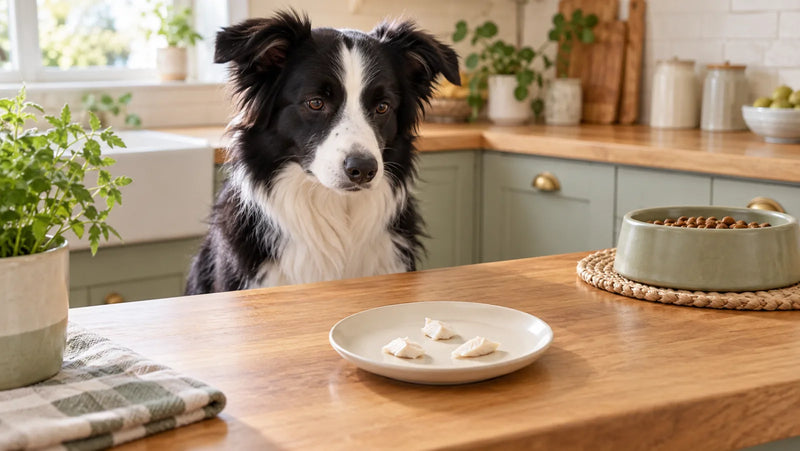

Can dogs have chicken broth? Yes—many healthy dogs can have a small amount of plain chicken broth when the complete ingredient list contains no onion, garlic, chives, leeks, added salt, or unsafe seasoning. Check the sodium line even on “low sodium” and “no salt added” products, use broth only as a measured topper, and keep fresh water and complete dog food in charge.
Ordinary soup, bouillon, stock concentrate, restaurant broth, gravy, and stuffing liquid should not be treated as plain broth. Recipes built for people often combine alliums, salt, fat, and seasonings that a dog does not need.
Can Dogs Have Chicken Broth? The Short Answer
A suitable broth has a short, fully understood ingredient list and a sodium amount that fits the individual dog's plan. “Chicken broth” on the front is not enough. Turn the package around and check the ingredients, Nutrition Facts, serving size, preparation directions, and any concentrate-to-water ratio.
Use broth for flavor or light moistening, not as a bowl-size drink, nutritional supplement, treatment for dehydration, or replacement for a complete meal. Dogs with chicken allergy, heart or kidney disease, pancreatitis history, prescription diets, medical fluid restrictions, or unexplained appetite changes need veterinary guidance before broth becomes part of the routine.
| Check | What to look for | Reason to pause |
|---|---|---|
| Ingredients | Chicken, water, and only fully understood dog-appropriate ingredients | Onion, garlic, leek, chive, scallion, shallot, powders, concentrates, bouillon, or unclear flavoring |
| Sodium | Actual milligrams per labeled serving and the serving size | Trusting “reduced,” “light,” or “no salt added” without reading the number |
| Use | A small measured splash over regular food | Replacing water, hiding ongoing appetite loss, or feeding a large bowl |
| Dog | Already tolerates chicken and has no relevant diet restriction | Known chicken reaction, prescription diet, or sodium/fluid-sensitive condition |
The Three-Check Store-Bought Broth Test
1. Check every ingredient for alliums and seasoning
Scan for onion, onion powder, dehydrated onion, garlic, garlic powder, leek, chive, scallion, shallot, soup base, bouillon, seasoning blend, and flavor components you cannot identify. Powdered and concentrated alliums do not become safe because they are farther down the list.
“Natural flavor” does not tell a shopper enough to approve a broth for a dog. If the product contains a broad flavor term and the manufacturer will not confirm whether it includes onion, garlic, or another unsafe seasoning, choose a clearer product. Organic, homemade-style, reduced-sodium, and premium labels do not override the ingredient panel.
2. Read the actual sodium number
Find sodium in milligrams and the exact serving size beside it. Broth labels may use a cup, fraction of a cup, or prepared serving, while concentrates may list values before or after dilution. Compare products at the same prepared volume rather than comparing two front-label slogans.
Do not use the human percent Daily Value to set a dog's limit. A veterinarian should decide whether broth fits a dog whose health plan controls sodium or fluid. For an ordinary healthy dog, a smaller measured amount keeps the exposure and the effect on the regular meal easier to assess.
3. Confirm the serving context
Ask what the broth is supposed to do. A teaspoon or tablespoon stirred through a normal meal is a flavor addition. A bowl offered because a dog will not drink, repeatedly refuses food, is vomiting, has diarrhea, or appears weak is an attempted medical intervention. Those situations require a veterinarian, not a stronger broth.
Count broth with all extras, including dog treats, chews, table tastes, and other toppers. Even a liquid addition can contribute sodium, calories, fat, and an ingredient the dog has not had before.
What “Low Sodium,” “Reduced Sodium” and “No Salt Added” Mean
These phrases are not interchangeable. The FDA's sodium-label guide for human foods explains that:
- Low sodium means 140 mg or less per labeled serving.
- Very low sodium means 35 mg or less per serving.
- Sodium free means less than 5 mg per serving.
- Reduced sodium means at least 25% less than the regular comparison product; it can still contain substantial sodium.
- No salt added or unsalted means salt was not added during processing; the product may still contain sodium.
Those definitions explain a human-food label. They are not canine feeding limits. A “low sodium” claim also does not remove onion or garlic, and an onion-free product is not automatically low in sodium. A safe screen must pass both tests independently.
If the broth is concentrated, calculate from the prepared directions. A teaspoon of undiluted concentrate is not the same as a teaspoon of ready-to-serve broth. When the math or ingredient identity is unclear, water is the simpler meal-moistening choice.
Why Onion and Garlic Make Broth Unsafe
Onion and garlic belong to the Allium family. The veterinarian-authored Merck Veterinary Manual allium toxicosis review explains that dogs and cats have been affected by raw, cooked, dehydrated, and granulated forms. Their sulfur-containing compounds can cause oxidative damage to red blood cells and hemolytic anemia.
Cooking an onion in broth does not neutralize the concern, and straining out the visible pieces does not prove the liquid is safe. Powders and dry soup mixes can be concentrated sources. Clinical anemia signs may not appear immediately, so a dog that seems normal right after an exposure is not automatically in the clear.
The separate dog and onion safety guide owns the amount, symptom, and exposure-response intent. The broader toxic foods for dogs reference helps identify co-exposures when the liquid came from soup, stuffing, a roast, or another complete dish.

Simple Homemade Chicken Broth for Dogs
The clearest homemade version uses two food ingredients: boneless skinless chicken and water. Boneless meat avoids having to recover every cooked bone or fragment, and a small batch is easier to cool, store, and use promptly.
- Prepare cleanly. Wash hands, clean the pot and tools, and keep raw chicken and its juices away from ready-to-eat food.
- Add chicken and water. Place plain boneless skinless chicken in a pot and cover it with water. Add no salt, onion, garlic, leek, chive, shallot, herbs, spice, oil, butter, bouillon, vinegar, supplement, or seasoning blend.
- Cook fully. Bring the water to a boil, then maintain a gentle simmer until the thickest part of the chicken reaches 165°F on a food thermometer. The USDA FSIS poultry safety answer identifies 165°F as the safe minimum internal temperature.
- Remove and strain. Lift out the chicken, then strain the liquid through a clean fine strainer. Let it cool and remove visible excess fat from the surface.
- Store promptly. Refrigerate the cooled broth in a clean closed container and make only an amount you can use promptly. Freeze extra broth in clearly identified small portions rather than keeping an aging pot in the refrigerator.
- Serve cool or slightly warm. Never pour hot broth onto food. Measure the amount before it reaches the bowl.
The cooked chicken is separate food. If it fits the dog's diet, it can be portioned as a plain treat or topper; it should not silently turn the broth recipe into an unbalanced chicken-based meal plan.
How Much Chicken Broth Can You Put on Dog Food?
For a first taste of a verified plain broth, use one teaspoon for a toy or small dog or up to one tablespoon for a medium or large dog, stirred through the regular meal. The goal is a light coating, not soup. Wait and watch for digestive upset before using it again.
This is a conservative kitchen starting point, not a therapeutic dose or daily maximum. A veterinarian-reviewed PetMD hydration discussion gives one tablespoon of unsalted chicken broth as an example a veterinarian may suggest after underlying illness has been ruled out. That does not mean every dog needs broth or that more is better.
Use the label serving size and sodium number to understand what the measured splash contains. Puppies, very small dogs, dogs eating several extras, and dogs with dietary restrictions have less room for casual additions. Stop if the dog develops vomiting, diarrhea, itching, facial swelling, or another new sign.
Chicken Broth vs Bone Broth for Dogs
Store labels use broth, stock, and bone broth inconsistently. Ordinary chicken broth may be made primarily from meat and water, while bone broth is generally associated with a longer cook involving bones and connective tissue. Neither name proves that the finished liquid is dog-safe.
Inspect bone broth for the same alliums, sodium, fat, seasonings, and unclear flavors. Never give the cooked bones themselves; straining a homemade bone preparation requires meticulous bone-fragment control. Our dedicated bone broth for dogs guide handles that separate intent.
Do not choose bone broth because of unverified promises about joints, gut health, immunity, detoxification, or treating dehydration. Choose an identified product for a modest flavoring job, and let the dog's complete diet and veterinarian handle nutrition and medical care.
When Chicken Broth Is Not the Answer
A topper can make an ordinary meal smell different, but it should not mask a health change. Call the veterinarian when a dog repeatedly refuses food or water, cannot keep liquids down, has repeated vomiting or diarrhea, seems painful, becomes unusually tired, has trouble breathing, has pale gums, collapses, or shows another concerning sign.
Broth is also a poor workaround for a prescription diet. A small splash can introduce sodium, protein, fat, or another ingredient that the diet is designed to control. Ask the prescribing veterinarian before adding any human food, even when the front says organic or unsalted.
For ordinary topper education, the dog food topper guide explains how supplemental additions differ from complete food. A topper supports a normal meal; it does not replace it.
A Dry Chicken Topper Alternative
American Paws does not sell chicken broth. For dogs that already tolerate chicken, the American Paws freeze-dried chicken meal topper is a dry alternative made from one ingredient: 100% USA chicken breast, finely ground and freeze-dried into crumbles in Highland, California.
It is intended for intermittent or supplemental feeding, not as a complete meal. Its current product page provides a measured feeding guide and directs cool, dry, tightly resealed storage. Use the stated amount for that exact product rather than applying a liquid-broth tablespoon.
Shoppers comparing other formats can browse American Paws dog treats, but every product needs its own ingredient and feeding check. A single-ingredient claim for the chicken topper does not describe the entire catalog.
What to Do If a Dog Drank Unsafe Broth
Keep the package, recipe, and remaining liquid. Record the exact product, ingredient list, amount missing, concentrate or dilution status, time of exposure, dog's weight and health conditions, and any signs. Contact the dog's veterinarian or a pet poison service promptly when onion, garlic, another allium, an unsafe seasoning, a large sodium exposure, or an unknown ingredient may be involved.
Do not wait for pale gums, weakness, fast breathing, dark urine, collapse, vomiting, or diarrhea before asking for guidance. Merck notes that allium-related anemia signs can be delayed. Do not induce vomiting or give a home remedy unless a veterinarian or poison professional specifically directs it for that dog and exposure.
Broth taken from a finished dish needs the full recipe reviewed. The hazards in gravy for dogs and stuffing and dogs go beyond the word “broth” and can include concentrated fat, salt, alliums, and additional ingredients or objects.
Frequently Asked Questions
Can dogs have store-bought chicken broth?
Some store-bought broths can fit in a small amount if the full ingredient list has no onion, garlic, related alliums, unsafe seasoning, or unclear flavoring and the sodium fits the dog's plan. Many products fail one of those checks.
Is low-sodium chicken broth safe for dogs?
Not automatically. “Low sodium” describes the sodium level under human-food labeling rules; it does not remove onion or garlic and is not a canine allowance. Read both ingredients and sodium per prepared serving.
Can dogs have chicken broth every day?
A healthy dog may tolerate a small verified amount, but daily broth is rarely necessary. Recheck the complete diet, sodium, calories, chicken tolerance, and whether the dog has learned to refuse plain food. Ask a veterinarian before routine use for a health reason.
Can puppies have chicken broth?
A puppy eating solid food may be able to try a very small amount of plain broth, but growth diets have little room for unplanned extras. Ask the puppy's veterinarian first for a very young puppy, digestive trouble, poor appetite, illness, or a special diet.
Can chicken broth replace water?
No. Fresh clean water should remain available. A dog that is not drinking normally, appears dehydrated, or cannot keep water down needs veterinary evaluation; flavored liquid is not a substitute.
Is chicken stock the same as chicken broth?
Not reliably. Brands use broth and stock in different ways. Judge the actual ingredient list, sodium, preparation directions, and intended use rather than assuming one name is safer.
Use the Simplest Verified Topper
A dog-safe chicken broth is intentionally plain: identified ingredients, no alliums, no added salt, a sodium number you have actually read, and a measured splash over a complete meal. When any ingredient or health condition is uncertain, use water or ask the veterinarian.
If a dry, clearly portioned chicken addition fits better, see the American Paws single-ingredient chicken meal topper and follow its own feeding directions rather than borrowing a broth amount.