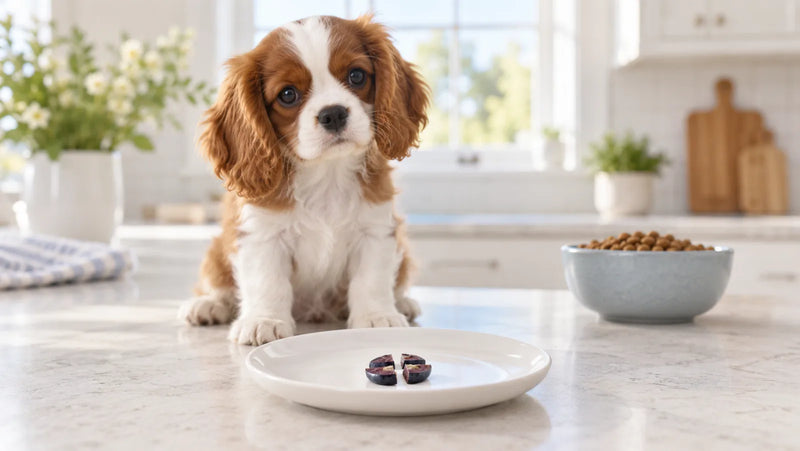

Bully sticks for puppies can be appropriate for some individuals, but there is no evidence-based birthday that makes every puppy ready. Mouth comfort, dental stage, chewing behavior, stick fit, health, and close supervision matter more than one week number. A puppy with loose or painful teeth, a habit of gulping, or a stick small enough to fit wholly in the mouth should not begin a session.
Use a conservative routine: screen dental and behavioral readiness, choose an oversized stick, secure it in a compatible holder, begin with a short observation window, and take it away before the remaining end becomes swallowable. Count the chew in the puppy's daily extras and wash hands and surfaces after handling it. No edible chew is risk-free, and a holder does not turn supervision into an optional step.
Bully Sticks for Puppies: The Short Answer
A fixed minimum age is less useful than a readiness check. Puppies move through tooth eruption and replacement at different rates, and they also differ in jaw strength, body size, chewing style, food guarding, and willingness to release an item. Use the following decisions together rather than choosing one rule in isolation.
| Decision | Conservative starting point | Reason to defer or stop |
|---|---|---|
| Age and mouth | Fully weaned, eating complete puppy food normally, comfortable mouth, and no obvious loose, retained, broken, or painful teeth | Active painful teething, bleeding, one-sided chewing, dental disease, recent oral procedure, or uncertain mouth health |
| Size | Long and thick enough that the entire chew cannot fit in the puppy's mouth or move behind the back teeth | The puppy can engulf it, fold it deeply, break off large pieces, or work an end behind the molars |
| First session | A five-minute observation window with an adult within reach | Frantic biting, gulping, guarding, coughing, gagging, bleeding, tooth pain, or large fragments |
| Later sessions | A cautious 10–15-minute review window only after calm, uneventful use | Any warning sign, even if the clock has barely started |
| Final end | Remove while the remaining nub is still too large to swallow | The nub could fit wholly in the mouth or the holder can no longer grip it securely |
| Calories and hygiene | Count it with every other extra; wash hands, holder, and contact surfaces | Unknown calorie fit, damaged packaging, unusual odor or appearance, or a contaminated chew |
The five-minute and 10–15-minute windows in this guide are conservative editorial starting points, not research-proven safety cutoffs. The puppy's behavior overrides the timer. End a session immediately when fit, mouth comfort, digestion, or control changes.
What a Bully Stick Is
A bully stick is a dried chew made from bovine pizzle. Our guide to what bully sticks are made of owns the deeper ingredient, processing, odor, and label questions. The puppy decision is narrower: readiness, fit, time, calories, nub control, and hygiene.
American Paws does not sell bully sticks. None of the guidance here depends on buying an American Paws product. If you buy one elsewhere, use the current maker's dimensions, calorie information, storage directions, and holder instructions, then apply the puppy-specific screening in this guide.
For a wider view of chew textures and tradeoffs, start with our guide to the best natural chews for dogs. No natural chew wins every category. A long-lasting chew may create more time for tooth stress, while a softer or quicker reward may create less chewing time but still require calorie and swallowing control.
What Age Can a Puppy Have a Bully Stick?
There is no universal medically established starting week for bully sticks. A package or seller may use an age such as 12 weeks, but that commercial threshold is not proof that every puppy of that age has the same teeth, coordination, chewing behavior, or digestive tolerance.
The Merck Veterinary Manual's dental-development overview says permanent teeth begin to appear at about four to five months and that all permanent teeth are generally present by about seven months, with considerable individual variation. That means many puppies pass through months of active tooth replacement. A calendar alone cannot tell you whether today's mouth is comfortable and stable.
Use a readiness checklist
Before offering a first bully stick, all of these conditions should be true:
- The puppy is fully weaned and consistently eating an appropriate complete-and-balanced growth diet.
- The puppy has no obvious oral pain, bleeding, facial swelling, broken tooth, retained baby tooth, or tooth that seems unusually loose.
- The puppy can take and release an object calmly without trying to gulp it or run away to guard it.
- An adult can remain in the same room, within reach, and pay attention for the entire session.
- A properly oversized stick and compatible secure holder are available.
- The puppy's veterinarian has not restricted chews because of dental work, digestive disease, food sensitivity, calorie control, or another health concern.
Defer the chew if any item fails. For a very young puppy, a puppy actively losing teeth, or a puppy whose mouth status is uncertain, ask the veterinarian at the next appropriate exam instead of using the bully stick as a tooth test. Eagerness to bite is not evidence that the teeth are ready.
Choose Size and Thickness by Fit, Not a Weight Chart
A body-weight chart cannot capture muzzle width, jaw strength, or chewing technique. Two puppies at the same weight may handle the same stick very differently. Fit the actual chew to the actual puppy, and recheck it as the stick softens and shrinks.
Start deliberately oversized
Choose a bully stick long enough and thick enough that the puppy cannot fit the whole item in the mouth, turn it sideways behind the molars, or hide most of it between the jaws. Extra exposed length also gives the adult and holder more control. “Longer than the muzzle” can be a useful visual screen, but it is not a guarantee; a flexible, narrow chew may still fold or slide.
Thickness matters because a thin stick can disappear quickly or break into a swallowable length. A thicker stick may last longer, but it can also demand more force from young teeth. The goal is not maximum hardness or maximum duration. It is a manageable chew that remains visibly oversized while the puppy uses it gently.
| What you observe | What it means for fit | Action |
|---|---|---|
| Puppy braces the stick and gnaws one exposed area slowly | Control may be acceptable if the mouth is comfortable and the holder stays secure | Continue watching closely and recheck after softening |
| Most of the stick vanishes between the jaws | Too short or too narrow for this puppy | Remove it and do not compensate by merely shortening the session |
| Puppy bites down violently or tries to snap sections off | Texture or thickness does not fit the chewing style | End the session and choose a different activity |
| Chew bends, frays, cracks, or releases a large flap | Original dimensions no longer describe the risk | Remove and discard according to the maker's directions |
Do not hand a smaller stick to a smaller puppy simply because it looks proportional in a photo. A chew should be inconvenient to swallow, not visually scaled like a miniature toy.
How Long Should a Puppy Chew?
There is no universal safe number of minutes. Duration changes exposure to calories, tooth pressure, softening, bacterial contact, and the chance that the chew reaches a dangerous size. The right routine uses short planned windows plus continuous observation.
First exposure: observe for five minutes
For a puppy who passes the readiness and fit checks, use five minutes as a cautious first observation window. Offer the secured stick when the puppy is calm, not ravenous or overexcited. Watch how the puppy picks it up, where the jaws contact it, whether the holder moves, and whether the dog gnaws or tries to gulp.
At the end, trade for a familiar approved reward rather than chasing or wrestling for the chew. Check the gums, teeth, stick surface, holder, and floor. Over the next day, note vomiting, diarrhea, constipation, reduced appetite, unusual drooling, or mouth sensitivity before deciding whether there should be another session.
Later sessions: use a short review window, not an unlimited chew
If the first exposure was calm and uneventful, a later 10–15-minute session can serve as another conservative review window. It is not permission to keep extending time until the stick is gone. End sooner if the puppy becomes forceful, the holder loosens, the chew softens or shrinks rapidly, or the mouth shows discomfort.
A puppy that needs constant physical intervention to prevent gulping is not demonstrating readiness. Choose a non-edible enrichment activity or a measured reward format the puppy can handle more predictably.
Use a Holder and Remove the Final Nub Early
A purpose-built holder can limit access to the last section, but only if it is compatible with the stick's shape and secured exactly as the manufacturer directs. Insert the chew deeply enough for the mechanism to grip, close or tighten it fully, and perform a firm hand tug before letting the puppy approach.
Keep watching. Saliva changes texture, chewing changes diameter, and an irregular natural stick can slip even when it initially feels secure. A holder cannot prevent every release, fracture, tooth injury, or swallowed piece. It is a backup control, not a substitute for an attentive adult.
Define the discard point before the session
Do not wait for a magic one-inch nub. Puppies have different mouths, and a narrow end can travel farther than its length suggests. Remove the chew while the remaining exposed section is still too large to fit wholly in the puppy's mouth or move behind the molars. Also stop when the holder can no longer maintain a reliable grip.
Trade calmly, place the wet nub directly in a closed trash container, and keep it away from children and other pets. Do not hand-hold a tiny end, microwave it, re-dry it, or invent a storage method to extract the last few minutes of value.

Count Bully-Stick Calories in the Puppy's Treat Budget
Bully sticks are edible, so a long chewing session is also a feeding event. A peer-reviewed Tufts and University of Guelph bully-stick study tested the calories of five samples. Those samples averaged 3.01 kilocalories per gram and 88 kilocalories per treat, with individual treats ranging from 45 to 133 kilocalories. The authors also estimated that the tested sticks provided about 9–22 kilocalories per inch.
Those figures show that calorie load can be meaningful and variable; they are not a calorie label for every brand, diameter, or current product. Five samples are far too few to create a universal inches-to-calories calculator. Use the current maker's calorie statement when available, weigh portions only if the maker or veterinary team provides a suitable method, and ask the veterinarian when the value is unclear.
The WSAVA treat guide recommends that treats stay at no more than 10% of a dog's daily calories. Treat that as a ceiling for all extras combined—not a target for one bully stick. Training bites, chews, table food, lick-mat ingredients, medication foods, and snacks from every family member share the same allowance.
Puppies need a diet formulated for growth, so calorie displacement matters as well as weight gain. Do not remove a large amount of complete puppy food merely to make room for a chew. If one session would consume most of the extras allowance, shorten the edible portion or choose another activity rather than trying to balance growth nutrition by guesswork.
Bacteria and Handwashing Matter
The same Tufts/Guelph paper tested 26 bully sticks for selected microorganisms. It found one sample with Clostridium difficile, one with methicillin-resistant Staphylococcus aureus, and seven with Escherichia coli, including one tetracycline-resistant isolate; no Salmonella was found in that set. The study was small, and the authors said a larger study was needed. These findings demonstrate possible contamination, not the current prevalence for all bully sticks or proof that every stick is contaminated.
Use ordinary food-handling discipline. The FDA's pet food and treat handling guidance advises washing hands with soap and water for at least 20 seconds before and after handling pet food or treats. Inspect packaging before purchase, and keep pet items and preparation areas clean.
- Open the chew with clean, dry hands and inspect it for damage, unusual odor, moisture, or visible contamination.
- Use a washable mat in a place separated from human food preparation.
- Keep the stick, holder, and saliva-wet surfaces away from young children and people at higher risk from infection.
- After the session, discard the nub, wash hands for at least 20 seconds, and clean the holder and mat according to their material directions.
- Follow the chew maker's storage directions. Do not return a saliva-wet chew to a clean dry package unless the manufacturer specifically provides a safe method.
Teeth, Stomach, and Choking Warning Signs
Bully sticks soften with chewing, but they can still demand substantial bite force. Cornell's canine dental-care guidance notes that hard objects can contribute to tooth wear or fracture and that some chews can cause gastrointestinal injury or obstruction. A chew is not a replacement for toothbrushing or professional dental care.
End the session and contact the regular veterinarian for a broken tooth, oral bleeding that does not stop quickly, persistent drooling, pawing at the mouth, one-sided chewing, refusal of normal food, repeated vomiting or diarrhea, abdominal pain, straining, or a suspected swallowed chunk. A swallowed piece can create a problem even if the puppy initially seems eager and normal.
Coughing, repeated gagging, frantic pawing at the mouth, blue or pale gums, collapse, or difficulty breathing is urgent. Seek emergency veterinary help immediately. Do not blindly reach into a conscious puppy's throat or induce vomiting unless a veterinary professional specifically directs it.
What to Offer If a Bully Stick Does Not Fit
A failed readiness check does not mean the puppy needs another long edible chew. Food-free enrichment, a veterinarian-approved rubber toy, a short training game using part of the regular meal, or quiet rest may fit the moment better. If an edible option is appropriate, choose it for its actual role rather than calling every product an equivalent chew.
Chicken feet are a different, crunchy chew
American Paws dehydrated chicken feet are single-ingredient, crunchy, bone-containing chews with natural variation. They are not bully sticks, not soft rewards, and not automatically appropriate for a puppy. Use the separate chicken-feet puppy readiness guide before considering them, especially during active tooth replacement. Match the whole foot to the puppy, supervise continuously, and stop if the puppy tries to swallow large pieces.
Soft jerky is a reward, not a lasting chew
The American Paws soft chicken training strips are made with USA chicken breast and a touch of natural glycerin for a tearable texture. They are all-natural but not single-ingredient. Snip an approved measured amount into small rewards; do not present a long strip as a substitute for a long-lasting chew.
Our chicken jerky versus bully sticks comparison separates quick reward and longer chew roles. You can also browse current American Paws dog treats by ingredient, texture, and use case after deciding what the puppy can safely manage.
Frequently Asked Questions
Can an eight-week-old puppy have a bully stick?
Do not assume an eight-week birthday establishes readiness. A puppy that young is still developing coordination and dental stability. Ask the veterinarian, prioritize complete puppy food and non-edible enrichment, and use the mouth, behavior, fit, and supervision checklist rather than a generic age claim.
Are bully sticks safe during teething?
Not automatically. Permanent teeth often begin emerging around four to five months and are generally present by about seven months, but timing varies. Painful gums, loose or retained teeth, bleeding, or forceful chewing are reasons to defer and ask the veterinarian.
What size bully stick should a puppy have?
Choose one that is long and thick enough that the entire stick cannot fit in the puppy's mouth or move behind the back teeth. Use a compatible secure holder, recheck the fit as the stick softens and shrinks, and remove it well before the final end becomes swallowable.
How long can a puppy chew a bully stick?
There is no universally safe duration. This guide uses five minutes for a first observation and a cautious 10–15-minute window for later uneventful sessions. Those are editorial starting points, not guarantees; any warning sign ends the session immediately.
Can a puppy swallow the end of a bully stick?
Yes. A short, slick nub can be gulped and may cause choking or digestive obstruction. Remove and discard the chew while the remaining end is still too large to fit wholly in the mouth and while the holder still grips it securely.
Do bully-stick holders make them safe?
No device removes every risk. A well-fitted holder can reduce access to the final end, but a natural chew can soften, narrow, break, or slip. Tug-test the setup and supervise within reach for the entire session.
Do bully sticks carry bacteria?
Contamination is possible. A small 26-stick study found selected bacteria in some samples, but it cannot establish current prevalence for every product. Inspect packaging and the chew, wash hands with soap and water for at least 20 seconds, and clean holders and contact surfaces.
Are bully sticks too high in calories for puppies?
They can use a meaningful share of a puppy's allowance. Five samples in one study ranged from 45 to 133 kilocalories per treat, but products vary. Use current calorie information, count every extra together under the puppy's plan, and keep complete growth food nutritionally dominant.
Use a Readiness Routine, Not a Birthday Rule
The safest decision starts before chewing: check the mouth, observe the puppy's control, choose an oversized stick, lock it into a compatible holder, define a short session and an early discard point, count the calories, and prepare to clean. If any control fails, skip the stick rather than trying to rescue the session with closer timing.
American Paws does not sell bully sticks. If that format does not suit the puppy, consider a separately screened dehydrated chicken-foot chew only after applying its bone-containing chew rules, or use a measured soft chicken training reward when the goal is a quick, tearable treat rather than extended chewing. The right choice is the one whose texture, portion, and purpose you can control honestly.