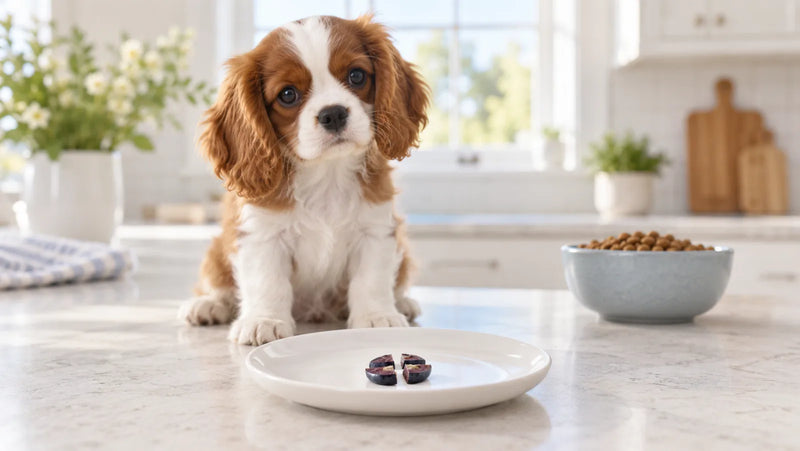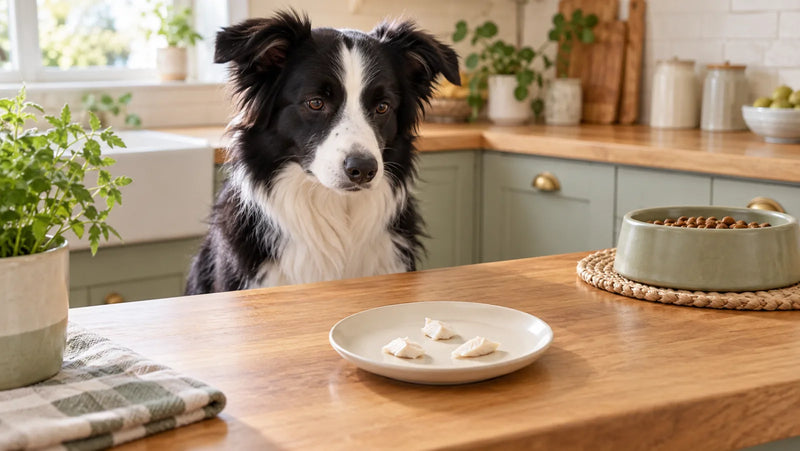

Can dogs eat popcorn? Yes—but only a few fully popped pieces of plain, air-popped popcorn with no butter, oil, salt, sugar, or seasoning. Remove every unpopped or firm half-popped kernel before a dog gets a piece. This is an optional taste for an otherwise suitable dog, not a bowl-sized snack or a useful replacement for balanced dog food.
The exact form matters. A soft popped flake, a rock-hard kernel, heavily seasoned movie popcorn, and a swallowed corn cob create four different decisions. A cob, trouble breathing, repeated vomiting, marked pain, or a product with a hazardous ingredient needs prompt professional help—not another snack or a home remedy. For corn kernels and corn on the cob specifically, see our can dogs eat corn guide.
Can Dogs Eat Popcorn? The Quick Answer
- Plain, fully air-popped popcorn: a few pieces can be an occasional extra for some healthy adult dogs.
- Unpopped or firm half-popped kernels: remove them. They can lodge around teeth, hurt a tooth, cause choking, or become a foreign-body concern.
- Buttered, oily, salty, kettle, caramel, cheese-style, or chocolate popcorn: do not choose it as a dog treat. Ingredients and calorie density vary, so inspect the actual product after an accidental theft.
- Corn on the cob: never offer it as food or a chew. Swallowed cob can cause a serious stomach or intestinal obstruction.
- A dog with dental disease, swallowing difficulty, a therapeutic diet, pancreatitis history, diabetes, kidney or heart disease, or another nutrition-sensitive condition: ask the veterinarian before sharing—or simply skip it.
The American Kennel Club's popcorn guidance reaches the same narrow verdict: plain air-popped popcorn can be offered in small quantities, while butter, oil, salt, toppings, and whole or partly popped kernels change the risk. Plain does not mean unlimited.
Which Popcorn Is Safe for Dogs?
Use preparation and the complete ingredient list—not the word popcorn alone—to decide. A front-of-bag phrase such as natural, light, skinny, kettle, movie style, or reduced fat does not prove that a product is plain or suitable.
| Popcorn form | Main concern | Dog decision |
|---|---|---|
| Fully popped, plain, air-popped | Still an extra; hard fragments and excess portions remain possible | A few inspected pieces may fit an otherwise suitable dog |
| Microwave or bagged popcorn | Oil, butter flavor, sodium, sweeteners, and seasoning blends vary | Do not assume it is plain; read every ingredient and the nutrition panel |
| Buttered or oil-popped | Added fat and calories; rich food may trigger digestive trouble in an individual dog | Skip it as a planned treat |
| Salted or cheese-style | Extra sodium plus a variable seasoning blend | Skip; investigate the exact product after a large theft or any symptoms |
| Kettle or caramel | Sugar, fat, sticky coating, and additional flavor ingredients | Not a dog treat; check the package if stolen |
| Chocolate-coated or sugar-free | May contain a dog toxin such as chocolate or xylitol | Call promptly for ingredient-specific professional advice |
| Unpopped or hard half-popped kernel | Dental injury, lodging, choking, or foreign-body risk | Remove every one before offering any popped pieces |
| Corn cob | Choking and gastrointestinal obstruction | Never offer; ingestion warrants an immediate veterinary call |
Plain air-popped popcorn
The permitted version starts as plain kernels popped by hot air. Add nothing before separating the dog's tiny portion. Inspect each piece under good light and discard pieces with a hard center. Let it cool, then offer one piece at a time while the dog is supervised.
Home air-popping provides the clearest ingredient control, but it does not transform popcorn into complete nutrition. A dog can receive all required nutrients from an appropriate complete and balanced diet without ever eating popcorn.
Microwave and prepackaged popcorn
Microwave does not automatically mean toxic, and air-popped on a package does not automatically mean plain. Products may include vegetable oil, butter or dairy ingredients, salt, natural or artificial flavors, sweeteners, colors, cheese-style powder, or a multi-ingredient seasoning packet. Recipes also change.
If the dog has not eaten it, there is no reason to decode a complicated product just to share it. If the dog stole some, keep the package. Record the product, ingredients, amount missing, earliest possible time, dog's weight, and any signs; those facts are more useful to a veterinarian than the general phrase popcorn.
Buttered, salted, kettle, caramel, cheese-style, and chocolate popcorn
These forms fall outside the yes. Butter and oil raise fat and calories; salt adds sodium; kettle and caramel coatings add sugar and often fat; cheese-style blends may add dairy, sodium, onion, garlic, or other seasonings depending on the recipe. Chocolate-coated popcorn creates a separate toxicology question. Sugar-free coatings deserve an exact xylitol check.
Do not overstate a small accident. One dropped salted flake is not automatically salt poisoning, and the word caramel does not identify every ingredient. At the same time, a large amount, an unknown coating, a medically vulnerable dog, or symptoms should not be dismissed. Use the actual label and call for case-specific advice. Our dog candy and coating safety guide owns the broader chocolate, xylitol, raisin, wrapper, and hard-candy decisions; this page keeps the focus on popcorn.
Unpopped Popcorn Kernels Can Hurt Teeth or Block the Gut
The hard leftovers at the bottom of the bowl are not dog treats. AKC advises keeping whole and partly popped kernels away because they may become stuck in teeth or pose a choking hazard. A veterinarian-reviewed PetMD popcorn guide also flags dental, choking, and intestinal-blockage concerns, especially for small dogs or after multiple kernels.
A kernel wedged between a tooth and gum can be painful and easy to miss. A forceful bite on a very hard kernel may damage or fracture a tooth. Watch for sudden yelping, blood in the mouth, pawing at the face, drooling, chewing on one side, dropping food, refusing hard food, or a visible chip. Do not pry around a painful mouth or force it open. Call the veterinary clinic for an examination.
Swallowing one kernel does not guarantee an obstruction, but size, number, chewing behavior, age, and the dog's anatomy affect risk. Choking, repeated gagging, inability to breathe normally, repeated vomiting or retching, belly pain or swelling, loss of appetite, marked lethargy, or inability to keep water down requires urgent veterinary care. Prevention is simpler: sort the dog's portion piece by piece and keep the popper, bowl bottom, trash, and spilled kernels out of reach.
A Corn Cob Is Not a Dog Chew
Popcorn and a corn cob share a plant source, but the safety decision is not transferable. The AKC corn safety guide warns that a cob can cause choking, lodge in the stomach or intestinal tract, and create a serious blockage.
If a dog swallows any part of a corn cob, contact a veterinarian or emergency animal clinic now, even if the dog still looks normal. Do not wait for the cob to dissolve, assume a large dog will pass it, feed bread or oil to push it through, or induce vomiting unless the clinician handling the case gives that instruction. The safest next step can depend on piece size, time, location, symptoms, and the dog's health.
Keep intact cobs, discarded cob segments, compost, trash bags, plates, and skewers inaccessible during cooking and cleanup. A dog can swallow a surprisingly large piece quickly, and early veterinary assessment may offer more options than waiting for obstruction signs.
How Much Popcorn Can a Dog Eat?
There is no veterinary popcorn dose and no piece count that guarantees safety. The table below gives conservative first-taste ceilings for a healthy adult dog after every piece has been confirmed fully popped and completely plain. They are not daily allowances, toxicity thresholds, or targets.
| Dog size | Cautious first-taste ceiling | Serving note |
|---|---|---|
| Under 20 lb | 1 small fully popped piece | Break the soft flake smaller; skip for gulpers or dogs with dental concerns |
| 20–49 lb | Up to 2 pieces | Offer one at a time and inspect for hard centers |
| 50–79 lb | Up to 4 pieces | Do not turn body size into permission for a bowl |
| 80 lb and over | Up to 6 pieces | Still an optional taste, not a handful or daily serving |
Start below the ceiling when the food is new. Puppies, seniors, flat-faced dogs, dogs that gulp, and dogs with missing or diseased teeth may need smaller pieces or none. A dog on a prescription, elimination, weight-loss, diabetic, kidney, heart, gastrointestinal, or fat-restricted plan should not receive an unapproved extra.
The WSAVA treat guide recommends that all treats and extras together supply less than 10% of daily calories, leaving at least 90% for complete and balanced food. Popcorn, table scraps, toppers, chews, biscuits, and training rewards share that one allowance. Our daily dog-treat calorie guide explains the calculation; popcorn does not get a separate 10% budget.
How to Make and Serve Dog-Safe Popcorn
- Check the dog first. Skip popcorn when dental, swallowing, diet, or medical concerns make it a poor fit.
- Air-pop a plain batch. Do not add oil, butter, salt, sugar, cheese powder, spice, or seasoning to the dog's portion.
- Let it cool. Separate the tiny portion before human toppings are added.
- Inspect every piece. Discard unpopped kernels, hard centers, burnt fragments, and firm half-popped pieces.
- Break and offer individually. Use pieces smaller than the dog's usual reward and watch the dog swallow comfortably.
- Stop at the first-taste ceiling. More is not more beneficial.
- Secure the waste. Put kernels, bags, bowls, cobs, wrappers, and trash behind a closed barrier.

What If a Dog Eats Popcorn, Kernels, or a Corn Cob?
First identify what happened. The response to two plain popped pieces is different from the response to a cob, a bowl of hard kernels, or a chocolate or sugar-free coating.
- Prevent more access. Secure the bowl, popper, package, kernels, cobs, wrappers, and trash.
- Check breathing without delaying care. Trouble breathing, blue or pale gums, collapse, frantic pawing at the mouth, or severe choking behavior is an emergency. Go to the emergency clinic and call ahead when possible.
- Preserve the evidence. Keep the package and ingredient panel. Estimate the amount, earliest time, dog's weight, and any missing cob or wrapper material.
- Use the right call. A swallowed cob, multiple hard kernels in a small dog, repeated gagging, vomiting, pain, marked lethargy, appetite loss, abdominal swelling, or inability to keep water down warrants prompt veterinary advice. For chocolate, xylitol, onion, garlic, or another suspected toxic ingredient, contact the veterinarian, emergency clinic, or ASPCA Animal Poison Control at (888) 426-4435. A consultation fee may apply.
- Do not improvise treatment. Do not induce vomiting or give hydrogen peroxide, salt, oil, butter, bread, milk, charcoal, or a forced meal unless the professional handling this exact case directs it.
If a healthy dog steals only a few fully popped plain pieces and remains normal, remove access and monitor closely. Contact the veterinarian if vomiting, diarrhea, pain, appetite change, coughing, gagging, unusual thirst, weakness, or another concern appears. When the product or amount is unknown, call rather than guessing.
Does Popcorn Have Benefits for Dogs?
Popcorn contains carbohydrate, fiber, and small amounts of micronutrients, but that does not make a few pieces a meaningful supplement. A complete and balanced dog food is formulated to meet the dog's nutritional requirements in appropriate proportions; adding popcorn to chase one nutrient can add calories while displacing that balance.
Corn is not automatically a meaningless filler, and a dog should not be diagnosed with a corn allergy from an internet list. At the same time, a grain's role in a formulated diet does not make every human corn snack a good dog treat. The right conclusion is modest: plain air-popped popcorn can be tolerated in a tiny amount by some dogs, but it is optional.
Better Movie-Night Rewards for Dogs
A dog does not need to share the human bowl to participate. Set aside part of the dog's normal meal, use one familiar veterinarian-approved reward, or choose a purpose-made dog treat with a readable ingredient list, known calories, and a size and texture matched to the dog. Measure the reward before the movie starts so repeated requests do not quietly multiply the portion. For another carefully portioned people-food option, see our plain cooked rice serving guide.
American Paws does not currently claim a popcorn product. You can browse all current American Paws dog treats and compare the actual ingredient panel, calories, texture, and piece size with the dog's needs. A dog-specific label still requires portion control and supervision; it is simply easier to evaluate than a bowl of mixed movie-night toppings.
Frequently Asked Questions
Can puppies eat popcorn?
Popcorn is unnecessary for a growing puppy. Small airways, fast eating, developing teeth, tiny calorie budgets, and the need to protect a complete growth diet make it easy to skip. Use a puppy-appropriate reward recommended by the veterinarian and sized for safe training instead.
Can dogs eat microwave popcorn?
Do not assume so. Microwave products often contain oil, butter flavor, salt, or a multi-ingredient seasoning, and hard kernels remain in the bag. If you want to offer popcorn, prepare a separate plain air-popped batch and inspect every piece. If microwave popcorn was stolen, keep the package and assess the exact ingredients and amount.
Can dogs eat caramel or kettle corn?
Skip both as dog treats. They commonly add sugar and may add fat, salt, or other flavor ingredients. A small accidental theft is not one universal poisoning scenario, so check the label, amount, dog, and symptoms. Call promptly if the coating contains chocolate, xylitol, raisins, or another hazardous ingredient.
Can dogs eat cheese popcorn?
Do not plan to share it. Cheese-style popcorn can be high in sodium and calories, and seasoning blends vary; some may contain onion or garlic ingredients. The word cheese does not reveal the full formula. Save the package after an accidental theft and contact the veterinarian when the amount is large, the dog is medically vulnerable, or symptoms appear.
Can dogs eat popcorn every day?
There is no reason to make popcorn daily. Even the plain form uses part of the shared extras budget and introduces preventable kernel risk without supplying a required benefit. If a suitable dog enjoys it, keep it tiny and occasional, and use the complete diet or a familiar measured dog treat for routine rewards.
Keep It Plain, Fully Popped, and Small
The useful rule is narrower than popcorn is safe. Start with a healthy, suitable dog; use only plain air-popped corn; remove every hard or partly popped kernel; serve a few inspected pieces one at a time; and count them with all other extras. Keep flavored popcorn and cobs inaccessible.
If the situation involves choking, a swallowed cob, repeated vomiting, pain, a large unknown amount, or a possible toxin, stop reading labels alone and call a veterinarian, emergency clinic, or poison-control professional. A careful movie-night setup prevents the hardest decisions before they happen.