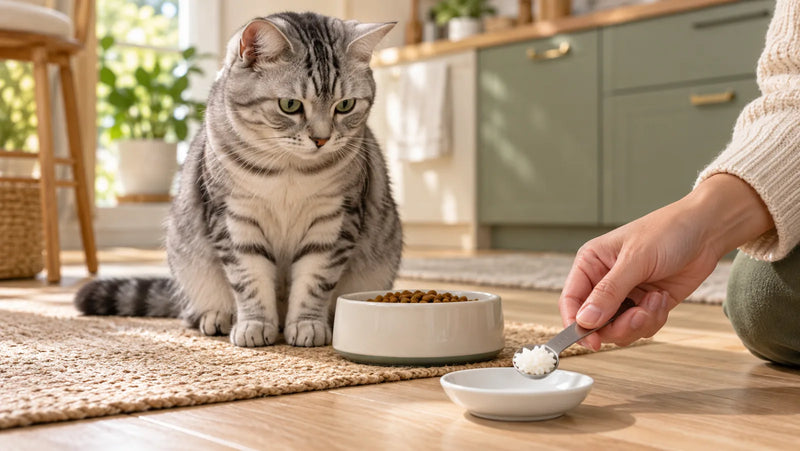
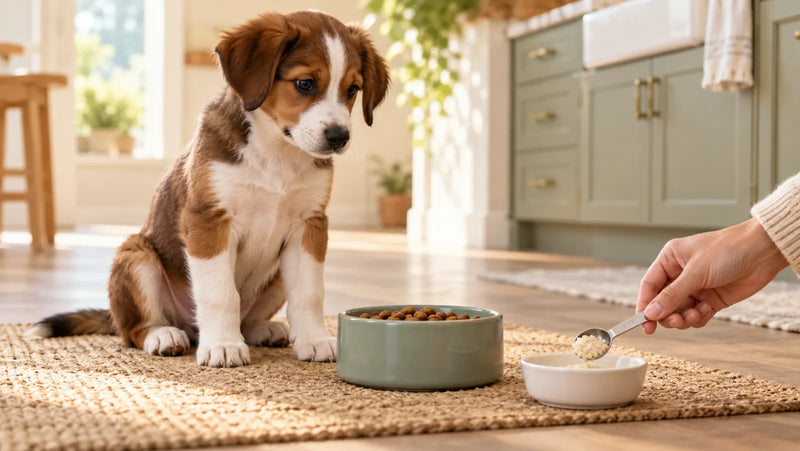
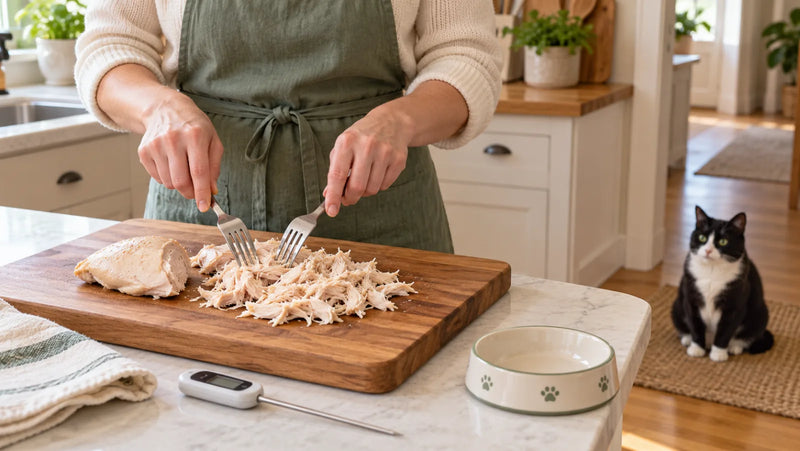
Can puppies eat turkey? A healthy, fully weaned puppy that reliably eats complete growth food may try a tiny amount of plain, fully cooked turkey when turkey fits the puppy's veterinary plan. Reserve unbrined, boneless, skinless white meat before the family recipe begins, cook it to 165°F, cool and inspect it, then shred and weigh one conservative first taste.
Do not serve turkey skin, bones, drippings, stuffing, gravy, deli meat, raw turkey, or a seasoned slice from the Thanksgiving platter. Plain turkey is an optional extra, not a complete puppy meal, a growth food, or a treatment for an upset stomach.
The broader turkey safety guide for dogs owns adult-dog suitability, seasoned forms, and accidental-exposure decisions. The decision here is narrower: whether one growing puppy is ready for one controlled plain taste.
Can Puppies Eat Turkey? The Six-Gate Answer
Use all six gates before preparing turkey. Passing one gate does not compensate for failing another.
| Gate | What must be true | Reason to wait |
|---|---|---|
| Readiness | The puppy is fully weaned, handles solid food comfortably, and reliably eats complete growth food | The puppy is nursing, transitioning, underweight, or struggling to chew or swallow |
| Health | Appetite, stool, energy, skin, and ears are normal that day | Vomiting, diarrhea, poor appetite, lethargy, itching, or another change needs attention first |
| Turkey form | Unbrined, boneless, skinless white meat with no seasoning | Skin, bone, dark fatty scraps, deli meat, injection solution, brine, stuffing, gravy, or unknown ingredients |
| Cooking | The thickest meat reaches 165°F, then is cooled and moved with clean tools | Raw, undercooked, counter-thawed, cross-contaminated, or temperature unknown |
| Amount | One weighed first taste from the conservative table below | A handful, a bowlful, repeated guest handouts, or an unmeasured plate scrap |
| Diet context | Turkey is allowed by the puppy's growth, allergy, prescription, and veterinary plan | An elimination diet, prescribed food, medical restriction, or uncertain poultry history controls the decision |
A puppy that passes every gate may try a small optional taste. That does not make turkey necessary, suitable every day, or interchangeable with a complete growth diet. The puppy-treat selection pillar explains how readiness, delivery size, texture, calories, and ingredients work together across all reward types.
Age Alone Does Not Decide: Full Weaning Comes First
There is no universal birthday when turkey becomes appropriate. The Merck Veterinary Manual's puppy-care guidance notes that puppies can generally feed themselves around seven to eight weeks and need food formulated for growth. That describes a common developmental stage; it is not automatic permission for every eight-week-old puppy to receive table food.
Wait until the individual puppy is fully weaned, eats the normal complete growth food reliably, and can manage small soft solids without coughing, gagging, gulping, or prolonged chewing. A puppy of the same age may still be transitioning, underweight, ill, newly arrived, stressed, or following a special feeding plan.
Growth nutrition remains the foundation. Merck's small-animal feeding reference emphasizes complete and balanced growth diets and individualized feeding during puppy development. Turkey muscle meat supplies protein and calories, but it does not supply every nutrient in the ratios required for growing bones, organs, and tissues.
Ask the veterinary team before a trial when the puppy has poor growth, low body weight, repeated digestive signs, a swallowing problem, suspected food reaction, pancreatitis history, or another health condition. The same pause applies to a prescription diet or a formal elimination trial. “Plain” describes the cooking method; it does not override an individual restriction.
Use Plain Boneless Skinless White Meat Cooked to 165°F
The most controlled first form is a small piece of turkey breast sold without brine, flavor solution, marinade, seasoning, skin, or bone. Read the package for terms such as “pre-basted,” “self-basting,” “enhanced,” “injected,” “seasoned,” “smoked,” or “deli.” If the ingredient statement includes more than turkey, it does not follow the plain first-taste method.
Reserve the puppy's portion before butter, oil, salt, rub, aromatics, stuffing, broth, glaze, or gravy enters the family workflow. Place it in its own clean dish and cook it separately. Rinsing a seasoned slice or scraping off gravy later cannot prove that absorbed salt, fat, seasoning, or cooking juices are gone.
The CDC's holiday turkey safety guidance says raw turkey can carry foodborne germs and directs cooks to verify 165°F with a food thermometer. Check the thickest center, not the color, juices, softness, or clock. Keep the raw board, knife, hands, juices, and packaging away from cooked turkey, puppy bowls, and other food.
- Reserve: move an unbrined boneless skinless breast portion to a separate clean dish before the family recipe starts.
- Cook: bake or gently simmer it completely plain and verify 165°F in the thickest part.
- Cool: transfer it with clean tools and let the center cool before handling or serving.
- Inspect: remove every piece of skin, visible fat, cartilage, hard fragment, string, clip, foil, or packaging.
- Shred: make soft pieces smaller than the puppy's usual reward so one piece is not a mouthful.
- Weigh: measure the first exposure after cooking, cooling, and inspection.
The complete plain turkey cooking method for dogs covers reserving, thawing, baking or simmering, thermometer placement, cooling, refrigeration, and freezing. Use that kitchen workflow, then return to the puppy-specific readiness and gram limits here.
Why Skin, Bones, Raw Turkey, and Rich Scraps Stay Out
Turkey meat, turkey skin, and turkey bones are different exposures. The American Veterinary Medical Association's Thanksgiving guidance limits a possible pet taste to plain boneless skinless turkey in small portions. It warns that fatty scraps and skin can be difficult to digest and that poultry bones can cause choking or intestinal blockage.
- Skin and drippings: they concentrate fat and often carry butter, oil, salt, rub, or pan juices. Removing visible skin from a seasoned slice does not turn the meat underneath into a controlled first taste.
- Cooked bones: they can break into hard or sharp pieces and create choking, mouth injury, digestive injury, or obstruction risks.
- Raw bones: they are not a puppy exception. They remain physical hazards and can carry raw-poultry contamination.
- Raw or undercooked meat: it can expose the puppy and household to pathogens through hands, bowls, surfaces, saliva, or stool.
- Rich dark scraps: plain skinless dark meat is not inherently poisonous, but it is commonly attached to skin, fat, joints, and small bones. Lean white breast is easier to inspect and standardize for a first exposure.
If a puppy swallows a bone, raids the carcass, or eats a seasoned dish, do not use the first-taste table to judge the exposure. Secure the remaining food, record the time and estimated amount, keep the packaging or recipe, and call the veterinary team. The turkey-bone response guide covers the separate accident, while the adult turkey owner handles other seasoned forms.
How Much Turkey Can a Puppy Try?
For an otherwise healthy, fully weaned puppy that passes every gate, the amounts below are deliberately small first exposures. Weigh plain turkey breast after it is cooked to 165°F, cooled, stripped of skin and bone, and shredded. Offer no other new food at the same time.
| Current puppy weight | Conservative cooked first taste | How to use it |
|---|---|---|
| Under 5 lb | 1 g | One tiny soft shred; ask first for a fragile, underweight, or very small puppy |
| 5–10 lb | 2 g | Separate into a few small shreds rather than one lump |
| 11–25 lb | 4 g | Offer after the normal growth-food routine is established |
| 26–50 lb | 8 g | Count the entire amount with every other extra that day |
| Over 50 lb | 14 g | Large current weight does not cancel growth-stage or medical restrictions |
These are conservative editorial starting tastes, not daily servings, clinical doses, nutritional targets, toxicity thresholds, or amounts to increase toward. A gram scale is more repeatable than a teaspoon because shreds pack differently. If the scale cannot register the amount, use one tiny soft shred and stop there.
The WSAVA treat guide says treats should stay below 10% of a dog's daily calories, should not replace meals, and should be an appropriate size and shape under supervision. Turkey shares that single extras ceiling with training treats, chews, toppers, pill foods, and guest handouts.
A growing puppy needs an individualized calorie target rather than an adult-dog portion chart. Use the daily puppy-treat calorie guide to calculate one shared extras budget from current weight, growth stage, daily calories, and the exact food offered. Ten tiny shreds still contain the calories of the original measured portion.
A Thanksgiving Setup That Prevents Guest Handouts
The safest holiday decision happens before the table is set. If the family turkey is brined, injected, stuffed, buttered, rubbed, glazed, smoked, or roasted over seasoned ingredients, reserve a separate plain breast portion first. If that did not happen, skip turkey for the puppy rather than trying to reconstruct a plain bite from the platter.
- Create a separate lane: use a small clean dish, board, knife, and covered container for the puppy's plain turkey.
- Measure once: place the puppy's entire approved amount for the day in one container before guests arrive.
- Name one feeder: everyone else knows that table scraps and “just one bite” are off limits.
- Keep the puppy out of the carving lane: use a gate, pen, or quiet room while hot food, knives, string, foil, bones, and plates are moving.
- Secure the carcass and trash: use a closed container the puppy cannot tip, nose open, or pull apart.

Stuffing, gravy, casseroles, bread, desserts, sauces, and plate scrapings require their own ingredient decisions. Use the Thanksgiving food map for dogs to sort the menu, and keep the toxic-food reference available for onion, garlic, grapes, raisins, chocolate, xylitol, alcohol, and other hazards. A safe plain turkey shred does not make the rest of the plate puppy-safe.
Introduce Turkey Alone and Watch for a Reaction
Choose an ordinary day when the puppy feels well and the normal diet, medication, schedule, stool, skin, ears, and appetite are stable. Offer only the measured turkey; do not introduce a new chew, topper, fruit, supplement, or second protein at the same time. Record the ingredient, amount, and date when the puppy has a sensitive history.
Supervise the first swallow and continue observing afterward. Stop turkey and contact the veterinary team for repeated vomiting or diarrhea, persistent soft stool, appetite change, marked tiredness, new itching, hives, red skin, or recurring ear discomfort. Breathing difficulty, facial swelling, collapse, repeated vomiting, marked weakness, choking, or a swallowed bone requires prompt veterinary attention.
Do not diagnose a turkey allergy from one nonspecific symptom, and do not assume an uneventful taste proves future tolerance. A puppy that tolerates chicken may still need turkey introduced separately; a puppy avoiding chicken is not automatically cleared for turkey. If the puppy is in a veterinary elimination trial, follow that protocol exactly rather than running a home challenge.
Turkey Is an Extra, Not Puppy Food or a Bland-Diet Treatment
A bowl that gradually becomes mostly turkey can dilute the complete growth diet. Plain breast meat does not provide the full calcium, phosphorus, vitamins, minerals, essential fats, and other nutrient balance required for development. Do not reduce the planned puppy meal simply because family turkey is available.
Turkey and rice is also not an automatic treatment for vomiting, diarrhea, poor appetite, or lethargy. Those signs in a young puppy can need prompt assessment, and the cause may need diagnosis. Call the veterinarian rather than fasting the puppy, extending an incomplete home diet, or adding medication without case-specific instructions.
If a home-prepared main diet is the goal, ask a board-certified veterinary nutritionist to formulate the entire recipe for the puppy's life stage and expected adult size. Adding vegetables, rice, eggs, broth, or a general supplement does not automatically balance turkey for growth.
Keep Neighboring Puppy Foods Separate
The guide to plain cooked chicken for puppies uses the same developmental gates and a matching conservative first-taste scale, but it owns chicken-specific reactions, cuts, and formats. Chicken and turkey are not one interchangeable ingredient for allergy tracking or an elimination diet.
The assigned strawberry guide for puppies covers a washed, hulled, soft-cut fruit trial with a different portion and preparation. Fruit is not a substitute for poultry, and neither food is necessary when the complete growth diet already meets the puppy's needs. Introduce one optional food at a time.
A Separate Labeled Chicken Reward
When turkey preparation is crowded and the puppy is already cleared for chicken, the current American Paws freeze-dried chicken training treats provide a separately labeled option. The live product fields list a 4 oz package, 100% USA chicken breast freeze-dried whole, a light crunchy texture, All Life Stages labeling, and approximately 5 kcal per piece.
That product is chicken, not turkey, and it is supplemental rather than a complete growth food. “All Life Stages” does not replace the puppy's readiness, swallowing, allergy, calorie, or veterinary checks. Natural pieces vary, so inspect the actual piece, break it smaller when needed, and count the original piece's calories even when it becomes several training rewards.
Store the bag in a cool, dry place, reseal it tightly after opening, and follow the current best-within-30-days storage field. Skip it when chicken is restricted or when a prescription or elimination diet excludes retail treats. Compare other American Paws treats by their own current labels; do not extend one product's ingredient, calorie, texture, or life-stage fields to the whole collection.
Common Turkey Mistakes With Puppies
- Using age as the only screen: eight weeks is not automatic clearance without full weaning and stable growth-food intake.
- Carving from the seasoned bird: reserve plain meat before brine, butter, stuffing, rub, or drippings.
- Trusting color: verify 165°F with a thermometer in the thickest part.
- Leaving skin on: skin adds concentrated fat and may hold seasoning.
- Missing a small bone: inspect under good light and discard every hard or uncertain fragment.
- Serving one large cube: shred the measured amount into soft puppy-sized pieces.
- Letting several guests feed: one designated container and feeder prevent invisible doubling.
- Testing several holiday foods: one new ingredient at a time keeps observations interpretable.
- Replacing growth food: turkey remains inside the shared extras budget.
- Treating symptoms at home: illness, a bone exposure, or a risky ingredient needs veterinary guidance.
Frequently Asked Questions
Can an 8-week-old puppy eat turkey?
An eight-week birthday alone is not permission. A healthy puppy around that age may try one tiny plain cooked shred only after full weaning, reliable complete growth-food intake, comfortable solid-food handling, and confirmation that turkey fits the veterinary plan. Wait when the puppy is newly ill, underweight, transitioning food, or having digestive signs.
Can puppies eat cooked turkey breast?
Plain unbrined boneless skinless breast cooked to 165°F is the easiest form to control. Cool it, inspect it for hard fragments, shred it below the puppy's usual reward size, and weigh one first taste. Skip seasoned, injected, smoked, deli-style, or gravy-coated breast.
How much turkey can a puppy eat?
For one conservative first exposure, use 1 g under 5 lb, 2 g at 5–10 lb, 4 g at 11–25 lb, 8 g at 26–50 lb, or 14 g over 50 lb. Those are starting tastes, not daily servings. Ongoing extras need an individualized puppy calorie and growth plan.
Can puppies eat Thanksgiving turkey?
Only use a separate boneless skinless portion that stayed plain from the beginning. Do not carve from a brined, injected, buttered, seasoned, stuffed, glazed, smoked, or gravy-covered bird and call the center plain. If no separate portion was reserved, the puppy can skip turkey.
Can puppies eat turkey skin?
No skin is used in this first-taste method. Turkey skin and drippings add concentrated fat and commonly carry oil, butter, salt, seasoning, or pan juices. Remove it before measuring the plain cooked meat.
Can puppies eat turkey bones?
Do not offer raw or cooked turkey bones. They can create choking, dental, injury, or obstruction risks, and cooked poultry bones may break into sharp pieces. Call the veterinarian after a swallowed bone rather than inducing vomiting or trying a home remedy unless specifically instructed.
Can puppies eat raw turkey?
Raw turkey is not the controlled choice. It can carry pathogens that spread through hands, bowls, surfaces, saliva, and stool. Use boneless skinless turkey cooked to 165°F with clean raw-to-cooked handling instead.
Can turkey replace puppy food?
No. Plain turkey muscle meat is not complete and balanced for growth. It may fit only as a small supplemental food while the complete growth diet remains the nutritional foundation. A home-prepared main diet requires veterinary-nutrition formulation.
Keep the Puppy Portion Plain, Tiny, and Separate
The reliable puppy decision is narrow: wait for full weaning and stable growth-food intake, reserve unbrined boneless skinless white meat before seasoning, cook it to 165°F, cool and inspect it, shred it small, and weigh one conservative first taste. Skin, bones, raw turkey, rich scraps, stuffing, gravy, and guest handouts stay outside that plan.
Prepare the puppy's portion before the holiday kitchen gets busy: use one clean container and one designated feeder, record the measured taste, and keep the normal growth food in charge. If a labeled reward is easier and chicken already fits the puppy, review the current single-ingredient freeze-dried chicken product by its exact ingredient, calories, texture, and storage directions.