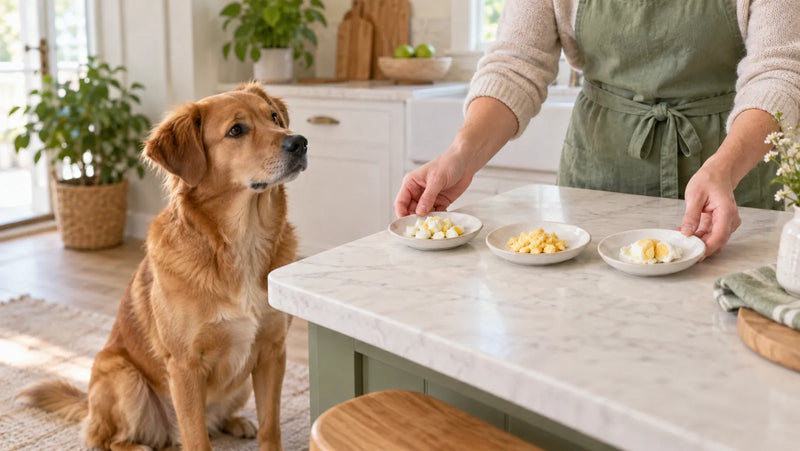

How to cook turkey for dogs: before brine, butter, seasoning, stuffing, or gravy enters the workflow, set aside an unseasoned piece of boneless, skinless turkey breast. Bake it at 325°F or higher, or gently simmer it in plain water, until the thickest part reaches 165°F on a food thermometer. Cool it, inspect it, dice the measured same-day amount, and freeze the remainder in small portions.
The separate portion is the entire Thanksgiving strategy. Do not try to turn a pre-basted, brined, injected, smoked, stuffed, buttered, or seasoned family bird back into plain turkey by rinsing or trimming it. If no truly plain portion was reserved, skip the turkey and use the dog’s usual food or a familiar labeled reward.
How to Cook Turkey for Dogs: The Thanksgiving Method at a Glance
- Reserve it first. Choose unbrined, unseasoned, boneless, skinless turkey breast and move the dog’s portion to its own clean dish before the family recipe begins.
- Keep the recipe plain. Add no salt, oil, butter, broth, bouillon, herbs, onion, garlic, chives, leeks, sauce, glaze, stuffing, or gravy.
- Cook to temperature. Bake in an oven set to at least 325°F or gently simmer in plain water. Verify 165°F in the thickest part.
- Cool and inspect. Use clean tools and remove every trace of skin, bone, cartilage, string, clip, and drippings.
- Dice for the individual dog. Cut a few easy-to-manage pieces; size does not determine the calorie allowance.
- Measure the day before serving. Put the full approved same-day amount in one container and count it with every other extra.
- Chill or freeze promptly. Refrigerate within two hours and freeze surplus in small measured portions.
The turkey safety and accidental-exposure guide owns the separate questions about which dogs can have turkey, seasoned meat, skin, bones, and what to do after a holiday accident.
Reserve the Dog’s Portion Before the Family Recipe Begins
The lowest-friction choice is a small boneless, skinless turkey breast cutlet or tenderloin sold without a flavor solution. Read the package before buying. Terms such as “pre-basted,” “self-basting,” “injected with a solution,” “enhanced,” “seasoned,” “marinated,” “smoked,” “cured,” and “deli” mean it is not the plain starting point this method requires.
If the family bird will be brined, rubbed, buttered, stuffed, or roasted over aromatics, reserve a separate raw breast portion before any of that begins. Place it in its own covered container in the refrigerator, use a separate small pan, and identify it clearly for the person cooking. Do not cut a slice from the seasoned roast later and assume the center escaped the brine or drippings.
A separate boneless portion creates fewer opportunities for seasoning contact, hidden bones, and guest confusion than carving from a whole Thanksgiving bird.
Thaw and Prepare Raw Turkey Safely
Thaw frozen turkey in the refrigerator, in cold water inside leak-proof packaging, or in the microwave followed by immediate cooking. Never thaw it on the counter. USDA FSIS turkey guidance recommends allowing about one refrigerator day per four to five pounds for a whole bird; a smaller breast still needs enough protected refrigerator time to thaw throughout.
Do not wash raw turkey. Splashing can spread raw juices around the sink and nearby food-prep area. Keep the raw board, knife, dish, tongs, hands, package, and absorbent pad away from cooked food, produce, the dog’s bowl, serving utensils, and the clean plate that will receive the finished portion.
Wash hands with soap and water for at least 20 seconds after handling raw poultry, then clean contacted surfaces and utensils. Keep the dog out of the prep zone and away from wrappers, string, and pads.
Method 1 — Bake Plain Boneless Turkey Breast
- Heat the oven to 350°F. This is above the CDC minimum oven setting of 325°F for roasting turkey.
- Place the thawed, unbrined, boneless, skinless turkey breast portion in a clean small baking dish or on parchment. Do not add oil, butter, salt, broth, vegetables, herbs, foil packets, rub, or marinade.
- Keep it separate from the family bird and its pan juices. If both pans share an oven, position them so no drips, baste, or utensil crosses between them.
- Begin temperature checks according to the cut’s thickness and package cooking guidance. Insert a clean food thermometer into the thickest center without pushing through to the pan.
- Continue baking until every thick section checked reaches 165°F. Move the turkey to a clean plate or shallow container with clean tools.
There is no reliable universal bake time: thickness, starting temperature, oven, and pan change the clock. Color, clear juices, firmness, and a pop-up timer cannot replace the thermometer.
Method 2 — Simmer a Small Plain Turkey Portion
- Place a thawed boneless, skinless turkey breast piece in a clean saucepan and cover it with plain water.
- Bring the water to a boil, then reduce it to a steady gentle simmer. Add no broth, bouillon, salt, oil, herbs, onion, garlic, or vegetables.
- Turn a thick piece with raw-designated tongs as needed until it is nearly cooked. Do not use those tongs to move the finished meat unless they have been washed.
- Check the thickest center with a clean thermometer. Continue simmering until the entire piece reaches 165°F.
- Move the finished meat to a clean shallow dish. Discard the cooking water rather than treating it as a formulated broth or hydration remedy.
Simmering can create a moist texture that shreds easily; baking can create a firmer surface that dices neatly. Neither method changes the need for verified doneness, clean handling, prompt cooling, and an individual portion. Do not use raw or undercooked turkey as the shortcut around a seasoned family roast.
If You Cook a Whole Turkey, Use a Three-Point Temperature Check
For a completely thawed, unstuffed, unseasoned whole bird, use an oven set to at least 325°F and follow an official weight-based roasting chart for planning. USDA and CDC instruct cooks to verify 165°F in three locations without touching bone: the thickest part of the breast, the place where the body and thigh join while aiming toward the thigh, and the place where the body and wing join while aiming toward the wing.
Even if the turkey has a pop-up timer, use a food thermometer. A clock estimates workflow; the measured internal temperature establishes the endpoint. Clean the probe between raw or partly cooked checks and finished-food use according to the thermometer instructions. The FSIS thermometer guide lists 165°F for all poultry.
Remove Skin, Bones, Cartilage, String, and Drippings
A boneless, skinless breast minimizes the inspection job, but check the finished meat anyway. Remove any remaining skin, visible fat, tough connective tissue, cartilage, hard fragment, butcher’s string, elastic tie, clip, thermometer part, absorbent pad, foil, or packaging. Keep pan drippings and the fatty surface layer out of the dog’s portion.
When meat comes from a truly plain whole bird, work under good light and pull it into small sections before dicing. Turkey ribs, wing and leg joints, the back, wishbone, neck opening, and cavity can hide small bones. If a hard piece cannot be identified with confidence, discard it. Grinding or blending does not make an uncertain cooked-bone fragment safe.
Dice the Turkey for the Dog in Front of You
Let the turkey cool until it can be handled safely, then use a clean board and knife. Dice or shred the approved amount into pieces the dog can swallow comfortably without gulping or prolonged chewing. A small dog or fast eater needs smaller delivery pieces than a calm large dog, but neither dog earns more calories because the cubes look tiny.
- For a topper: finely shred the measured amount and scatter it over complete food instead of covering the whole bowl.
- For training: cut the measured allowance into many small pieces and keep only the session amount in the pouch.
- For a first taste: offer one small piece when the dog is otherwise well and keep the rest of the diet familiar.
Do not season the turkey or mix it with holiday sides. Turkey is a supplemental extra, not a complete meal or an automatic bland diet.

Measure the Same-Day Amount Before Serving
Put the dog’s entire approved turkey allowance for the day into one container before guests arrive. Every piece comes from that container; when it is empty, turkey service is over. This prevents several people from each offering “just one bite” and makes it possible to track what the dog actually received.
WSAVA’s treat guidance says treats should supply no more than 10% of a dog’s daily calories. Turkey shares that ceiling with training rewards, chews, toppers, table tastes, and food used for medication. Ten percent is not a target, and it is not a separate allowance for each person or each extra.
There is no universal cube, spoon, or ounce allowance. Use the daily dog-treat calorie guide to organize one extras budget, or ask the veterinary team for the dog’s current number.
Cool, Refrigerate, and Freeze Small Portions
Refrigerate or freeze cooked turkey within two hours of cooking, or within one hour when the surrounding temperature is above 90°F. Do not leave a breast or carved bird on the counter through dinner and dessert. Cut large amounts into smaller pieces and use shallow covered containers so the food cools quickly.
FSIS leftovers guidance gives three to four refrigerated days and three to four frozen months for properly handled leftovers. Keep the refrigerator at 40°F or below and the freezer at 0°F or below. Storage time does not rescue turkey that sat out too long or had uncertain raw-to-cooked handling.
- Same-day container: hold only the dog’s measured approved amount, covered and refrigerated until needed.
- Short refrigerator supply: store in a shallow sealed container and use within three to four days.
- Freezer portions: divide into one-use amounts, seal, label with the cook date and weight, and freeze promptly.
- Thawing: move the next portion to the refrigerator. If microwaved, heat safely, check for hot spots, and cool before offering.
- Discard: throw away turkey with unknown timing, leakage, slime, mold, off odor, or uncertain identity; do not taste-test it for the dog.
Keep Stuffing, Casserole, Gravy, and Guest Plates Separate
Create two physical lanes: one clean lane for the plain turkey and one for the family meal. Use separate dishes and utensils, cover the dog’s portions, and remove them from the carving station before stuffing, gravy, skin, bones, string, foil, and guest plates accumulate.
Give guests one instruction: only the designated caregiver feeds the dog, and only from the approved container. Secure the carcass and trash in a lidded bin the dog cannot open. For the rest of the menu, use the Thanksgiving foods dogs can eat and must avoid guide and the broader toxic foods for dogs reference.
Prepared side dishes are not equivalent to their plain vegetables or bread. The green bean casserole recipe audit covers fried onions, cream soup, salt, dairy, and fat, while the stuffing safety guide covers alliums, raisins, nuts, fat, salt, broth, and physical hazards. Keep both dishes out of the plain-turkey lane.
Turkey Necks Require a Different Decision
Do not apply a boneless-breast recipe to a whole turkey neck. A cooked neck remains a cooked bone-in item with many small vertebrae; simmering, baking, slow-cooking, or pressure-cooking does not turn it into inspected boneless breast meat.
The turkey-neck cooking and bone-safety guide explains why the cooked bone-in answer is the wrong one and how to separate any boneless meat before cooking. Keep the raw neck, giblet package, and carcass secured while preparing the holiday meal.
When Plain Turkey Is Still the Wrong Extra
Ask the veterinary team before adding turkey when a dog eats a prescription or elimination diet, has a known or suspected turkey reaction, has pancreatitis history or a low-fat plan, is growing, pregnant or nursing, needs weight control, or has kidney, liver, gastrointestinal, swallowing, or other medical restrictions. “Plain” describes preparation; it does not override the individual diet.
Do not use turkey as a home treatment for vomiting, diarrhea, appetite loss, pain, or weakness. It is also not a novel protein if it has appeared in prior foods, treats, broth, flavors, or table scraps.
A No-Cook Chicken Topper Alternative
If Thanksgiving cooking is already crowded and the dog reliably tolerates chicken, the current American Paws Chicken Meal Topper is a dry freeze-dried crumble made from 100% USA chicken breast. Its product page lists it for dogs as a meal topper at approximately 25 kcal per teaspoon.
It is not turkey, it does not add moisture, and it is not a complete meal. Follow the exact current label, measure it with the day’s other extras, and skip it for a dog avoiding chicken or following a veterinary diet. You can also browse the current American Paws dog treats by exact product, ingredient, and texture.
Frequently Asked Questions
Can I cook turkey breast for my dog in the oven?
Yes, when the individual dog’s diet allows it. Use an unbrined, unseasoned, boneless, skinless breast portion in its own clean dish, add nothing, and bake in an oven set to at least 325°F until the thickest part reaches 165°F.
How long should I boil turkey for dogs?
Use time only to plan. Thickness, starting temperature, saucepan, water volume, and piece size change the minutes. Gently simmer the plain boneless portion and continue until a clean thermometer reads 165°F in the thickest center.
What temperature should turkey reach for dogs?
All turkey meat should reach 165°F. For a whole bird, check the thickest breast and the thigh/body and wing/body junctions without touching bone. Do not rely on color, clear juices, tenderness, a clock, or a pop-up timer.
Can I use Thanksgiving turkey for my dog?
Only use meat kept truly plain from the start: not brined, enhanced, stuffed, buttered, seasoned, glazed, smoked, cured, or sitting in drippings. The most controlled method is a separate boneless, skinless breast portion reserved before the family recipe begins.
Can dogs eat turkey skin or cooked turkey bones?
Do not include either. Skin and drippings concentrate fat and often carry seasoning, while cooked bones can splinter, choke, injure, or obstruct. Inspect the cooled meat from several angles and discard every questionable hard fragment.
How much cooked turkey can a dog have?
There is no universal cube or spoon count. Keep all extras together at no more than 10% of the dog’s veterinarian-confirmed daily calories, and use less when possible. Pre-measure one same-day container and subtract every other treat and topper.
How long does cooked turkey last in the refrigerator?
Properly handled cooked turkey can be refrigerated in a covered shallow container at 40°F or below for three to four days. Refrigerate it within two hours of cooking, or within one hour above 90°F.
Can I freeze cooked turkey for my dog?
Yes. Freeze only promptly cooled, inspected plain meat. Divide it into small measured portions, seal and date them, and use within three to four months for best quality. Thaw the next portion in the refrigerator.
Reserve It Plain, Verify 165°F, and Portion Before the Table
The dependable Thanksgiving workflow happens before dinner: reserve a separate unbrined boneless breast portion, cook it without additions, verify 165°F, remove every skin and bone hazard, measure the day’s allowance, and freeze the surplus promptly. That keeps the dog’s food out of the seasoned roasting pan and the uncertainty out of the serving decision.
Prefer a labeled no-cook option? If chicken fits the dog, compare the current single-ingredient freeze-dried chicken topper and follow its exact label. Whether the extra is turkey or topper, keep complete food in charge and stop when the pre-measured daily amount is gone.