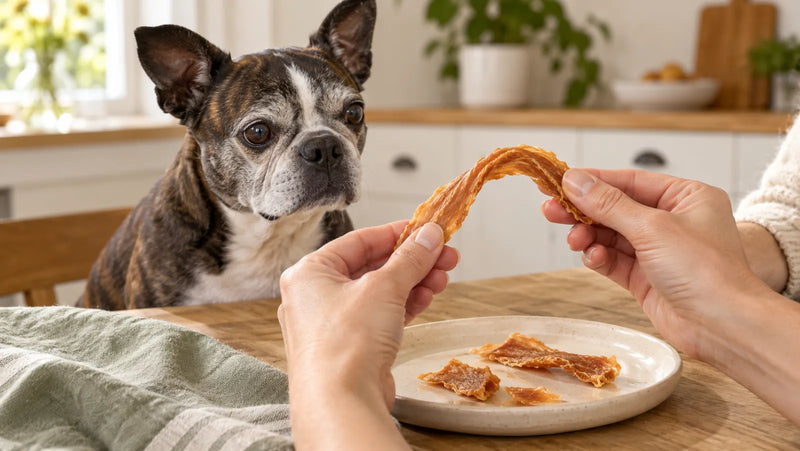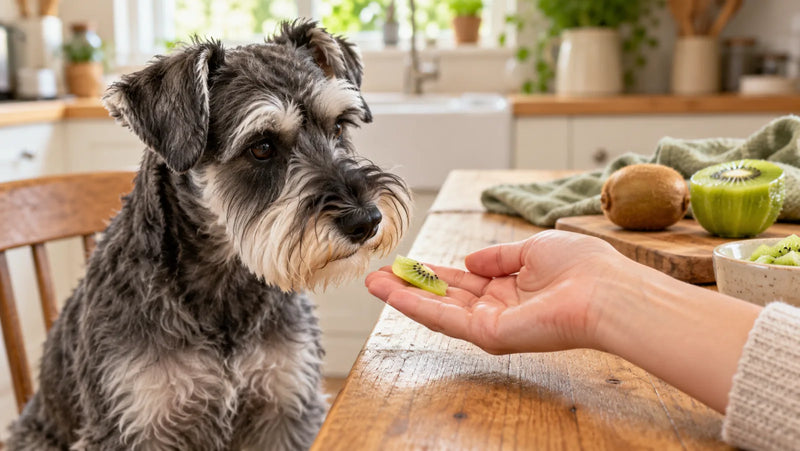

Can puppies eat strawberries? Some healthy, fully weaned puppies may try one or two tiny pieces of plain fresh strawberry after their veterinarian has cleared ordinary food treats. Wash the berry, remove the entire leafy cap and firm stem, cut a soft piece smaller than the puppy's usual training reward, and supervise. For the first exposure, offer just one piece.
“One or two” means prepared pieces—not one or two whole berries, a daily ration, or a target to increase. Skip a whole strawberry, canned berries in syrup, jam, pie filling, sweetened yogurt, candy, and frozen-hard fruit. Strawberry is optional variety; complete-and-balanced growth food remains the puppy's nutritional foundation.
Can Puppies Eat Strawberries Safely?
The strawberry itself is not classified as poisonous to dogs. The ASPCA plant database lists Fragaria strawberry species as non-toxic to dogs. That answers a toxicity question, but it does not make every form, amount, texture, or puppy a yes.
Use five gates before the first piece:
- Fully weaned: the puppy has finished the nursing-to-solid-food transition and reliably eats an appropriate growth diet.
- Well today: there is no current vomiting, diarrhea, poor appetite, unusual tiredness, abdominal discomfort, or other active illness.
- Diet allows extras: the veterinary team has not restricted food treats, and the puppy is not in an unapproved prescription or elimination-diet experiment.
- The fruit is plain and sound: use a fresh berry without mold, fermentation, leaking decay, syrup, sweetener, chocolate, dairy coating, or mixed-recipe ingredients.
- The piece fits the puppy: remove the cap and stem, make the flesh soft and very small, and watch one calm bite from pickup through swallowing.
| Strawberry form | Puppy decision | Reason |
|---|---|---|
| Fresh, washed, hulled, tiny soft piece | Possible after all five gates | Preparation and portion are visible and controlled |
| Whole fresh strawberry | Do not offer whole | It is too large and slippery for a controlled puppy trial |
| Leafy top and firm stem | Remove | They are fibrous, unnecessary, and can hide damaged fruit |
| Canned or syrup-packed strawberry | Skip | The syrup adds concentrated sugar and makes the portion harder to control |
| Jam, dessert, candy, or sweetened dairy | Skip | The full recipe, not the berry picture, determines the risk |
| Whole frozen-hard strawberry or clump | Do not offer | It is hard, cold, slippery, and poorly sized for a young mouth |
| Plain frozen berry, thawed soft and resized | Possibly | Only after the same readiness, label, preparation, and portion checks |
The adult question covers more body sizes and more processed-product scenarios. For a mature dog, use the complete strawberry guide for dogs. This page keeps the answer narrow for growth, weaning status, a small changing mouth, and a puppy-sized calorie budget.
Wash, Hull, Inspect, and Cut the Berry Small
Prepare the strawberry as carefully as food for the rest of the family. Begin with clean hands, a clean knife, and a clean board that has not just held raw meat. The FDA's produce-safety guidance says to rinse produce thoroughly under running water, cut away damaged areas, and keep raw produce separate from raw meat, poultry, seafood, and their utensils.
Do not wash strawberries with soap, detergent, bleach, or commercial produce wash. The FDA notes that produce is porous and does not recommend those products. Plain running water and gentle rubbing are the correct household step. Washing can reduce surface bacteria; it does not sterilize a moldy or rotten berry. Discard fruit that smells fermented, has fuzzy growth, leaks from decay, or has extensive damage.
After rinsing and drying the berry, lift off the green leaves and cut away the firm pale stem beneath them. The top is not being removed because strawberry leaves are classified as a canine poison. It comes off because the fibrous cap adds nothing to the trial, is awkward to resize, and can conceal a soft or damaged area.
Slice the berry lengthwise so the interior is visible. From one sound section, cut a thin, flat, soft piece smaller than the puppy's normal training reward. For a very small puppy, uncertain chewer, or fast gulper, mash that one piece with a fork and serve the mash from a stable shallow dish or on top of a measured meal. Do not toss slippery fruit through the air, place it on a skewer, or create competition between puppies.

How Many Strawberries Can a Puppy Eat?
Begin with one tiny prepared piece. Offer it on a normal day after the puppy is settled into the usual growth food and when no other new ingredient is being tested. If the puppy has eaten strawberry before without digestive, skin, appetite, or behavior changes, one or two tiny pieces may be used for an occasional serving after the veterinarian agrees that fruit fits the plan.
Stop there. The puppy does not need to work up to a whole berry, and a large puppy has not earned an adult serving simply because the current body weight is higher. Strawberry sizes vary, puppy energy needs change quickly, and some young dogs gulp food regardless of body size. Piece preparation and the day's total calories matter more than a berry count.
| Situation | Conservative amount | Delivery |
|---|---|---|
| First-ever taste | One tiny piece | Soft, flat, smaller than the usual training reward, and supervised |
| Previously tolerated occasional taste | One or two tiny pieces | Offer one at a time; there is no need to increase |
| Very small, fast-gulping, dental, or swallowing concern | Ask first; fruit may not fit | If the veterinarian approves, mash a single tiny piece rather than offering a lump |
| Unknown amount or a bowlful stolen | Not a serving plan | Call the veterinary team with the puppy's weight, time, amount, form, and symptoms |
The World Small Animal Veterinary Association's dog-treat guide recommends keeping treats at no more than 10% of daily calories and asking the veterinary team when health conditions or a veterinary diet affect treat choice. Its printed body-weight examples are for average healthy adult dogs in ideal condition, so they should not be copied into a puppy calorie plan.
For a growing dog, calculate one shared extras ceiling from the puppy's current veterinary calorie target, then subtract every noncomplete extra: training rewards, chews, toppers, food used for medication, enrichment fillings, table tastes, and strawberry. The puppy treat-budget guide walks through that calculation without pretending that one piece count works throughout growth.
Natural Strawberry Sugar Still Counts
A fresh strawberry and a piece of candy are not equivalent, but fresh fruit still contributes naturally occurring sugar and calories. “Non-toxic” does not mean calorie-free, unlimited, or appropriate for every puppy. A bowl of fruit can crowd out the food designed for growth and can deliver more fiber and sugar than an unfamiliar digestive system handles comfortably.
Merck's feeding guidance for growing dogs explains that growth diets are designed with the nutrient density, digestibility, and bioavailability puppies need in a smaller volume of food. It also emphasizes individualized feeding and body-condition monitoring. Strawberry does not supply that balanced growth package and should never replace a meal.
There is no need to sell the taste as a vitamin supplement, hydration treatment, immunity booster, dental cleaner, weight-loss tool, or growth aid. A puppy already eating an appropriate complete-and-balanced diet does not need strawberries to prevent a deficiency. The honest purpose is small, optional flavor variety.
Why Canned Strawberries and Syrup Stay Out
Canned strawberries in light or heavy syrup carry an added sweet liquid into every bite. Draining or rinsing them does not recreate a fresh berry or show how much syrup remains in the softened fruit. Pie filling and fruit sauce are even harder to separate from added sugar, thickeners, flavorings, and other recipe ingredients. Choose one plain fresh berry instead.
Jam, jelly, sweetened yogurt, ice cream, smoothies, fruit leather, gummies, baked desserts, and chocolate-covered strawberries are mixed foods. Some add only unnecessary sugar and fat; others may include ingredients that need an urgent response. A strawberry picture on the package is not a safety verdict. Read the full ingredient list and keep the package if a puppy steals the product.
The adult strawberry safety article covers sugar-free products, xylitol, chocolate, and mixed-food triage in more depth. For a puppy, do not taste-test a processed product to see whether symptoms develop. Contact the veterinary team or an animal poison-control service with the exact label and amount.
Can Puppies Eat Frozen Strawberries?
Plain unsweetened frozen strawberry can only return to the “possible” column after it is thawed until soft, inspected, hulled if necessary, and cut again for the puppy. A whole rock-hard berry or frozen cluster is not a teething device. Its hardness, cold temperature, roundness, and slippery surface work against a controlled first bite.
Fresh fruit is simpler for a first exposure because texture and portion are easy to see. If using a previously frozen berry, press the final piece between clean fingers. It should flatten readily and contain no hard icy center. Serve one piece from a stable dish or open hand while the puppy is calm; never encourage catching or gulping.
Which Puppies Should Skip Strawberry or Ask First?
Do not start a casual strawberry trial before full weaning. Ask the veterinary team first when the puppy has diabetes, a weight-management plan, chronic vomiting or diarrhea, pancreatitis history, a known food reaction, dental pain, difficulty chewing or swallowing, or another condition that changes calories, fiber, sugar, or texture choices.
A puppy eating a prescription diet or completing a food-elimination trial needs explicit approval before any strawberry. Even an ingredient that is not toxic can undermine a controlled diagnostic diet or add calories that were not included in the treatment plan. A sick puppy, a puppy with poor appetite, or one recovering from a procedure needs the veterinary feeding plan—not a new fruit experiment.
Large- and giant-breed puppies remain in the growth stage longer and need careful control of body condition and growth nutrition. Strawberry does not solve a growth requirement. The puppy treat-selection guide helps compare readiness, delivery size, texture, calories, ingredients, and age without using the calendar or adult-looking teeth as the only permission.
Run One Clean First-Strawberry Trial
- Choose an ordinary day. The puppy should feel well, eat the normal growth food, and have no travel, vaccination reaction, medication change, or other new food confusing the observation.
- Prepare one sound berry. Wash, dry, remove the full cap and stem, inspect the inside, and reserve one tiny soft piece.
- Offer it calmly. Give the piece after or alongside the normal food, not to a frantic or competing puppy.
- Watch the swallow. Coughing, gagging, repeated attempts to swallow, pawing at the mouth, or breathing difficulty needs immediate attention.
- Observe afterward. Note vomiting, diarrhea, itching, facial swelling, appetite change, unusual tiredness, or behavior that is not normal for this puppy.
Do not introduce another new ingredient during the same observation period. If a mild change occurs, stop strawberry and call the veterinary team for advice. Breathing trouble, collapse, severe facial swelling, blue or very pale gums, repeated choking, or severe distress is an emergency.
What If a Puppy Steals Strawberries?
Identify the form before deciding what the word “strawberry” means. A few plain fresh pieces, a carton of moldy berries, fruit in syrup, jam, sugar-free candy, a chocolate dessert, and a smoothie are different exposures. Save the container or recipe, photograph the ingredients, estimate how much is missing, and record the time, puppy's current weight, and symptoms.
Call the veterinary team promptly for an unknown or large amount, repeated vomiting or diarrhea, a painful or swollen abdomen, marked lethargy, choking signs, any mixed product, or a label containing a concerning ingredient. Do not induce vomiting or give salt, oil, milk, hydrogen peroxide, activated charcoal, or another home remedy unless a veterinarian specifically directs it for this puppy.
If the theft was limited to one or two plain prepared pieces and the puppy is acting normally, the veterinarian may recommend observation. That likely outcome is not a reason to generalize it to syrup, desserts, moldy fruit, a whole carton, or a puppy with a medical condition.
Strawberry and Watermelon Need Different Prep
“Fruit” is not one preparation rule. Strawberries need their leafy cap and firm stem removed; watermelon needs every bit of rind and visible seed removed. The watermelon guide for puppies also explains why one soft piece does not treat dehydration and why a frozen cube must not become a hard teething object.
For the wider map—safe flesh, toxic fruits, pits, cores, seeds, skins, rinds, and processed products—use the dog fruit safety guide. Then return to the puppy's weaning status, mouth, calorie plan, and veterinary restrictions before sharing any optional fruit.
Fruit Is Not Always the Best Training Reward
Strawberry pieces are wet, slippery, variable in size, and quick to crush in a pocket. Those qualities can make them inconvenient for repeated reinforcement even when one taste is appropriate. Measured growth-food kibble is often the simplest first training reward because it already belongs to the daily diet.
When a separate reward is useful, browse the current American Paws training-treat collection, then check the exact product's intended species, full ingredient statement, calories, texture, and breakability against the puppy's plan. A collection name is not blanket approval for every puppy. All selected dog treats and fruit tastes still share one extras budget.
You can also compare the wider American Paws dog-treat assortment, but verify each item rather than assuming the full catalog has one texture, calorie value, or puppy fit. The right reward is the one that can be made small, eaten comfortably, counted accurately, and cleared for that individual puppy.
Frequently Asked Questions
Can an 8-week-old puppy eat strawberries?
An eight-week birthday alone is not permission. The puppy must be fully weaned, reliably eating an appropriate complete growth diet, healthy that day, able to manage the texture, and cleared by the veterinarian for ordinary food treats. If every gate is met, begin with one tiny mashed or soft-cut piece.
How many strawberries can a puppy eat?
Use one tiny piece for the first trial. A puppy that has already tolerated strawberry may have one or two tiny pieces at an occasional serving if the veterinary plan allows it. These are pieces, not whole berries, and not a daily prescription or maximum safe dose.
Can a puppy eat a whole strawberry?
Do not offer it whole. A full berry is slippery, varies widely in size, and prevents careful portioning for a young mouth. Wash it, remove the entire cap and firm stem, inspect it, and cut one soft flat piece smaller than the puppy's usual training reward.
Can puppies eat strawberry tops or leaves?
ASPCA lists the strawberry plant as non-toxic to dogs, but the fibrous leafy cap and firm stem are unnecessary and awkward to resize. Remove both before serving. Call the veterinarian after a large plant-material ingestion, pesticide concern, or any persistent symptoms.
Can puppies eat frozen strawberries?
Only if the fruit is plain and unsweetened, then thawed until soft, inspected, hulled, and cut into a tiny piece. Do not give a whole frozen-hard berry or clump as a teething chew. Fresh strawberry is easier to control for a first trial.
Can puppies eat canned strawberries?
Skip canned strawberries in light or heavy syrup, as well as pie filling and fruit sauce. They add concentrated sugar and mixed ingredients, and draining does not turn them back into fresh fruit. Use one washed fresh berry to prepare a tiny piece instead.
Can strawberries give a puppy diarrhea?
Yes. Too much fruit or an unfamiliar food can lead to loose stool, vomiting, or abdominal discomfort even though strawberry is non-toxic. Stop the fruit and contact the veterinarian for repeated symptoms, pain, lethargy, poor appetite, dehydration concern, or any worsening change.
Can puppies eat strawberries every day?
They do not need to. An occasional one- or two-piece taste may fit some puppies, but complete growth food remains primary and every extra shares the same calorie ceiling. Ask the veterinary team before making any human food a routine part of a growing puppy's day.
Keep the First Strawberry Small and Observable
The puppy-safe version is specific: fully weaned, healthy, cleared for extras, and offered one washed, hulled, soft-cut piece under supervision. If that trial is tolerated, one or two tiny pieces are still enough for an occasional taste. Whole berries, leafy tops, syrup, canned fruit, desserts, and frozen-hard pieces stay out.
Ready for a reward that is easier to label, count, and carry? Browse training treats, then use the puppy treat screen to choose by readiness, ingredient, calorie, delivery size, and texture.