
A dog advent calendar can be a safe December countdown when each of its 24 doors represents one tiny, familiar reward already counted inside that day’s treat budget. It is not an extra meal or a second treat allowance. Calculate the dog’s normal daily extras ceiling, subtract training rewards, chews, toppers, and medication treats already planned, and put no more than the remainder behind that day’s door.
Build the calendar for a person to open, not for a dog to tear apart. Use clean food-safe compartments, load only treats that can remain safe in that storage format, and keep the entire organizer out of reach. Human chocolate and sugar-free advent calendars stay in a separate closed cabinet.
Dog Advent Calendar: The Safe DIY Plan
American Paws does not sell a ready-made advent calendar or a pre-portioned 24-pack. This guide shows how to build your own from a sturdy organizer and real treats whose ingredients, calories, size, and storage instructions you can verify.
The countdown has four jobs: control one daily portion, preserve the original product information, prevent moisture and package access, and make the ritual enjoyable without changing the dog’s balanced meal plan. A decorative box that fails any of those jobs is not improved by having 24 doors.
Keep this intent narrow. If you are filling one Christmas stocking, use our dog-stocking selection guide. If you are choosing a present by age, size, or chewing style, see the dog gift guide by size and chewing style. For a party with guests, table food, and trash to manage, use the holiday dog-treat safety plan. This page owns the 24-day calendar routine.
Do the 24-Day Treat Math Before You Build
The WSAVA treat guide says treats should stay below 10% of a dog’s daily calories and should never replace a complete meal. That limit covers all extras together. The calendar is one line in the daily total, not a holiday exception.
Use the individual dog’s daily calorie plan
Start with the calorie target already used for this dog’s complete food. If you do not know it, ask the veterinary team rather than copying a social-media chart. Puppies, overweight dogs, dogs on prescription diets, and dogs with medical conditions may need a different plan from a healthy adult at ideal body condition.
Treat 10% as a ceiling, not a goal. A dog does not need the full amount just because the calendar exists. Our daily treat-calorie guide explains the broader calculation and how to account for different treat sizes.
Subtract first; do not add a holiday bonus
For each day, use this sequence:
- Find 10% of the dog’s established daily calorie target.
- Add the calories in training rewards, chews, toppers, table tastes, and medication treats planned for that day.
- Subtract that extras total from the ceiling.
- Put no more than the remaining calories in the calendar door. If no room remains, use a nonfood token for a walk, sniff game, brushing session, or a few pieces taken from the measured meal.
For example, suppose a dog’s established plan is 600 kcal per day. Ten percent is 60 kcal for all extras. If training rewards and a chew already use 45 kcal, that day’s calendar reward must fit inside the remaining 15 kcal; it does not receive another 60 kcal. This example is arithmetic, not a feeding recommendation for every dog.
Reset the subtraction every day. Do not multiply 60 by 24, call the result a monthly bank, and move unused calories into Christmas Eve. Twenty-four doors organize twenty-four daily decisions.
Choose Calendar Treats That Are Small, Familiar, and Countable
Use one or two proteins and formats the dog already tolerates. A calendar is a poor time for 24 new ingredients because a reaction becomes hard to trace. Check calories per piece or per weight, then make every daily portion appropriate for the dog’s size and swallowing habits.
Naturally small single-ingredient training pieces
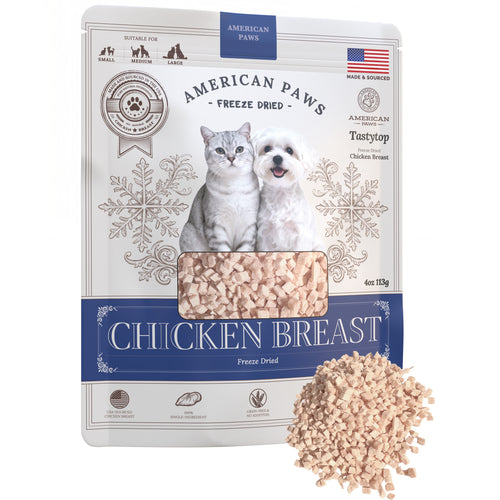
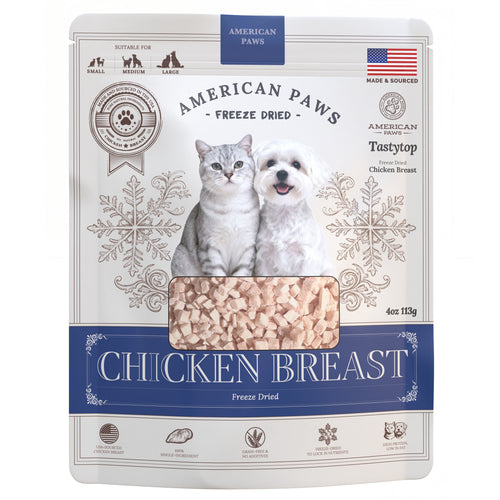
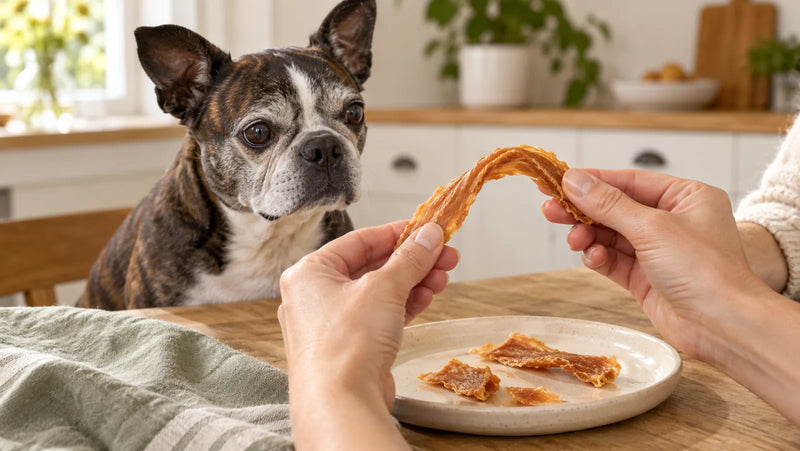
Small freeze-dried pieces are easy to count and can often be divided into micro-rewards. American Paws single-ingredient freeze-dried chicken training pieces are made from 100% USA chicken breast and arrive in naturally small pieces. They fit a chicken-tolerant dog, not a dog avoiding chicken or following an unapproved elimination diet.
Browse the current training-treat collection for other size-aware options. “One piece” is not a calorie unit: weigh or divide irregular pieces when a dog’s allowance is tight.
Soft chicken jerky resized with clean kitchen shears
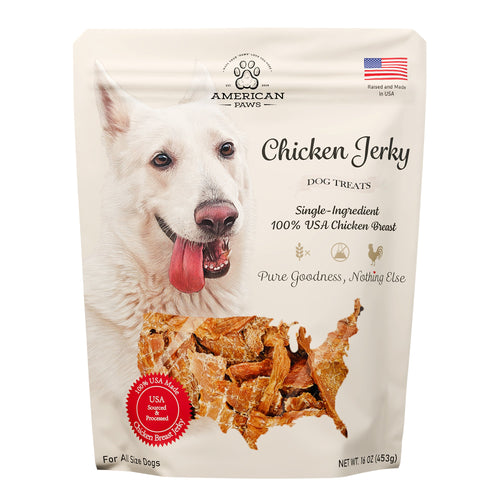
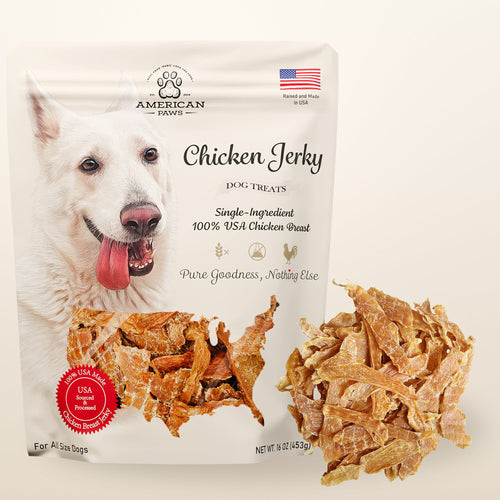
Long strips can work when the exact product cuts cleanly. American Paws soft chicken jerky strips you can snip into smaller bites are designed to be cut with scissors. The current recipe contains USA chicken plus a touch of natural glycerin, so it is all-natural but not single-ingredient. Keep that distinction intact when comparing it with the freeze-dried chicken.
Use clean, dry kitchen shears, make pieces appropriate for the dog, and discard a piece that becomes sharp, excessively hard, or too small to handle safely. Do not pre-cut all 24 days if the product label tells you to preserve the strips in their original resealable package.
Formats to keep out of room-temperature doors
Soft, moist, refrigerated, frozen, or homemade treats do not become shelf-stable because a paper door closes. Follow the exact recipe or package instructions. If a treat belongs in the refrigerator or freezer, put a paper token in the calendar and retrieve the food from safe storage at serving time.
This article does not supply a Christmas-cookie recipe or invent a 24-day room-temperature shelf life. A visibly damp, moldy, rancid-smelling, unusually soft, leaking, or otherwise changed treat is discarded.
Build a 24-Compartment Calendar the Dog Cannot Raid
- Choose a stable outer organizer. A 6-by-4 drawer box or lidded tray creates 24 compartments. It stays on a shelf or counter the dog cannot reach.
- Use food-safe inner containers. Select 24 clean, dry, lidded cups or small resealable food bags that fit inside the organizer. Bare painted wood, glittered paper, and craft foam should not touch food.
- Calculate before filling. Make a private human checklist with each date, product, calories, and piece count. Do not rely on visual memory.
- Remove swallowable hardware. Do not use loose staples, magnets, batteries, ribbon, string, wire, bells, buttons, ornaments, or detachable number tiles.
- Keep packaging out of the doors. Never place a desiccant, oxygen absorber, thin film wrapper, or loose sachet beside the treat.
- Load with clean, dry hands and tools. Moisture carried in on fingers or shears defeats the storage plan.
- Close the outer box. The calendar is a human-managed organizer, not an enrichment toy the dog opens.
- Store the source package. Keep the original label, lot code, best-by date, calories, ingredients, and feeding directions until day 24 is finished.
Option A: load one dry week at a time
For dry commercial treats whose label permits cool, dry storage, portion seven closed inner containers at a time. Keep the remaining treats sealed in the original bag and refresh the next week with clean, dry tools. The 24 drawers can still mark the full countdown; only the current week needs food inside.
Option B: use tokens and keep food in its original bag
This is the safest option for freshness and traceability. Put a small paper token behind each door, keep every treat in its original package, and measure the day’s piece after opening the door. The person handles and discards the token; it is never given to the dog. This also works for refrigerated rewards and days when the “treat” comes from the measured meal.

Keep the Treats Dry and the Product Information Intact
The FDA’s pet-food and treat storage guidance recommends retaining the original bag or container so the product name, manufacturer, UPC, lot number, and best-by date remain available. If dry food is transferred, the new container should be clean, dry, tightly lidded, and stored in a cool, dry place below 80°F.
The calendar does not replace the package instructions. Keep it away from a sunny window, stove, dishwasher steam, humid bathroom, garage temperature swings, and the dog’s nose. Wash and completely dry measuring tools and reusable cups between batches. If there is a recall or quality problem, the original package is how you identify what the dog ate.
Never Mix a Human Advent Calendar into the Dog Setup
The ASPCA’s people-food hazard guide lists chocolate, grapes and raisins, xylitol, and other foods that can seriously harm dogs. A human chocolate or candy calendar is never a substitute for a dog calendar, even if one piece looks small.
“Sugar-free” is not a safety claim. The FDA’s xylitol warning notes that this sweetener can appear in sugar-free candy and baked goods and can cause a rapid, dangerous drop in a dog’s blood sugar. Store human and dog calendars in different closed locations so they cannot be confused during a busy morning.
If a dog eats chocolate, a sugar-free item, xylitol, grapes, raisins, an unknown candy, or several wrappers, call a veterinarian or emergency animal hospital immediately. ASPCA Animal Poison Control is available at 888-426-4435. Keep the package, ingredient list, estimated amount, dog’s weight, and exposure time ready. Do not wait for symptoms and do not induce vomiting unless a veterinary professional directs you.
Calendar parts matter too. The VCA holiday-safety guide warns that foil, indigestible wrapping, ribbon, and string can contribute to dangerous gastrointestinal problems. A person opens the door and removes every wrapper or craft piece before the dog approaches.
How to Use One Door Each Day
- Check the day’s planned training, chew, topper, and medication-treat calories.
- Open one door while the dog waits away from the organizer.
- Confirm that the compartment is dry and the treat looks and smells normal.
- Serve one appropriately sized portion by hand or use it during a short training cue.
- Close the calendar, discard any token or inner wrapper, and return the organizer to secure storage.
If someone else gives an unplanned treat, reduce or skip the calendar portion rather than rolling it into tomorrow. The ritual can still happen with a nonfood token and a short game.
What to Check in a Ready-Made Dog Advent Calendar
A commercial calendar can be evaluated without assuming that every product is good or bad. Before buying, check:
- a complete ingredient list for every flavor, including hidden protein changes;
- calories per piece or a manufacturer willing to provide them;
- piece dimensions and texture appropriate for the individual dog;
- feeding and storage directions that cover the whole countdown;
- a best-by date, manufacturer contact, and traceable lot information;
- secure inner packaging that a person opens and promptly discards;
- no chocolate, cocoa, xylitol, grapes, raisins, candy, or human-food crossover.
Twenty different flavors may look festive but can make intolerance difficult to identify. Familiarity and measurable calories are better buying criteria than door artwork.
Frequently Asked Questions
Can I put homemade dog cookies in all 24 doors?
Not unless a tested recipe and storage plan specifically support that use. Many homemade treats need refrigeration or freezing and do not have a verified 24-day room-temperature life. Use token doors and retrieve them from proper storage instead.
Can puppies use a dog advent calendar?
Ask the veterinary team and protect the puppy’s complete growth diet. If approved, use a tiny familiar piece or measured kibble and keep every drawer, wrapper, string, and small component out of reach.
What if my dog opens several doors at once?
Remove the calendar, identify the products and amounts eaten, and call the veterinarian if the dog consumed a large quantity, unknown ingredients, wrappers, or craft parts. Do not assume that small compartments make a multi-door raid harmless.
Can I mix several proteins for variety?
You can use already tolerated proteins when the calorie and storage plan works, but variety is optional. Keep a simple daily record so a digestive or skin reaction can be traced. Do not mix proteins during a veterinarian-directed elimination trial.
Make the Countdown Small, Secure, and Repeatable
A good dog advent calendar creates 24 calm moments without creating 24 nutritional surprises. Set the daily ceiling, subtract other extras, choose a familiar label, keep the food dry, let a person open one secure door, and return the organizer out of reach.
American Paws does not sell a ready-made advent calendar. You can build a truthful DIY version from our current training formats or browse all current American Paws dog treats, then select only what fits your dog’s ingredients, size, and calorie plan. Preserve the source package through day 24, and ask the veterinary team before using any new treat with a prescription diet or medical condition.