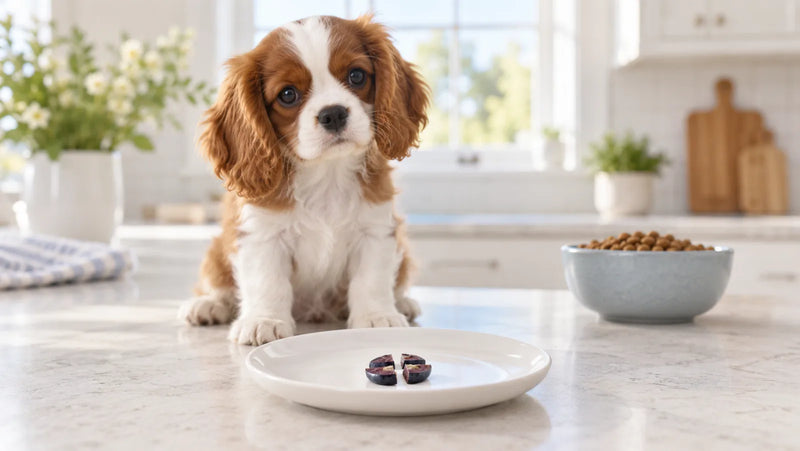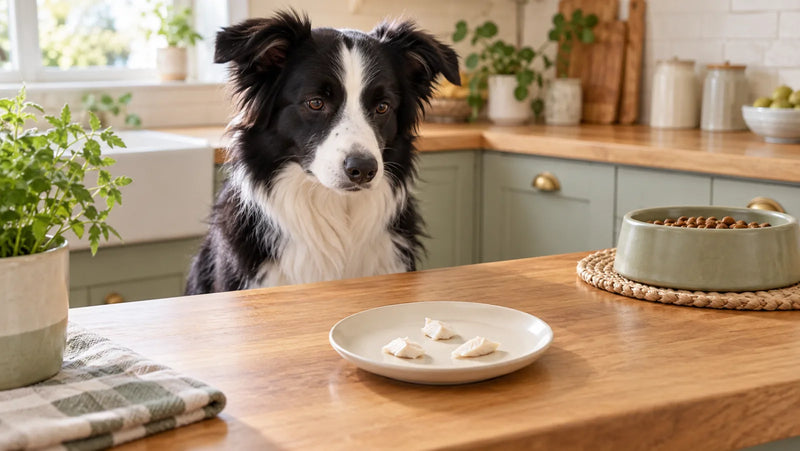

How to prepare sweet potatoes for dogs is simple: wash the whole root under running water, remove the skin before serving, and steam, boil, or bake the flesh until it mashes easily with a fork. Let it cool completely, then mash or recut one small plain portion for your dog.
Do not add butter, oil, salt, sugar, syrup, sweet spice blends, onion, or garlic. Count the portion with every other treat your dog receives that day. Cooking method matters less than the final standard: plain, peeled, soft all the way through, cool, and sized for the individual dog.
How to prepare sweet potatoes for dogs: the short version
- Choose a firm sweet potato without mold, leaking areas, or major soft spots.
- Wash your hands, then rinse the whole root under plain running water.
- Peel before cutting, or bake in the skin and remove every bit of skin after cooking.
- Steam or boil even cubes, or bake the whole root, with no added ingredients.
- Cook until the center yields easily and a fork can flatten the flesh without effort.
- Cool completely before serving.
- Mash or cut one small portion to suit the dog's size and chewing habits.
- Introduce it slowly and include its calories in the day's total extras.
This is an occasional supplemental food, not a complete meal and not something a dog needs to eat. If your dog has diabetes, gastrointestinal disease, a weight plan, a food sensitivity, a prior obstruction, or a prescription diet, ask the veterinary team before adding it.
Before cooking: wash, inspect, and peel
Safe preparation begins before the sweet potato reaches the pot. Use a clean cutting board and utensils, wash your hands, and keep produce away from surfaces that held raw meat or poultry. A clean kitchen routine protects both the person preparing the food and the dog eating the finished portion.
Wash before the peeler or knife touches the root
The FDA's produce-safety guidance says to wash produce thoroughly under running water before peeling or cutting it. That matters even when the skin will be discarded, because a peeler or knife can move dirt and bacteria from the outside to the flesh.
Use plain running water, gently rubbing the surface. Do not use dish soap, detergent, or commercial produce wash; the FDA does not recommend them for porous produce. Cut away a small superficial bruise, but discard a root that is moldy, rotten, leaking, or broadly soft.
Cook with or without the skin, but remove it before serving
The conservative serving choice is skin removed. The AKC's current sweet-potato guidance recommends cooked flesh with the skin removed because the skin can be harder for a dog to digest. The skin is not being called poisonous here; it is a texture and digestibility decision.
For steaming or boiling, peel first and cut even cooking cubes. For baking, the skin helps hold the root together, so it can stay on in the oven. After the baked root is cool enough to handle, scoop out the soft flesh or peel the skin away completely before making the dog's portion.
Raw pieces do not belong in this method. If you need the separate safety explanation or your dog stole a raw chunk, read why raw sweet-potato chunks are not recommended. That article covers chewing, stomach, choking, and obstruction concerns without turning this preparation guide into an ingestion-triage page.
Steam, boil, or bake? A quick comparison
| Method | Practical advantage | Watch for | Done when |
|---|---|---|---|
| Steam cubes | Easy to check several same-size pieces | Water running dry; uneven cubes | Every center mashes easily |
| Boil cubes | Simple and usually fastest | Overcooking into watery pieces; added salt | Fork slides through; cubes drain soft |
| Bake whole | Minimal cutting before cooking | Large roots taking longer; hot center | Flesh is soft from edge to center |
None of the three methods is automatically best for every dog. Steaming and boiling make it easy to test cubes. Baking is hands-off and makes the skin simple to remove after cooling. Choose the method that helps you create a plain, fully soft result without adding a glaze, fat, salt, or seasoning.
Method 1: Steam sweet-potato cubes until mashably soft
Peel the washed sweet potato and cut the flesh into even cubes about 1 inch across. That is a cooking size, not the final serving size. Even pieces finish more predictably than a mix of thin slivers and thick chunks.
- Add water to a pot below the level of the steamer basket.
- Bring the water to a simmer.
- Place the plain cubes in the basket and cover the pot.
- Steam for roughly 15–30 minutes, beginning to check at the early end.
- Test cubes from more than one part of the basket.
- Remove them only when a fork flattens the centers easily.
- Spread a small portion on a clean plate to cool, then mash or recut it.
Oregon State University Extension gives a broad 15–30 minute range for steamed cubes. Cube size, the strength of the simmer, basket depth, altitude, and cookware change the clock. If one center stays firm, continue steaming; do not serve an undercooked piece just because the timer ended.
Method 2: Boil plain cubes and drain them well
Peel the washed root and cut even cubes about 1 inch across. Place them in a clean saucepan and cover with plain water. Do not salt the water and do not use broth, bouillon, onion powder, garlic powder, or a seasoning packet.
- Bring the water and cubes to a controlled boil, then maintain a gentle simmer.
- Begin checking around 12 minutes; many batches need closer to 15–20 minutes.
- Press a fork through the center of a larger cube.
- When all sampled centers yield easily, drain the cubes thoroughly.
- Let them cool in a single layer before making a dog-size portion.
Do not treat orange cooking water as a special broth for the dog. It may be hot, carries no measured serving plan, and can make it harder to control the extra. Drain the cubes, cool the flesh, and offer only the small prepared portion.
Method 3: Bake a whole sweet potato without toppings
Baking works well when you want to avoid peeling a hard raw root. Wash and dry the sweet potato, prick the skin several times with a fork so steam can escape, and place it on a parchment-lined baking sheet. Do not rub it with oil, salt, butter, or a sweet coating.
- Heat the oven to 400°F.
- Bake the whole root for roughly 40–50 minutes as a starting range.
- Check the thickest part. A larger root may need longer.
- Remove it only when the center is completely soft.
- Let it cool until it can be handled safely.
- Open the skin, scoop out the flesh, and discard the skin.
- Mash or recut a small cooled portion for the dog.
Clemson Cooperative Extension's sweet-potato factsheet uses 400°F and about 40–50 minutes for baking, while emphasizing softness. Home ovens, altitude, and root size vary. A clock estimate helps you plan; it cannot inspect the center.

The fork test matters more than the clock
A sweet potato can look soft at the edge and remain firm in the middle. Test a thick cube or the deepest part of a baked root. The fork should slide through without resistance, and gentle pressure should flatten the flesh into a smooth mash.
If the fork meets a dense core, keep cooking. If the outside has fallen apart but the center is firm, the pieces were too uneven. For the next batch, cut cooking cubes to a more consistent size. Do not try to solve undercooking by serving a large firm piece to a bigger dog.
After cooking, temperature is a second test. Split a cube or mash the portion so hidden heat can escape, then wait until it is fully cool. Never hold a sample to a dog's mouth to see whether it feels cool enough.
What not to add to a dog's sweet potato
The safest recipe has one ingredient: plain sweet potato. Human side dishes are designed for human taste, and the additions can change calories, fat, sugar, salt, and safety.
Skip butter, oil, salt, sugar, syrup, and sweet spice blends
Butter and cooking oil add concentrated fat and calories that are unnecessary for softening the root. Salt, brown sugar, honey, maple syrup, corn syrup, and cinnamon-flavored syrup make portion control harder. Marshmallows and sweet glazes turn a small plain extra into dessert.
This guide does not claim that a tiny dusting of plain cinnamon is a poison. It skips cinnamon because no seasoning is needed, and it specifically avoids cinnamon-sugar blends, flavored syrups, and mixed spice products whose full ingredients may be unclear. Plain and one-ingredient is easier to assess.
Keep onion, garlic, and chives out completely
Onion, garlic, and chives are different from the unnecessary toppings above: they are toxic Allium ingredients. The ASPCA's people-food safety list explains that Allium species can irritate the gastrointestinal tract and damage red blood cells. Dogs are at risk, even though cats are more susceptible.
Check broth, seasoning packets, prepared mash, casseroles, leftovers, and spice blends for onion or garlic in any form. If your dog eats a sweet-potato dish containing an unsafe ingredient, record the product, ingredients, amount, time, and dog weight, then contact your veterinarian or animal poison control rather than relying on this plain-prep article.
Cut or mash the portion for the individual dog
Cooking cubes are not automatically serving cubes. Resize the cooled flesh after it passes the fork test. A dog's body size matters, but so do mouth shape, teeth, chewing habits, age, and any swallowing history.
| Dog | Practical finished texture | Preparation example |
|---|---|---|
| Toy or small dog | Fully mashed or very small soft pieces | About 1/4-inch pieces at most, then supervise |
| Medium dog | Soft pieces that flatten immediately | About 1/2-inch pieces at most |
| Large dog | Still soft and modest, never a whole half-root | No larger than about 3/4 inch |
| Gulper, senior, puppy, or dental concern | Mashed smooth after veterinary approval | One tiny sample, not a chew |
These dimensions are preparation examples, not guaranteed safe serving sizes or prescribed portions. A large dog can still gulp a large chunk. A small dog with healthy teeth may chew well, while a larger senior may need mash. Supervise, and ask a veterinarian about dental disease, swallowing difficulty, or a history of obstruction.
Keep sweet potato inside the daily treat-calorie budget
There is no honest universal spoonful or cube count. Daily energy needs depend on the dog's weight, body condition, age, activity, complete diet, and health. The amount of sweet potato also changes with water loss and how tightly a mash is packed.
The current WSAVA guide to feeding dog treats says all treats should remain below 10% of daily calories and should never replace a complete meal. That less-than-10% ceiling includes sweet potato, training rewards, chews, toppers, pill food, and table bites together.
Use the dog's veterinarian-set daily calories when available. Subtract every other planned extra, then fit one small plain sample inside the remainder. Do not aim to use all 10%, and do not casually reduce complete-and-balanced food to make space. Our daily dog-treat calorie budget explains how to count all extras without inventing a piece number.
A dehydrated slice is a no-cook format, not the same food texture
A plain commercially prepared dehydrated sweet-potato slice can be a no-cook alternative when its ingredient list, feeding directions, and texture suit the dog. It is not equivalent to a soft steamed cube. Removing water makes the slice drier, often firmer or chewier, and more calorie-dense by weight than the same amount of fresh cooked flesh.
Read the complete label, choose a dog-appropriate size, supervise chewing, and count the calories. A gulper, a dog with weak teeth, or a dog that swallows chew sections may need a different format. Do not assume “dehydrated” means soft, low-calorie, or right for every dog.
This article does not provide a home-dehydration recipe. Its job is the safe steam, boil, and bake method; a packaged slice follows the directions on the package in your hand.
Introduce one small plain portion and watch the response
Even a carefully cooked food can disagree with an individual dog. Offer one tiny cooled sample on a day when the normal diet is stable. Do not combine it with several other new foods, because that makes any response difficult to interpret.
Watch for vomiting, diarrhea, marked gas, abdominal discomfort, itching, facial swelling, or a change in appetite. Stop the new food and call the veterinarian for concerning or persistent signs; facial swelling, trouble breathing, collapse, repeated vomiting, or severe distress needs urgent care.
For a step-by-step routine, see how to introduce a new dog treat slowly. Puppies, pregnant or nursing dogs, dogs with diabetes or gastrointestinal disease, and dogs eating a prescription diet need individualized veterinary guidance before a new extra.
Frequently asked questions
Do I have to peel sweet potatoes for dogs?
The conservative answer is yes: serve the cooked flesh with the skin removed. AKC guidance says the skin can be harder for dogs to digest. You may bake the root in its skin, but cool it and remove the skin before mashing or cutting the dog's portion. Do not call the skin poisonous; this is a chewability and digestibility choice.
Is steaming, boiling, or baking best?
Choose the method that reliably produces plain, fully soft flesh in your kitchen. Steaming keeps cubes out of the cooking water, boiling is quick and easy to test, and baking avoids peeling the hard raw root. None is automatically nutritionally superior for this purpose. The center must pass the same fork test.
Can I cook sweet potato in butter or oil?
There is no need. Water, steam, or the root's own moisture can soften it. Butter and oil add concentrated fat and calories, while many prepared recipes add salt, sugar, or unsafe seasonings. Cook it plain and add nothing after cooking.
How soft should sweet potato be for a dog?
A fork should slide through the thickest part without resistance, and gentle pressure should mash the center. Cool it completely, then mash or recut it. If a piece remains dense or crunchy in the center, keep cooking rather than giving it to a larger dog.
How much cooked sweet potato should I give?
Start with one tiny plain sample, not a bowl. Fit it inside the dog's veterinarian-informed calorie plan and keep all daily extras below 10% of calories. Size, body condition, activity, main diet, and health prevent one universal cube or spoon count.
Plain, soft, cool, and small is the whole method
Good preparation does not need a recipe card full of ingredients. Wash before peeling, steam or boil even cubes or bake a whole root, remove the skin, and keep cooking until the center mashes effortlessly. Cool it, resize one modest portion, and leave butter, sugar, syrups, onion, garlic, and other additions out.
If you prefer a clearly labeled ready-made reward instead of preparing produce, browse all American Paws dog treats and choose a texture and ingredient list that fit your dog. Whichever format you use, keep the main diet complete, count every extra, and ask the veterinary team when the dog's health or diet makes the choice less simple.