
Limited ingredient dog treats use a short, understandable ingredient list, but the phrase alone does not tell you exactly how many ingredients are inside or whether the treat suits your dog. Read the full ingredient panel, choose a protein your dog already tolerates, check every added ingredient, and introduce one new treat at a time.
The clearest label is often the easiest one to evaluate. That does not make it universally safe or automatically better. A dog can react to a familiar-sounding protein, a single-ingredient treat can still conflict with a prescription diet, and a small serving can matter as much as a short ingredient list.
What are limited ingredient dog treats?
Limited ingredient dog treats are products formulated with fewer components than many conventional treats. Ideally, the ingredient panel names a clear animal protein and only the ingredients needed to create the intended texture and shelf life. The useful part of the idea is transparency: fewer variables can make a product easier to compare with foods your dog already eats.
There is no universal ingredient count that every package must meet before using the phrase. One company may use it for a one-protein recipe with several supporting ingredients; another may use it for a treat containing only one item. Treat the front label as an invitation to inspect the back, not as the final answer.
Limited ingredient vs single ingredient vs all-natural
These terms overlap in everyday marketing, but they do not mean the same thing. Keeping them separate prevents a simple shopping goal from turning into guesswork.
Limited ingredient: a useful description, not a fixed count
A limited ingredient recipe should have a relatively short, purposeful list, yet it may contain more than one ingredient. A meat treat might also include an ingredient for texture or moisture control. Read every line and decide whether each item fits your dog's needs.
Single ingredient: one named ingredient
A genuinely single-ingredient treat lists one item, such as chicken breast. This is the narrowest version of a simple label and can make evaluation straightforward. It is not automatically hypoallergenic: if chicken does not suit a dog, chicken-only jerky is still the wrong choice.
All-natural does not mean single ingredient
All-natural describes the character of a formula, not its ingredient count. An all-natural product can contain multiple ingredients. Likewise, grain-free only tells you that specified grains are absent; it says nothing by itself about the number of proteins, fats, flavors, or other additions.
How to read a limited ingredient dog treat label
Turn the package over before deciding. Our full dog treat label-reading guide covers the major label sections; the steps below focus on comparing simple recipes.
Start with the ingredient panel
Ingredients are generally listed in descending order by weight before processing. Read to the end instead of stopping after the first appealing protein. A short panel should let you name every component and understand why it may be present.
Identify every animal protein
Look beyond the main flavor on the front. Chicken, beef, liver, broth, gelatin, and animal-derived flavor can place more than one animal source in a formula. That matters when you are trying to avoid a known ingredient or keep a veterinary food trial controlled.
Check fats, flavors, humectants, and preservatives
Supporting ingredients are not automatically bad. They can affect flexibility, moisture, flavor, and storage. The practical question is whether the label states them clearly and whether they fit your dog's history. Do not assume that a soft texture was achieved without additional ingredients.
Review calories, feeding guidance, and piece size
A simple recipe can still be calorie-dense. Check calories per piece or by weight, follow the package guidance, and prepare a portion appropriate for the dog's size and daily plan. Breaking one strip into several rewards changes the number of reward moments, not the strip's total calories.

A five-step selection checklist
- Start with your dog, not a trend. List proteins and ingredients the dog already eats comfortably, plus anything your veterinarian has told you to avoid.
- Read the complete panel. Confirm the named protein and identify every supporting ingredient.
- Compare the guaranteed analysis and calories. A short list does not answer questions about richness or portion size.
- Inspect the actual format. Choose a piece you can portion and that your dog can chew and swallow under supervision.
- Change one item at a time. Keep meals and other extras steady while testing the new treat.
If two options both look suitable, choose the one that creates fewer unknowns for your dog. A familiar protein and a clear panel are usually more useful than a long collection of wellness claims.
Are limited ingredient treats better for sensitive dogs?
They can be easier to evaluate because there are fewer variables, but they are not a treatment for digestive disease or food allergy. A short label does not make an unsuitable protein suitable, and symptoms after eating do not prove an allergy. Portion size, richness, sudden diet changes, infection, medication, and other health issues can also affect a dog.
For a practical framework built around protein familiarity, portion control, and warning signs, read our guide to choosing treats for a sensitive stomach. Persistent vomiting, diarrhea, itching, ear problems, appetite change, or weight change deserves veterinary attention rather than repeated at-home ingredient experiments.
How to introduce a new treat without muddying the test
Choose an otherwise ordinary day and offer one tiny piece. Do not introduce a new food, topper, chew, supplement, and treat together. Watch how your dog eats the texture and monitor for changes afterward. If everything remains normal, increase gradually according to the package directions and the dog's overall treat allowance.
Keep the package so you can refer back to the lot information and ingredient panel. If a problem occurs, stop the new item and record what was served, how much, and when signs appeared. Our step-by-step guide explains how to introduce a new treat gradually.
A verified single-ingredient American Paws option
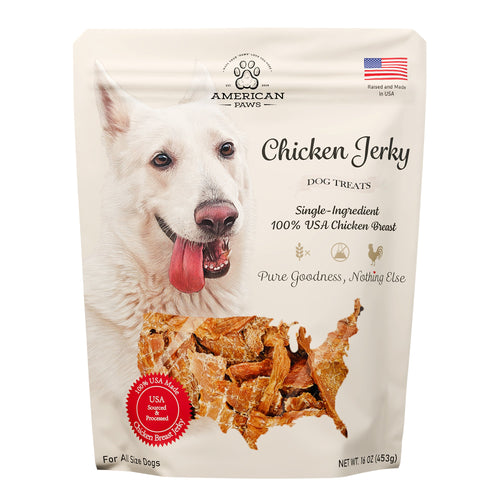
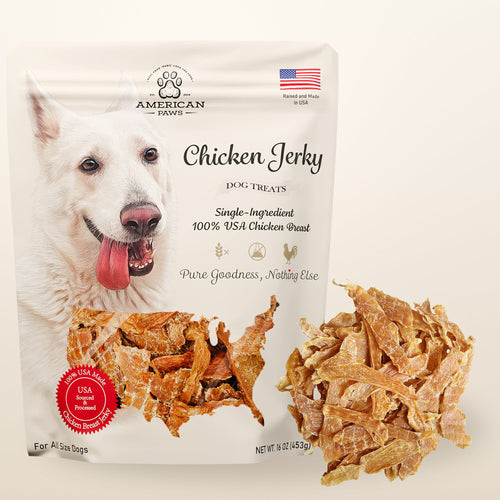
For dogs that already tolerate chicken, American Paws single-ingredient whole-cut chicken jerky lists chicken breast as its one ingredient. It is made in the USA and can be broken into smaller supervised portions. The single-ingredient statement belongs to this specific product; it does not describe every item in the American Paws catalog.
You can also browse the chicken treat collection to compare formats, but read each product's own panel because recipes and textures differ. If your dog should avoid chicken, choose another veterinarian-approved approach rather than relying on the simplicity of this label.
Common mistakes when shopping by the front of the bag
- Counting claims instead of ingredients. Words such as natural, premium, grain-free, and limited do not replace the ingredient panel.
- Assuming one protein is safe for every dog. Suitability depends on the individual dog's history and diet.
- Ignoring portion size. Too much of an otherwise suitable treat can still cause trouble or displace balanced food.
- Testing several new products together. Multiple changes make it difficult to identify what worked or what caused a problem.
- Using treats during an elimination trial without approval. One unplanned bite can introduce an ingredient the trial is designed to exclude.
- Equating soft with simple. Texture may require supporting ingredients, so verify the panel rather than guessing.
When to involve your veterinarian
Ask your veterinarian before adding treats when your dog eats a prescription diet, is undergoing a food-elimination trial, has diagnosed pancreatitis or another condition affected by diet, or has a history of serious reactions. A veterinary team can help define which ingredients and calories fit the plan.
Stop feeding the new treat and seek prompt care for trouble breathing, facial swelling, collapse, repeated vomiting, severe diarrhea, or marked lethargy. For recurring but less urgent digestive or skin signs, schedule an evaluation instead of cycling through increasingly restrictive products on your own.
Frequently asked questions
How many ingredients should a limited ingredient treat have?
There is no universal number. Look for a short list in which every ingredient is clearly named and purposeful. If you specifically want one ingredient, verify that the ingredient panel contains exactly one item.
Are limited ingredient treats hypoallergenic?
No. Limited ingredient does not mean hypoallergenic. A dog can react to the primary protein or another listed component, and food allergy should be assessed with veterinary guidance.
Is grain-free the same as limited ingredient?
No. Grain-free refers to the absence of specified grains. A grain-free treat can still contain many animal proteins, starches, fats, flavors, and other ingredients.
Can a dog react to a single-ingredient treat?
Yes. A one-ingredient label makes the exposure clear, but the ingredient itself may not suit the dog. Choose a protein the dog tolerates and stop if concerning signs occur.
Should dogs on elimination diets have treats?
Only treats specifically allowed by the veterinarian managing the trial. Even a simple product can invalidate the trial if its ingredient is outside the prescribed plan.
Choose the clearest label that fits your dog
The value of limited ingredient dog treats is not a promise printed on the front. It is the ability to understand what you are feeding, compare it with your dog's known tolerances, control the portion, and observe one change at a time.
If chicken already fits your dog's diet, review American Paws single-ingredient whole-cut chicken jerky and read its one-item panel yourself. Prepare one small supervised test piece, keep the rest of the day's diet steady, and let your dog's actual response—not a marketing phrase—guide the next step.