
Can kittens have cat treats? Yes—many fully weaned kittens can have a tiny amount of a regular cat treat, but there is no single age that makes every adult cat treat appropriate. The package directions, the kitten's stage of weaning, the piece size, and the ingredients all matter.
Keep complete and balanced kitten food at the center of the diet. If a treat says it is only for adult cats, lists a minimum age your kitten has not reached, or conflicts with a veterinary diet, wait or ask your veterinarian. A treat being sold in the cat aisle does not automatically make the full-size piece right for a growing kitten.
Can kittens have cat treats? The label-first answer
A regular cat treat can fit when five things are true:
- Your kitten is fully weaned and reliably eating solid kitten food.
- The package identifies the product for cats and does not exclude kittens.
- The ingredients fit your kitten's needs and veterinary plan.
- The treat can be broken into a soft or crumb-size reward.
- The amount stays tiny enough that it does not displace kitten food.
If any one of those checks fails, choose a different treat or wait. There is no nutritional reason to rush: treats are optional, while growth-formulated kitten food is essential.
The ASPCA's kitten nutrition guidance says it is fine to give a kitten a few treats, but treats should account for no more than 5% of daily nutrient intake and the rest should come from high-quality kitten food. That is a ceiling, not a daily target to fill.
If your main question is when solid-food readiness normally begins, use our separate guide to when kittens can start having treats. This article stays focused on whether a regular or adult-labeled cat treat fits the kitten in front of you.
Adult cat treats are not the same as adult cat food
The word adult can appear on two very different kinds of products. Adult-maintenance cat food is designed as a complete diet for mature cats. An adult cat treat is usually a supplemental snack. Neither should replace complete kitten food, but for different reasons.
Most treats are supplemental, not complete and balanced
The FDA explains that treats, snacks, and supplements are typically not intended to be a pet's sole diet. They often do not carry the full nutrient balance required for growth. Meat alone, even when it is a simple ingredient, is not a complete kitten diet.
AAFCO's pet-food label guide likewise notes that products prominently labeled as a snack or treat are generally supplemental and may be exempt from the nutritional-adequacy statement required for complete food. Read the feeding purpose instead of assuming that a cat picture or the word natural answers the life-stage question.
Adult-maintenance food cannot replace growth-formulated kitten food
Complete foods for growth and complete foods for adult maintenance are formulated for different life stages. If the package says “complete and balanced for adult maintenance,” it is describing an adult main food—not a kitten treat. Do not swap it for the kitten's growth-formulated meals.
| What the package says | What it means for a kitten |
|---|---|
| “Treat,” “snack,” or “for intermittent or supplemental feeding” | It is an extra, not a meal; continue the label and safety checks |
| “Adult cats only” or a minimum age | Follow the restriction; wait or ask the veterinarian or manufacturer |
| “All life stages” | The product is not adult-only, but portion, texture, ingredients, and feeding purpose still matter |
| “Complete and balanced for adult maintenance” | It is adult main food and should not displace kitten food formulated for growth |
What age can kittens have regular cat treats?
Readiness matters more than one magic birthday
A kitten should be fully weaned, chewing comfortably, and eating complete kitten food reliably before extras are added. The ASPCA says weaning generally starts around four weeks and is usually complete by eight to 10 weeks. That range describes a developmental process; it does not certify every adult cat treat as safe at eight weeks.
Two kittens of the same age may have different needs. An orphaned kitten still mastering solid food, a newly rescued kitten with diarrhea, or an underweight kitten needs a simpler feeding routine than a healthy, steadily growing littermate. When the main diet or digestion is not stable, treats can wait.
Follow adult-only and minimum-age directions
A manufacturer's age restriction is not an invitation to improvise. If a package says “adult cats only,” “12 months and older,” or provides another minimum age, do not feed it early just because the ingredients look familiar. Choose a product whose label permits the kitten's life stage or contact the manufacturer and your veterinarian.
A package does not have to use the word kitten for every safe supplemental treat, but it must not contradict the kitten's age. The absence of an adult-only statement still leaves you responsible for checking ingredients, texture, calories, and portion.
How to screen a cat treat for a kitten
Confirm the species and feeding purpose
Start with a product labeled for cats. Some treats are made for both cats and dogs, but a dog-only chew or large strip should not be repurposed for a kitten. Look for the intended species, feeding statement, age restriction, feeding directions, calorie information, lot code, and best-by date.
“Single ingredient” tells you the ingredient list is short. It does not mean the product is complete and balanced, free of every food-safety risk, or suitable for a kitten with an allergy to that protein.
Check the ingredient list and avoid raw or seasoned foods
Choose an identifiable, unseasoned cat treat and introduce only one new product at a time. Avoid sharing onion- or garlic-seasoned meat, rich sauces, bones, alcohol, chocolate, caffeinated food, or other human snacks. If your kitten has a known food sensitivity or prescription diet, ask the veterinarian before trying even a simple treat.
Do not treat raw meat as a casual shortcut. Young kittens can be more vulnerable when foodborne illness occurs, and freeze-drying should not be described as sterilization. Buy properly labeled pet treats, keep the original package, store them as directed, and wash your hands and the food dish.
Resize the texture for a kitten's mouth
The World Small Animal Veterinary Association's cat-treat guide recommends an appropriate size and shape and supervision during feeding. For a kitten, that usually means breaking a larger piece into crumbs smaller than a pea, then offering one crumb at a time.
Skip hard chews, bones, sharp fragments, sticky pieces, and anything the kitten tries to gulp whole. A reward should be quick to chew and swallow. If the kitten coughs, gags, paws at the mouth, or struggles with the texture, remove it and choose a softer or smaller option.
Find the calories before deciding the portion
Look for calories per piece, per gram, or per package. A full treat designed for an adult cat may use too much of a small kitten's extra-food allowance. If the calorie information is unclear, ask the manufacturer rather than guessing from size; airy freeze-dried pieces and dense soft treats can look similar while carrying different calories.
Breaking a treat smaller changes the portion, not the ingredient. It is a useful way to create many training rewards from one piece, but each crumb still counts toward the day's extras.

How many cat treats can a kitten have?
There is no responsible fixed answer such as three treats for every kitten. Treat calories vary, and so do kitten size, age, growth rate, body condition, main-food calories, and veterinary needs. A large commercial treat and a tiny crumb are not equivalent units.
Use the ASPCA's conservative kitten guidance: keep treats to no more than about 5% of daily nutrient intake, with the rest coming from high-quality kitten food. Ask your veterinarian for a calorie target if you need a precise plan. Once you know the treat's calories, make the portion fit inside that small allowance.
Count all extras together: training rewards, toppers, lickable treats, table samples, and food used to hide medicine. Do not reduce a growing kitten's nutritionally complete meals merely to make room for more snacks. The percentage is a limit, not a goal.
A safe first-treat routine
- Read the whole package. Confirm cats are an intended species and check age limits, feeding purpose, ingredients, calories, storage, and expiration guidance.
- Wait for stable solid-food eating. Do not introduce a treat during active weaning, poor appetite, vomiting, diarrhea, or a major food transition.
- Break off one crumb. Make it smaller than a pea and appropriate for the kitten's chewing ability.
- Offer it after normal kitten food. This keeps the main diet first and avoids turning a treat into a meal substitute.
- Supervise and watch. Check chewing and swallowing in the moment, then monitor appetite, stool, vomiting, skin changes, and energy.
- Change one thing at a time. If the first exposure goes well, use a few tiny crumbs on a later day instead of adding several new treats at once.
Treats work best when attached to a purpose: name recognition, carrier practice, gentle handling, or one short training session. Our cat-cluster guide explains using cat treats for training without turning every interaction into snack time.
When freeze-dried chicken can fit
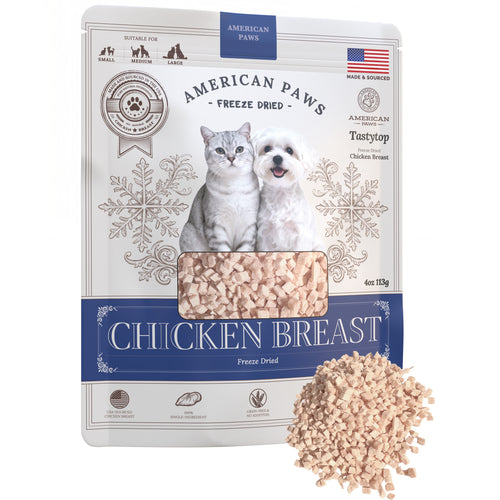
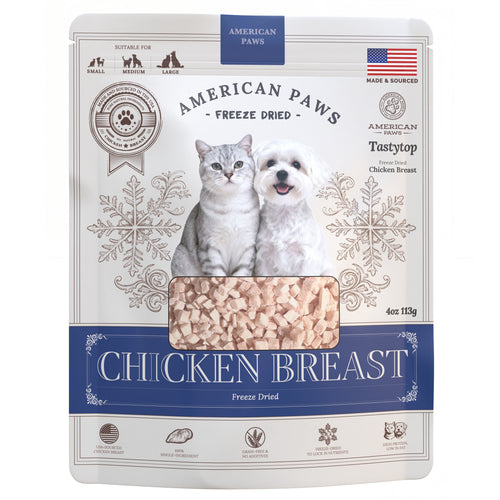
American Paws single-ingredient freeze-dried chicken for cats and dogs is made with 100% USA chicken breast in Highland, California. The product page lists it for all life stages and for intermittent or supplemental feeding only. Each full piece is approximately 0.5–1 inch and about 5 kcal.
Those full-piece measurements are why resizing matters. Do not automatically give a kitten one entire piece. Break one cube into many crumbs, use only the number that fits the kitten's daily allowance, reseal the bag, and keep the nutritionally complete kitten food unchanged.
Chicken is not appropriate for a kitten with a known chicken sensitivity, and single-ingredient does not mean complete and balanced. If you want to compare formats and label features rather than answer the adult-treat question, see how to choose the best treats for kittens.
If your household also has a dog, keep kitten crumbs separate from larger dog portions. You can compare all American Paws dog treats and pet treats, but every item still needs to match the species, life stage, texture, and portion of the pet receiving it.
When to stop treats and call a veterinarian
Stop the new treat and call your veterinarian if the kitten develops repeated vomiting, diarrhea, poor appetite, unusual tiredness, facial swelling, persistent itching, coughing or gagging while eating, trouble swallowing, or a painful abdomen. Seek advice sooner for very young, underweight, chronically ill, or recently rescued kittens because they can decline quickly.
If you suspect a toxic ingredient, swallowed packaging, or a large uncontrolled amount, do not wait for symptoms. The ASPCA explains when accidental ingestion needs urgent help; contact your veterinarian, an emergency clinic, or ASPCA Animal Poison Control at (888) 426-4435. Difficulty breathing, collapse, unresponsiveness, or seizures require immediate emergency care. Do not induce vomiting or give a home remedy unless a veterinary professional directs you.
Frequently asked questions
Can kittens have adult cat treats?
Some fully weaned kittens can have a tiny amount of a regular cat treat if the product is labeled for cats, does not say adult-only, has suitable ingredients and texture, and fits the kitten's small extra-food allowance. If the package restricts the treat to adult cats, follow the label and wait or ask your veterinarian.
Can an eight-week-old kitten have cat treats?
Possibly, but eight weeks is not an automatic green light. Many kittens finish weaning around eight to 10 weeks, yet readiness and health vary. The kitten should be eating complete kitten food reliably, and the specific treat must pass its label, ingredient, size, and portion checks.
Does a cat treat have to say “kitten” on the package?
Not always. A supplemental treat may be labeled for cats or all life stages without using the word kitten. It should not carry an adult-only or conflicting age restriction, and it still needs to be safe to break small. When the wording is unclear, contact the manufacturer or veterinarian.
What if my kitten ate an adult cat treat?
Remove the package and read the ingredients, age guidance, calories, and amount missing. One small, non-toxic cat treat is not automatically an emergency, but monitor closely and call your veterinarian if the piece was hard or large, the kitten ate many treats or packaging, the label contains a concerning ingredient, or any symptoms appear.
Can cat treats replace kitten food?
No. Most cat treats are supplemental and do not provide complete and balanced growth nutrition. Complete kitten food should remain the main diet even when the treat is real meat or single-ingredient.
Keep the label, the piece, and the portion kitten-sized
Many fully weaned kittens can enjoy a regular cat treat, but the answer belongs to the specific label and kitten—not a universal birthday. Reject adult-only restrictions, protect the complete kitten diet, break suitable treats into crumbs, and count every extra.
For a simple option that can be resized, try American Paws freeze-dried chicken for cats and dogs. Start with one tiny crumb, supervise, and let treats support training and bonding without taking over the bowl.